Weekly-daily schedule

Our daily schedule concerning English has developed slowly. E. is 11 months old and for a month now we’ve had a more or less fixed weekly agenda. Here it is:
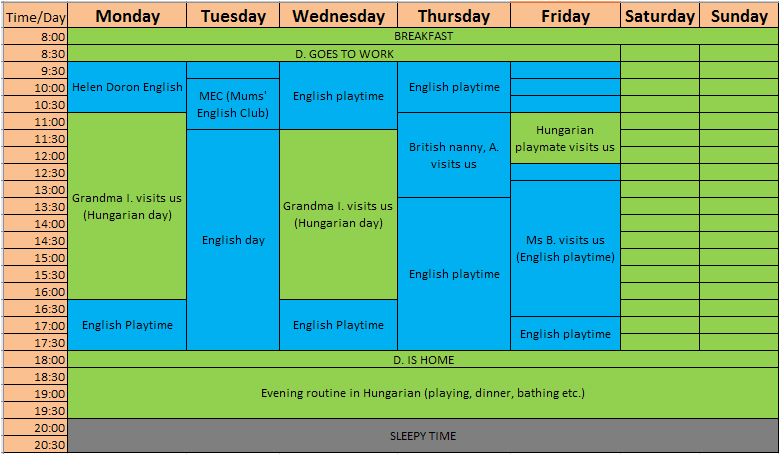
60% is in Hungarian and 40% is in English – I wish we could keep this balance

We’ve just started Helen Doron English (in a later post I’ll write about our experience), but it definitely increases the time spent on English and we are not at home using the minor language at last. Tuesdays and Thursdays are clearly dedicated to English. Mondays and Wednesdays are the Hungarian days. Still, on these days we have 2 or 3 hours of English input. (What is not in the chart is the 20-30 minutes when D. takes the dog out for a walk in the evening. E. and I change into English and lay the table, put away the toys or watch some videos or books in English while they’re away.)

Fridays are changeable, but in general half of the day goes in Hungarian, the other half in English. Before our Hungarian playmate comes to visit us, we go out for a walk together or to the market and then we use Hungarian as English would be unnatural.

My only problem is the weekends. As the whole family is together, it’s really difficult to find time and natural situations when we can use English. At weekends 1 hour of English per day is “forced” into our programme (singing, video watching, reading out) but not real communicative interactions. I’ll try to find out something for the weekends. If you have any suggestions, just feel free to share it with me.

In the table above you can’t see food time (which is in the given language according to which day it is) and daily sleeping time, however the latter takes away 2-3 hours per day.

At the beginning of January we took up baby swimming on Saturday mornings. I found a course at Budapest Moms (you can find the group’s facebook page here), which was held in two languages. The tutor is Hungarian and in the water one of the moms do the interpreting. As the swimming pool echoes a lot it is hard to hear the Hungarian words, not to mention the English ones, however, we met a lot of non-Hungarian families (Russians, French, Dutch, Canadians etc). As for the English language, it doesn’t make a big difference whether we take part in this swimming course or another, but the trainer is really professional and the pool is clean, the water is warm. So all in all we, and most important of all, E. enjoy it. It’s a good family programme for the weekend. The course is finished in a week, now we are thinking of continuing it, but not sure. Good weather has arrived, we might want to spend time outside instead.

I’m a little worried about being able to keep this schedule. One thing is permanent in a baby’s life that nothing is permanent. As I’m planning to work part-time soon, probably in a month or two our agenda needs to be revised.

Singing and signing

I promised a post on singing nursery rhymes together with MAKATON signing. So here it is.

The MAKATON signs can be used while you sing the traditional nursery rhymes as the Signing Hands do. These two ladies sign while singing. Have a look at this song, which is the well-known ‘Ba Ba Black Sheep’ with signs.

Easy to learn, right? Their songs, which are available on the net, give us the opportunity to learn more signs.

Some more common songs with MAKATON signs:
The Wheels On The Bus
Row row row your boat
Old MacDonald Had a Farm
We wish you a merry Christmas Little Peter Rabbit
Something Special, the BBC series, also includes some songs like the Rainbow Song. On the link you can find Mr Tumble singing and signing it.

After you have learnt a lot of signs, you can use them with other songs or rhymes.
Within 1-2 months you can learn 50-70 signs without an effort. Of course, it doesn’t mean you HAVE TO use all of them. You’ll see what the two (three) of you really need.

How we did it when E. was 6-8 months old:

When she couldn’t sit properly, but could only crawl, she got tired easily and became grouchy. This was the time when I made her lie on her back looking at me. Then I sang the songs and a signed along. She smiled and even laughed out loudly. She could enjoy it even for 15-20 minutes. This was enough for her to be refreshed and we could play again, or have her food etc.

Now, when she’s 11 months old it’s changed a little:

E. can stand and cruise (tiptoe along some furniture) so it’s very difficult to keep her in one place. I don’t bother to make her lie down any more. When we play and she sits for a while I sing two or three songs followed with the signs. No more because she moves on quickly and doesn’t really care any longer. But she is screaming and/or flapping her hands with joy during the songs. We do the short singing/signing sessions twice or three times a day.

(Have you noticed how easy to misspell or misread the two words singing and signing? 🙂

The beginning

Huh, where shall I start? It all began long, long time ago when I became obsessed with the English language as a teenager. Slowly I became an English teacher thanks to lots of great teachers, the support of my Mummy, my persistance and love of the language and the connected cultural matters.

In 2012 my baby, E., was born, and while I was still pregnant with her I was wondering whether to raise her bilingual. As both my hubby and I  are native Hungarians living in Hungary, it seemed out of place, a non-sense thing to do as the English input we have is very little, not to mention the fact that it is very difficult and pricey to ensure that our child will get enough English input under these circumstances. So I did research on the Net, bought books on the topic (see a later post) and tried to find people who do the same. And from time to time, my belief got stronger and stronger that raising E. bilingual IS a great idea, what’s more, it’s managable.
When she was born, I was knackered even shocked by the coming of my baby, though I had been praparing for her for a long time. It was great and horrible at the same time. The first 6 months I couldn’t concentrate on our bilingual project so much. Yes, it’s true that even in my tummy she heard a lot of English as I was teaching till the end of my pregnancy. After her birth I sang a lot of English lullabies to her, however I did not speak to her in English.
When our life got a little easier when she turned 6 months I decided to speak to her in English when we are just the two of us, which meant most of the time during the weekdays as Daddy worked, and Grandmas’ being around became less frequent.

When I’m starting this blog, E. is almost 11 months old now and we have a great balance between Hungarian and English. There will be posts about what we have done so far, what we have reached, what we have been doing to increase the English input in her life. Then I’ll go on with a regular update on our status. I do not know how long I’ll have time to post or how long we will last with our project, but I hope for years and years. I wish this blog would live until our second child is born, until we start picking up new languages. Or until my grand-daughter is born and will be raised bilingual as well. Wishful thinking… These are only hopes and wishes for the future and time will tell if we can manage to do so.