Fun with Flupe – the new Helen Doron package

It’s been a while since we started the new Helen Doron Early English package: Fun with Flupe. Now I have the time to review it a little.

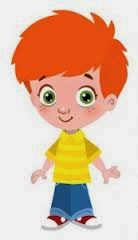
The whole story is based on 3 main characters:
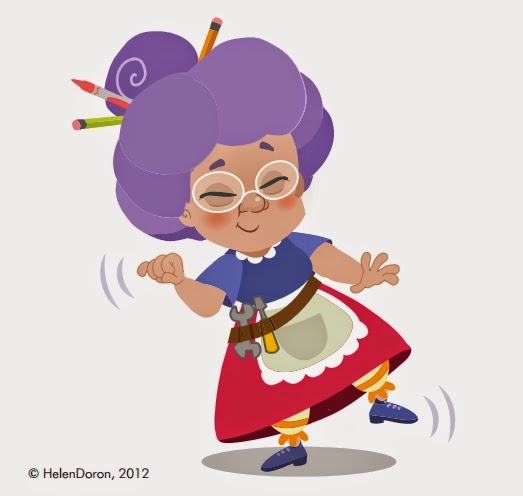
Granny Fix


Paul

Granny Fix – who solves all the problems and speaks in rhymes

  • Paul Ward – I guess he is Granny Fix’s grandson. He helps Granny sort out the problems
  • Flupe or Flupie – a purple alien, who does not speak much apart from some words (it is very funny to see Flupe sad – turns blue – or frightened – turns yellow)


Flupe

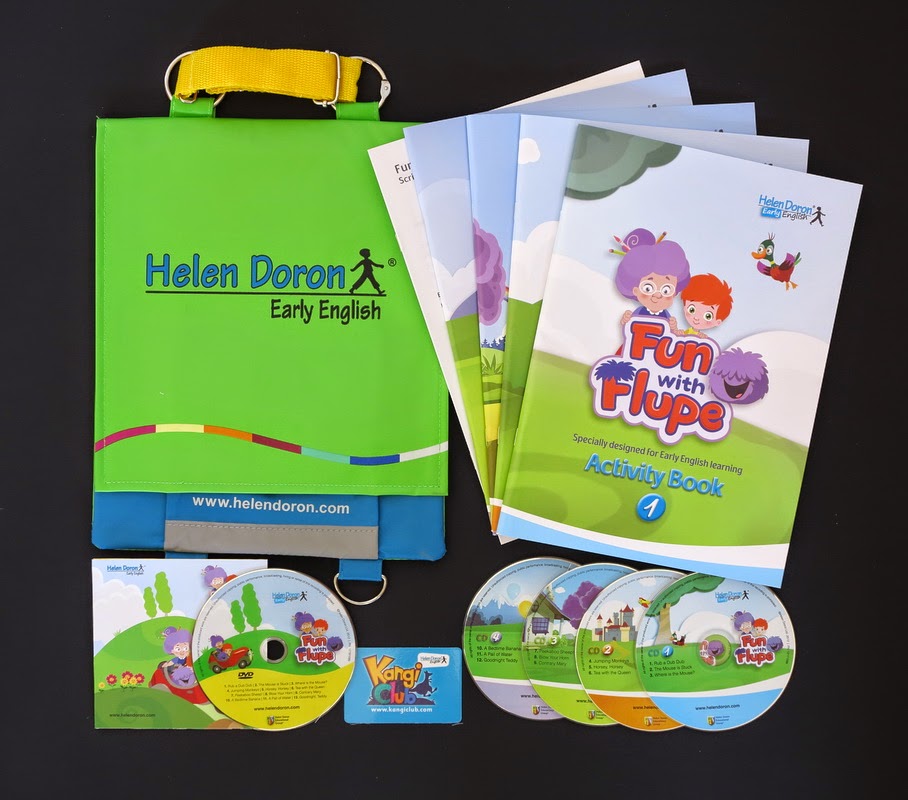
This is what our package looks like:


Content:

  • A bag – it’s similar to the previous, but the colour of the straps are yellow while in case of the first package they were green
  • 4 activity books – not just picture books and rhymes, but proper workbooks. One can colour, stick stickers. Now we are working with the second one. During the lesson we work in the booklets, but no longer than 4-5 minutes


Rub-a-dub-dub – we coloured the tub and the animals, then had to put 5 carrot stickers on the holes
Skill development: Find and circle the same animal as you can see in the front
  • Booklet with the words for parents – quite useful for those parents who do not speak and/or understand much English (in the picture it is behind the 4 activity booklets)
  • 1 DVD – with short stories
  • 4 CDs – with all the conversations from the stories. My problem with the CDs is that the songs themselves cannot be listened to separately, only as a part of the whole story

I know it is officially not allowed but I asked our teacher to give us the teacher’s CD and I uploaded the songs on our PC, so we can listen to the songs only.

I feel very strongly about this package. Very good material from many aspects. The workbooks are strong and good quality. The tasks are suitable for kids between 2-5 years of age.

Not only does this course develop a child’s language skills but also their movements (dancing, jumping, crawling, running and hopping), fine motor skills (sticking, colouring, matching, craft activities). The five senses are in focus again.

There are 25 songs to listen to. They are mainly traditional nursery rhymes/songs with some change in the tune or in the lyrics. The songs appear in 12 animated stories in which Granny Fix talks in rhymes. (Certain lines of her return from episode to episode.) These episodes can be seen on the DVD.

Have a look at one episode (Rub a dub dub):

Our teacher, Zs., always involves some eating and drinking during the sessions if it is somehow connected to the topic. (E.g.: biscuits were hanging by the window on a rope. – I can’t reach it. – she said and all the kids tried to reach the biscuits. Then they needed to ask for it: – Can I get a biscuit? But a similar situation is created when asking for water to drink etc.) And this is just one example how well the kids are involved and encouraged to use the language in real life situations.

There is a Helen Doron Song Club on youtube where you can find videos connected to this material and to other courses too.

Five Little Monkeys has always been a favourite:

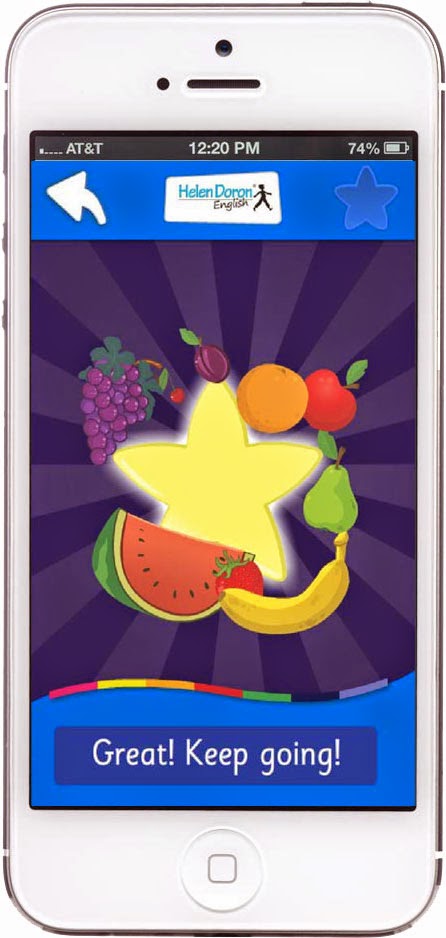
You can find Fun with Flupe as an application in the Google Play Store. Have a look at what it looks like. When I installed it, it was free of charge.


All in all, this set is just as professional, well-designed and full of fun as the previous, Baby’s Best Start.

We love numbers – Numbers II.

Every time before E. goes to sleep we have this conversation (either in English or in Hungarian):

E.: – Mommy, numbers.
M.: – Which numbers?
E.: – The little numbers.
M.: – 1, 2, 3, …
E.: – No, Mommy. Zero….
M.: – Oh, yes, sorry. 0, 1, 2, 3, 4, 5, 6, 7, 8, 9, 10
E.: – Now the big numbers.
M.: – 10, 20, 30, 40, 50, 60, 70, 80, 90
E.: – Hundreeeed (giggles)

She is so fascinated by numbers that at the age of 18 months she could read the numbers on her baby bottle from 10 to 280.

Let’s see some number games we play.

First of all, our favourite number songs:

Zero, zero, super hero

Ten in the bed

The new favourite: Ten Little Dinosaurs

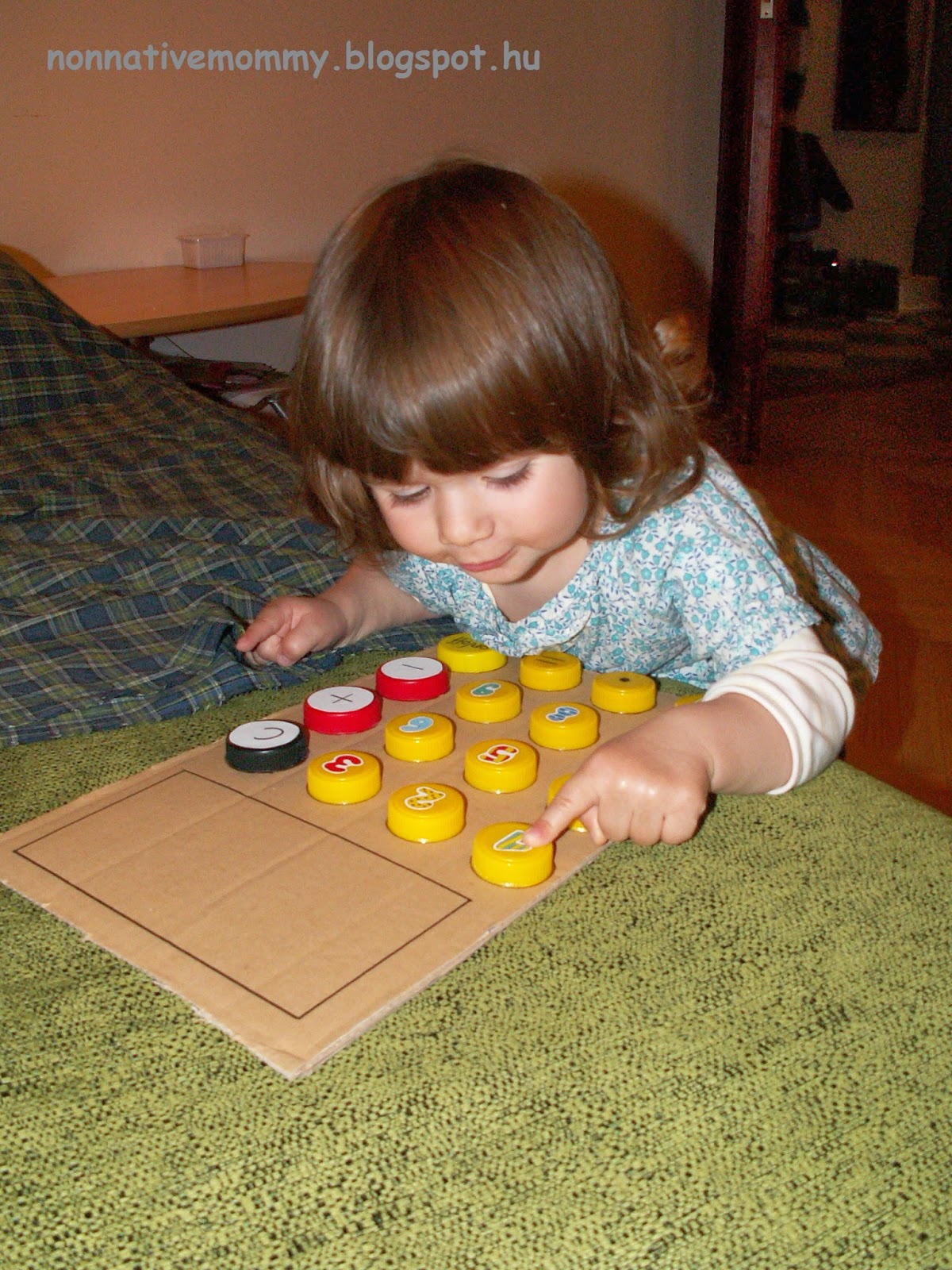
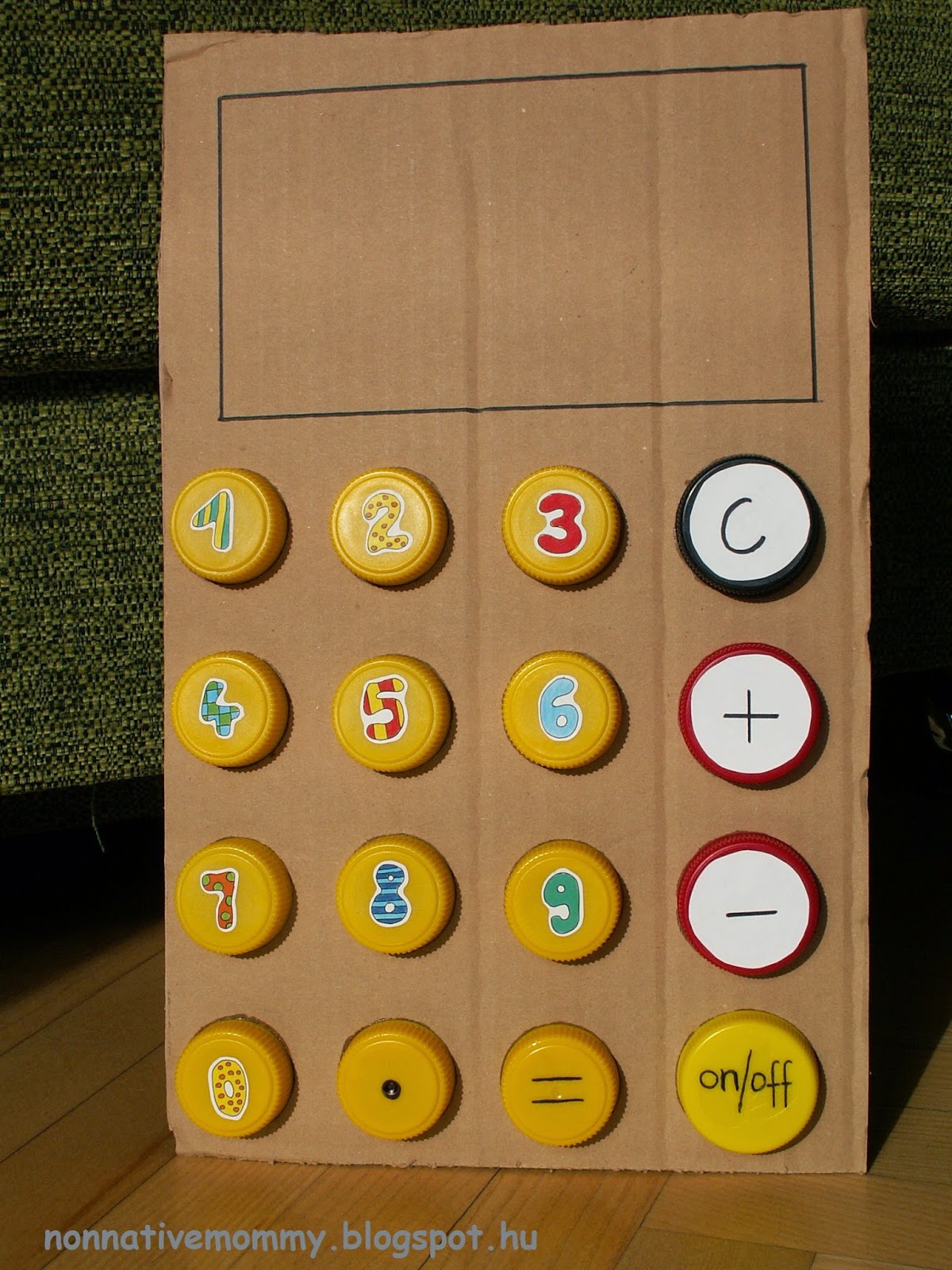
The bottle top calculator is just as much fun as pushing the buttons on a real calculator.

What’s missing?

I found a quite difficult number task on www.firstgradebrain.com. (I just checked the link recently and it’s not there anymore. Sorry. I’ve put it on my to-do-list to make an activity like this) What comes between? This task is more for 4-5 year old kids, but we gave it a try. I printed the sheets laminated them and at first I just put one task in front of her with 3 possible options that can come between the two numbers.

Easy-peasy lemon squeezy

Much to my surprise it wasn’t very difficult for her. We did two more of this task then she started to order the numbers. All by herself.

There is nothing more to add 🙂

Ordering the numbers – Making big numbers

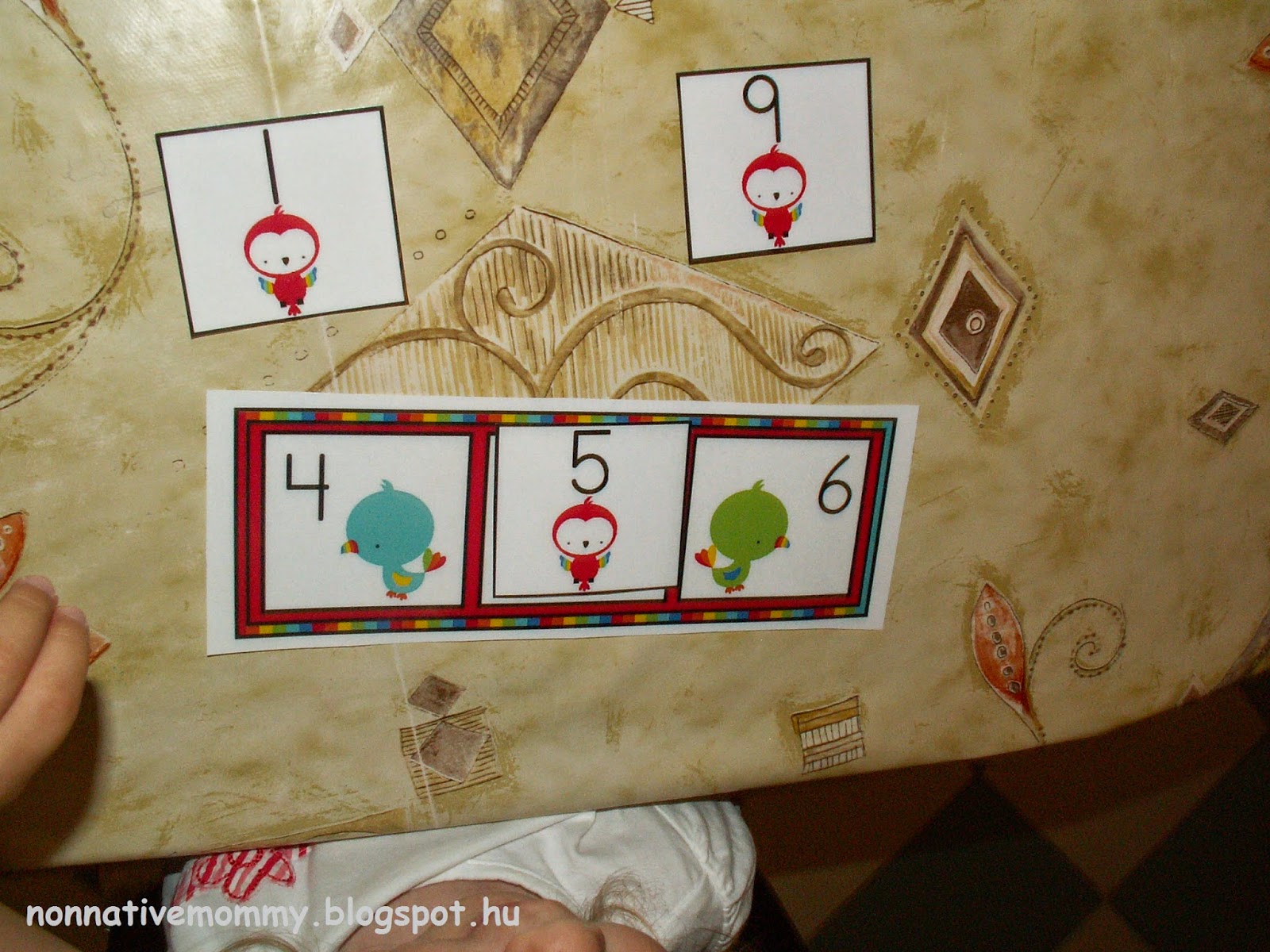
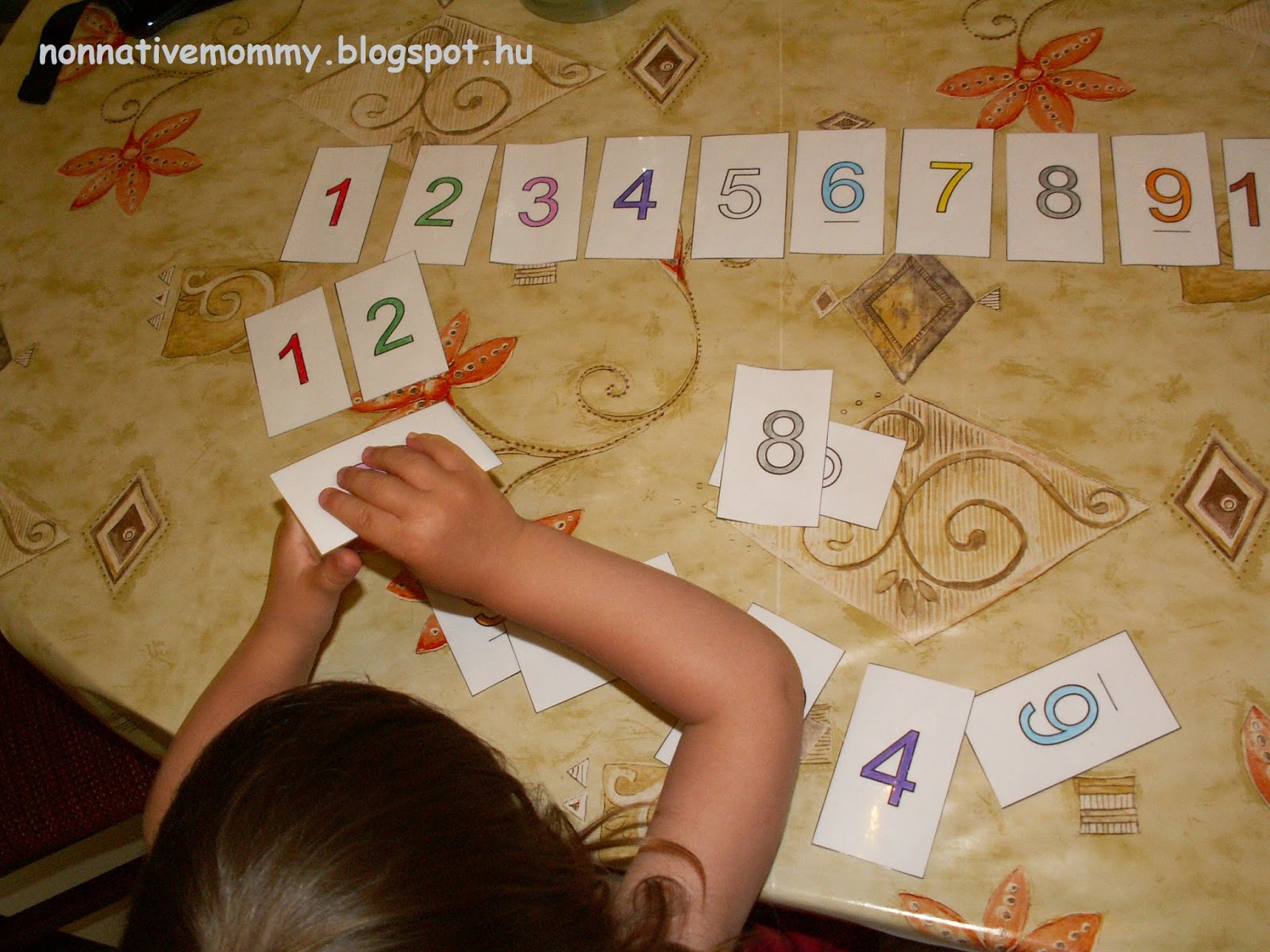
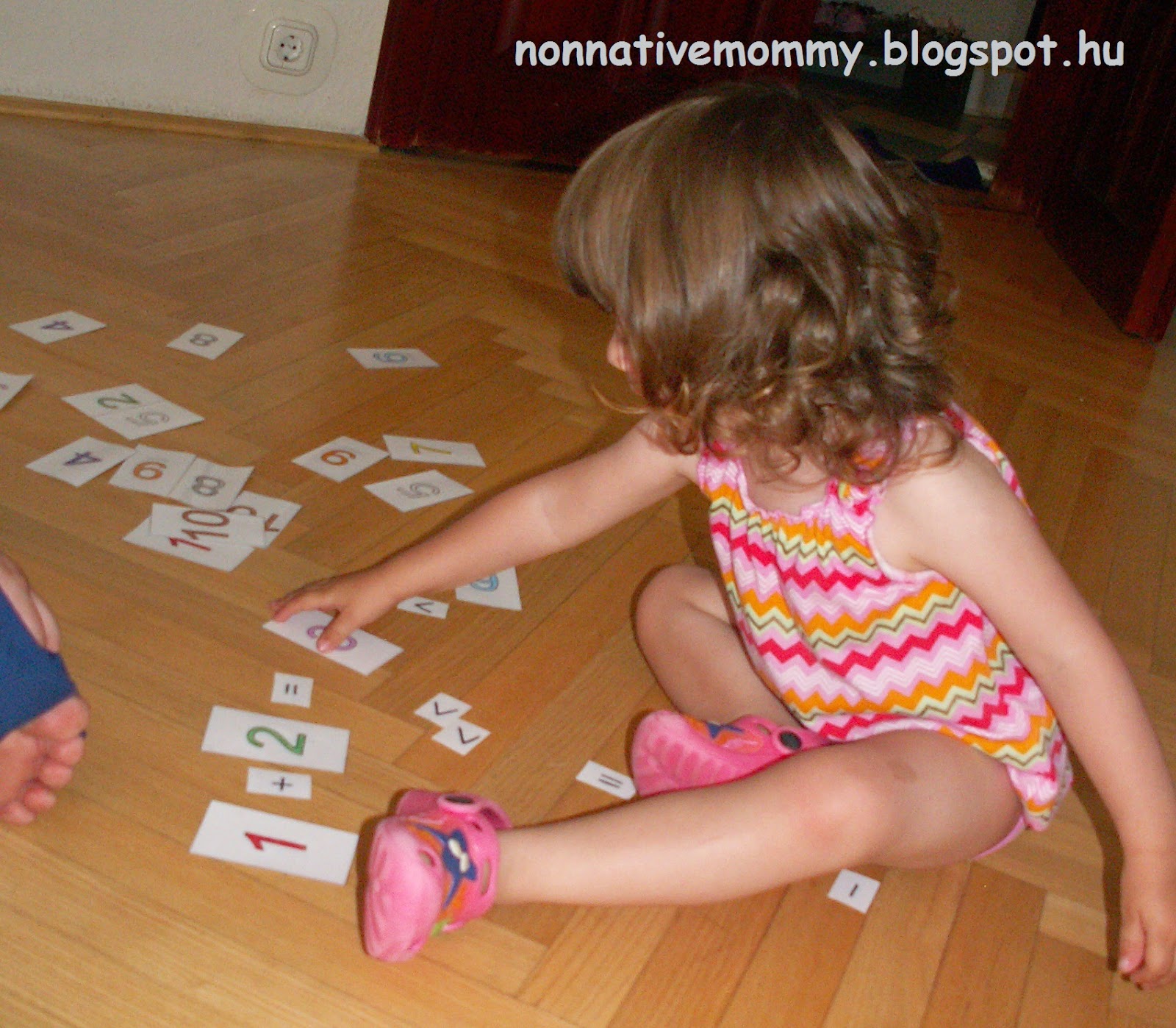
I printed the numbers from 1 to 10 in two copies. I coloured and laminated them and the fun could begin.

First, I put them in order, then she matched the other set.

We played a memory game with them. (There are ladybird stickers on one side of the cards so that you can’t see what is on the back)

I’ve found a match

With these numbers, A., our British nanny, played another game. She and E. made big numbers putting the numbers next to each other.

110

And some basic additions.

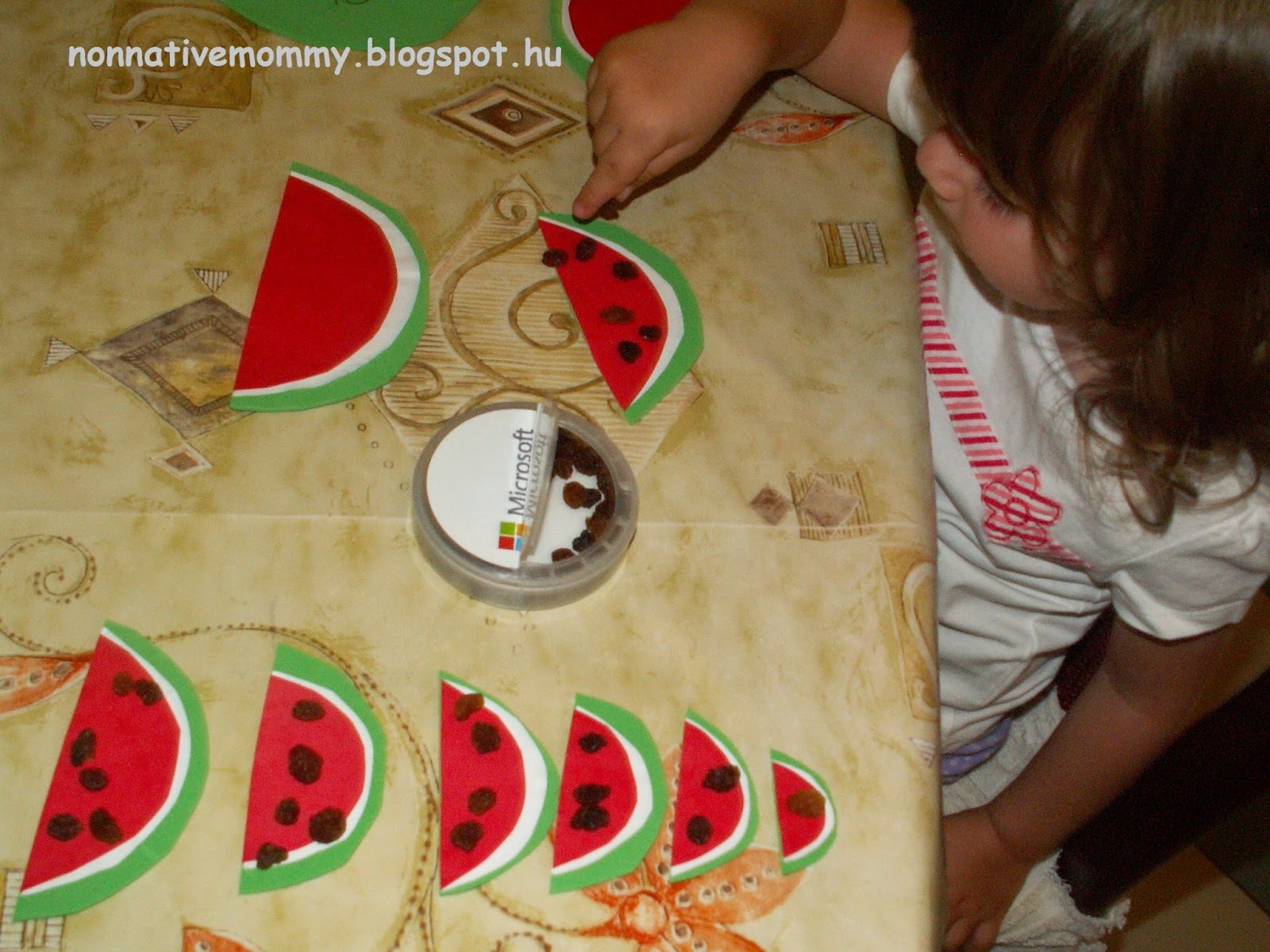
Watermelon seeds counting game

I used the watermelon seeds counting idea on Toddler Approved! which I really like following as they have great and easy-to-make ideas.

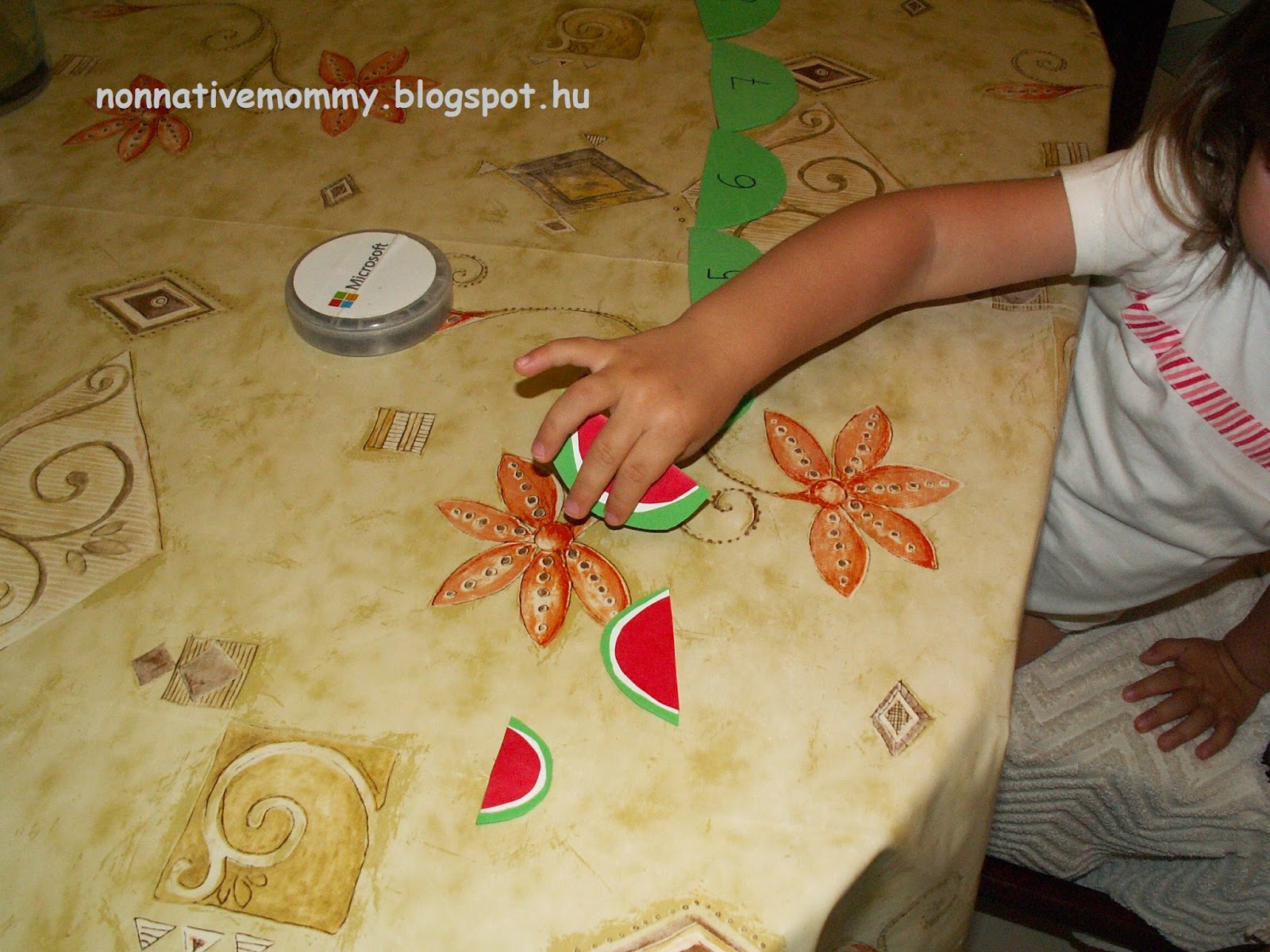
So I just made the watermelon slices out of a green foam sheet, a white and a red sheet. I glued the different coloured paper on top of each other.

Turning the slices right side up

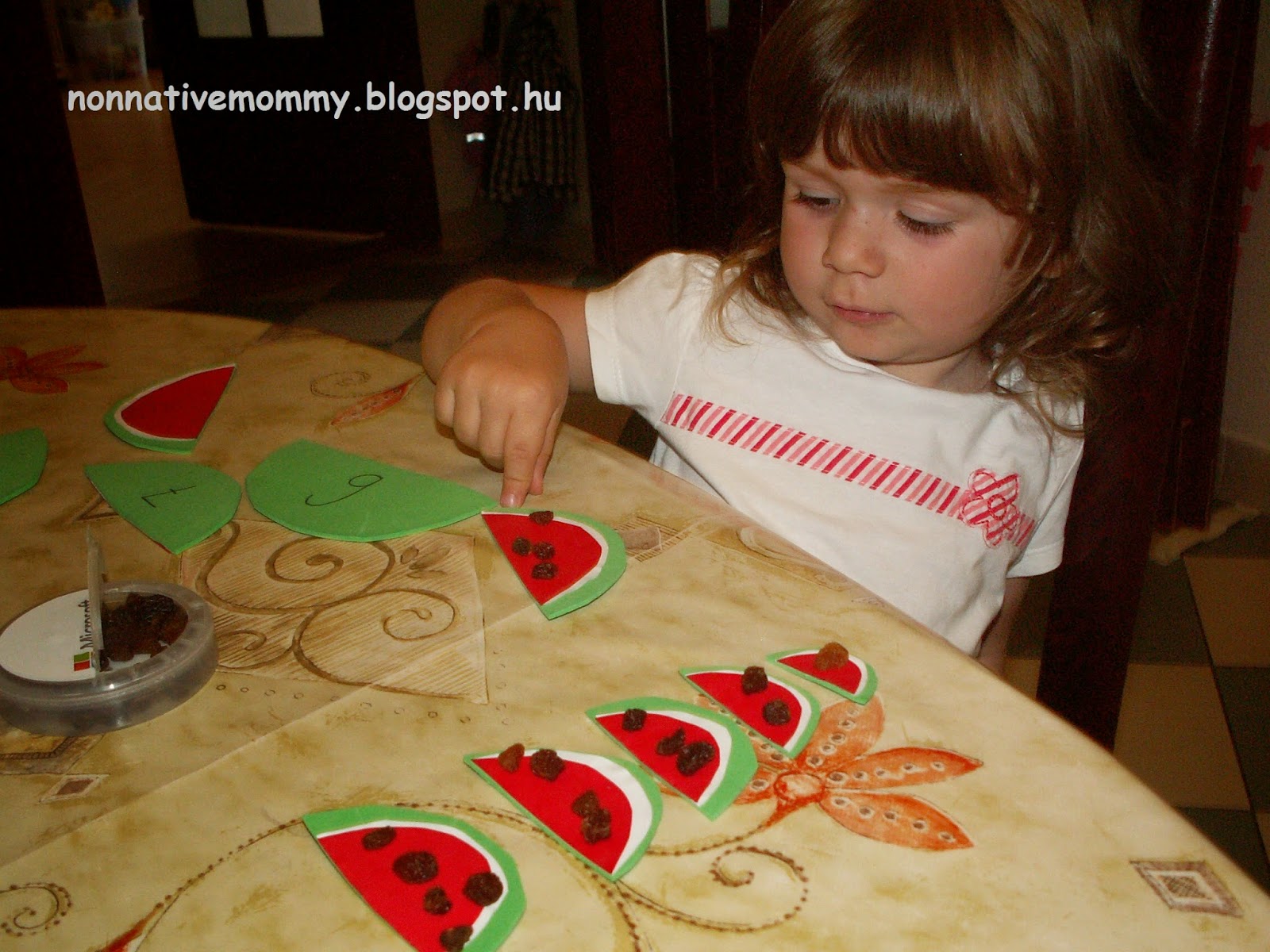
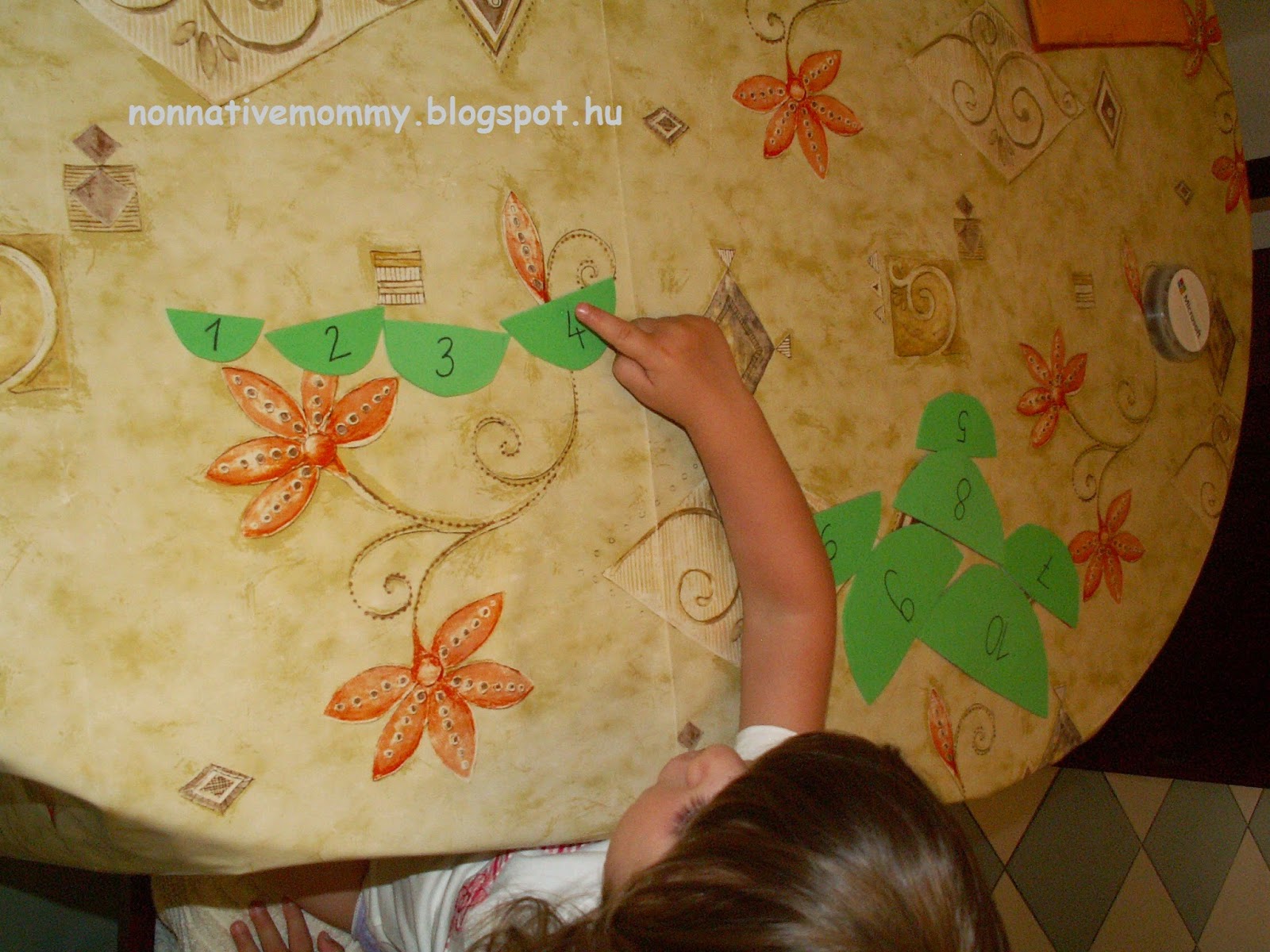
On the back of the slices there are the numbers written. (the slices deliberately grow in size from 1 to 10 so there is more room for the seeds and in this way we can put the slices in growing order.)

counting

I picked raisins instead of the chocolate chips recommended in the Toddler Approved blog post. Healthier and they do not leave a mark. I put them in a box and the counting started.

One raisin rolled down

We can do many other things with the watermelon slices:

  • put them in order according to the numbers (or backwards)
This is four, Mommy
  • order them according to their sizes
    1, 2, 3, 4, 5, 6 …
  • throw a lot of raisins on a slice and eat up all the “seeds” that are not necessary in order to have the number of seeds on the slice as written on the back
    yummie
  • explain how to eat up all the raisins to someone who does not know this game

Number stickers – Helping Little Mole build a house

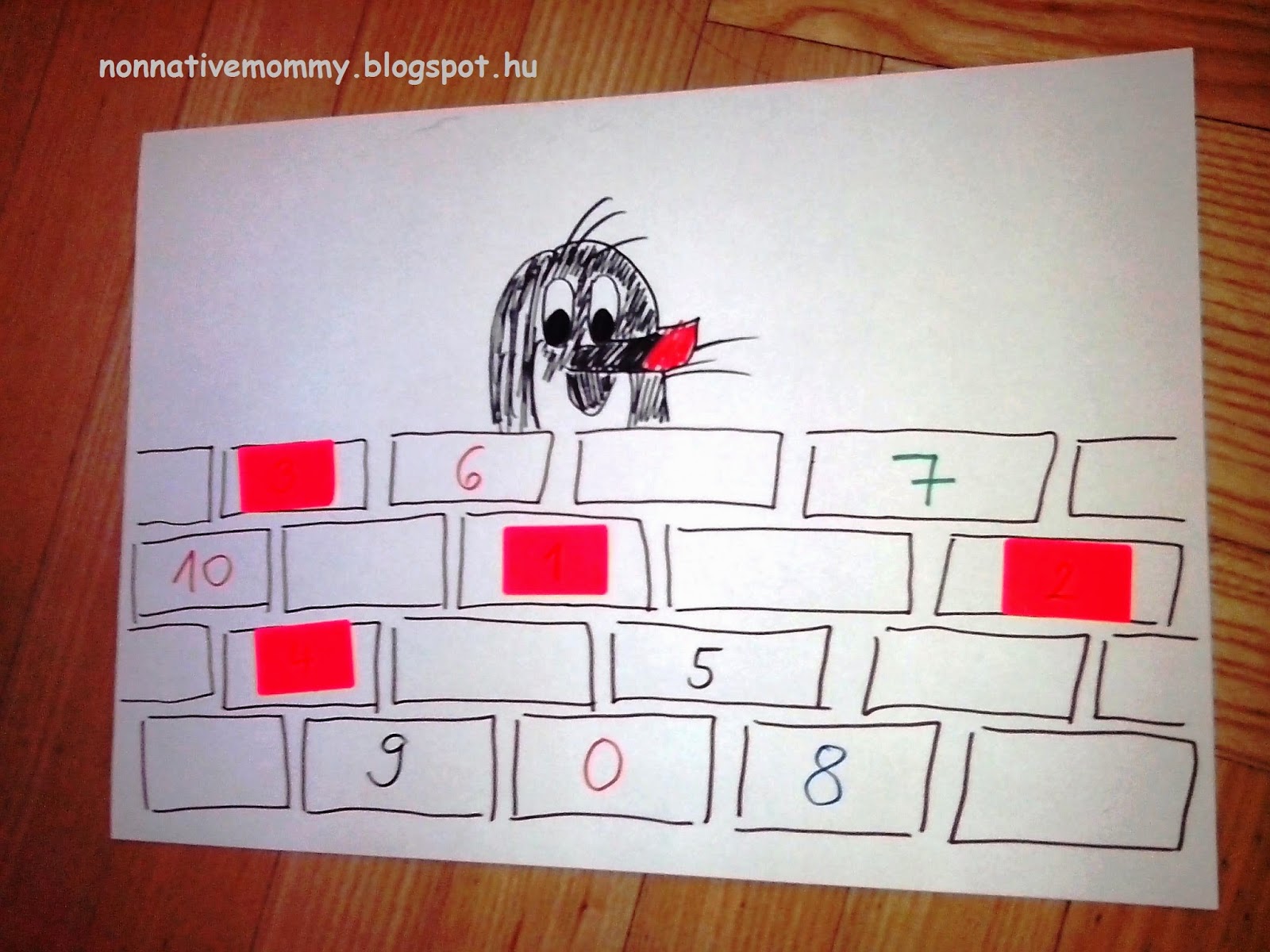
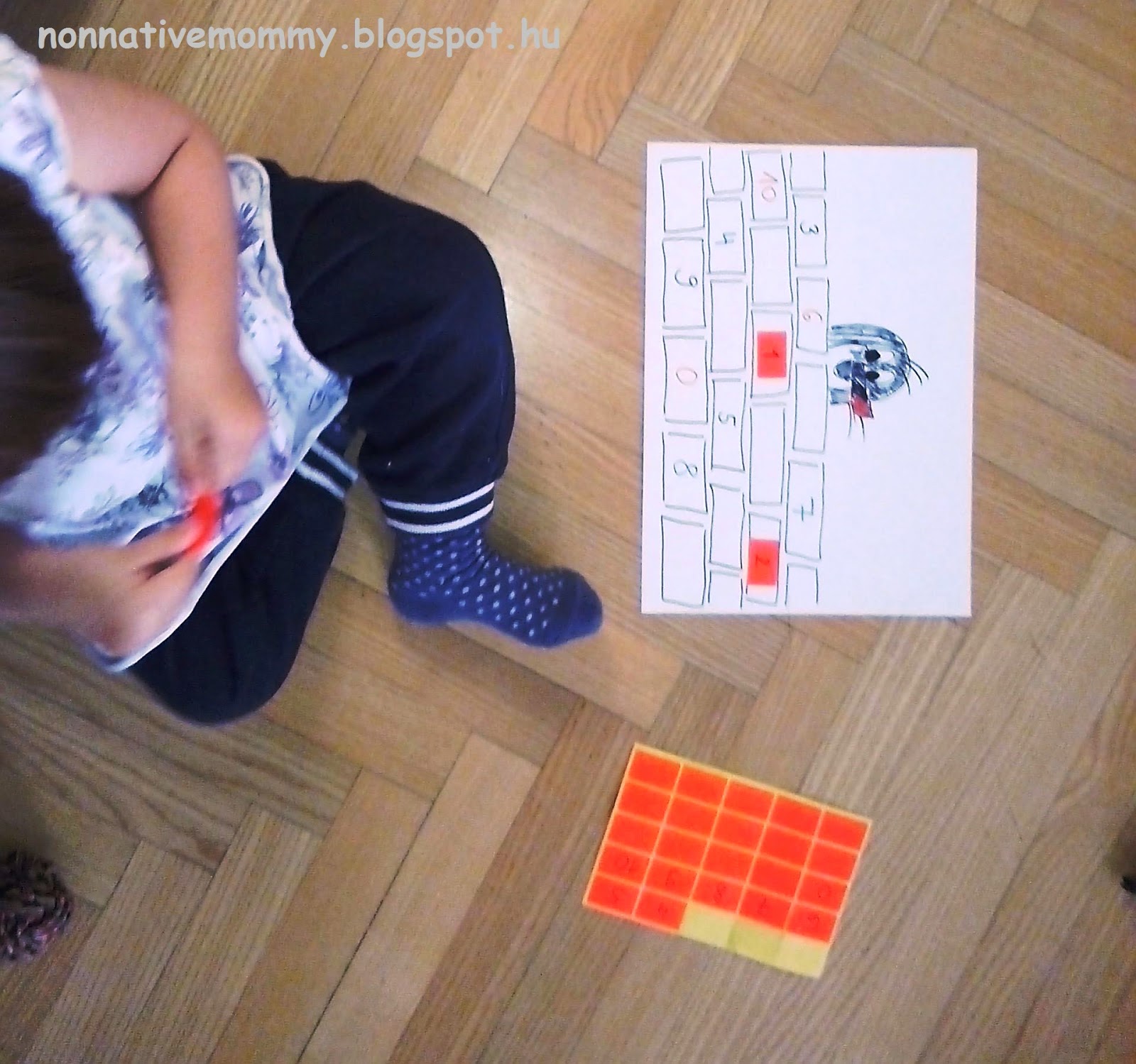
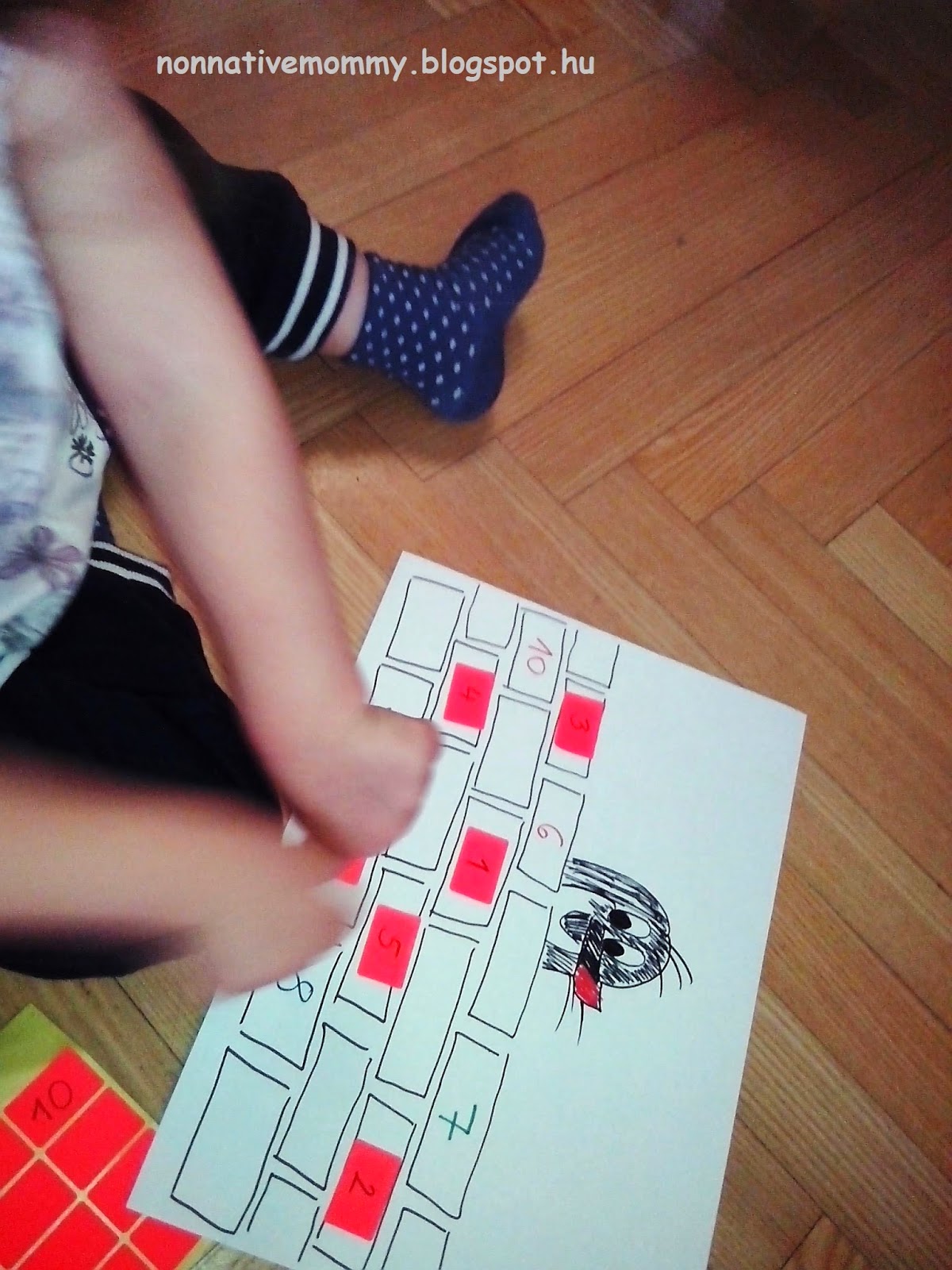
I drew a brick wall and Little Mole’s head on a sheet of paper. Some bricks had the numbers on them from 0-10. On rectangle shaped empty stickers I wrote the numbers from 0-10. E. had to build the wall putting the stickers in the right places, on the matching number. She filled the empty bricks with empty stickers. (Sorry about these photos, they were taken by my mobile.)

(You can buy these stickers at a “one euro shop” – well, in Hungary at the Chinese markets or shops)

This idea has endless varieties: with the ABC, with big numbers, matching animals, clothes, everyday objects, playing with the colours, copying patterns etc. If you have any idea how to expand this game share it with me in the comments.

Books – some fun books to finish with

Dora the Explorer – A Birthday for Boots (By Scholastic)

In this Dora book, she and her friends buy some goody bags for Boots’ birthday party, but Swiper always takes away one every page.

I bought this book when E was just 1 year old and she loved looking at the pictures. You can talk about a lot of things in the pictures. There can be a lot of counting (goody bags, candle sticks, balloons etc.) but also naming objects connected to a birthday party.

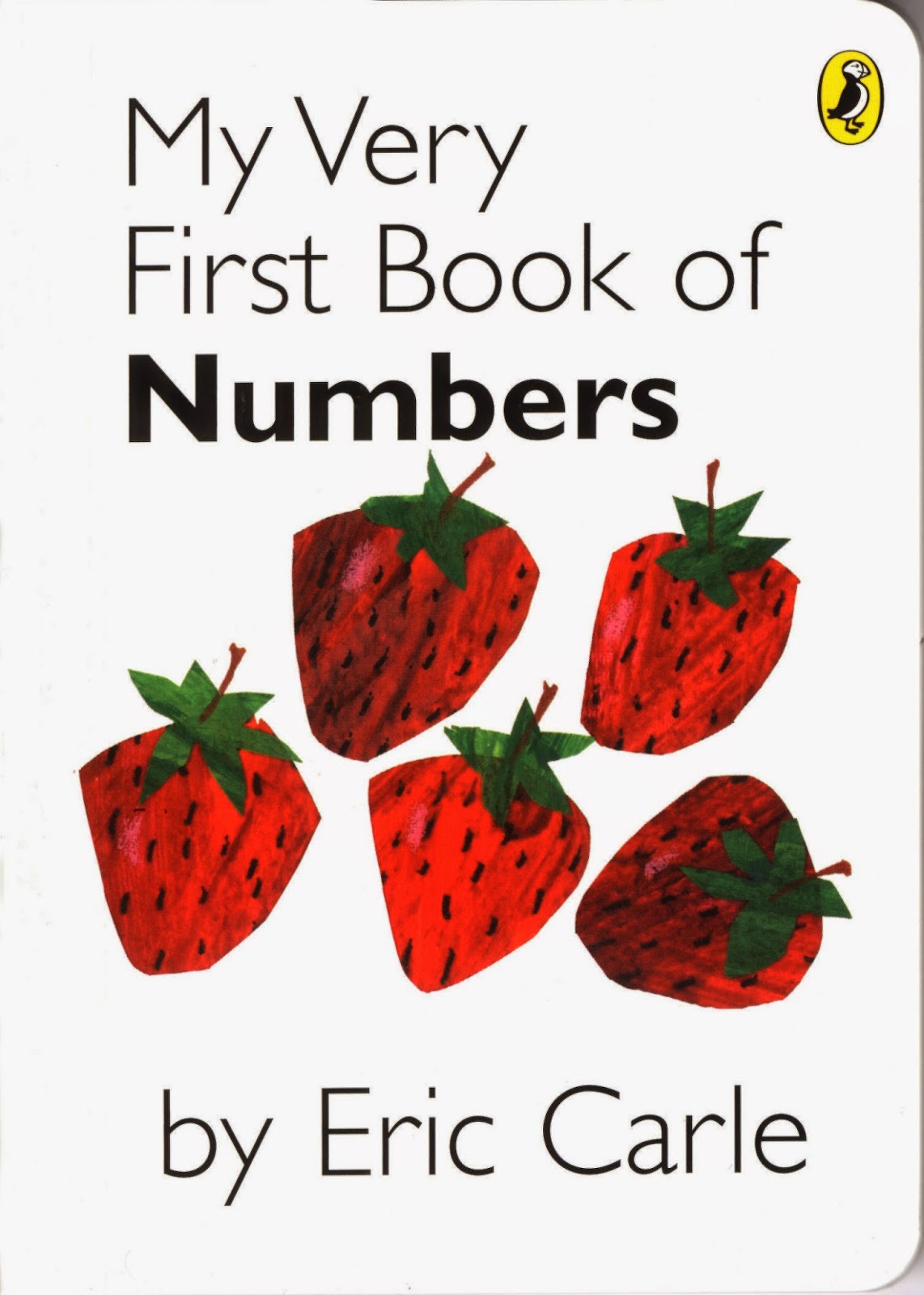
My very first book of numbers by Eric Carl

This book is divided in two parts horizontally and your child needs to find and match the fruits in the bottom part with the numbers (written in numerals and also represented with black squares). As E. has passed two years old, she doesn’t need help, but around last Christmas when she got this book she needed help with the page turning and matching.

Flip me! Counting 1-10 (By Buster Books) You can read the full review of it here. I’m quoting just the essential part of it:

“Counting 1-10 has pages divided into two panels, which kids can rearrange to match. One side has photographs of objects to count <dolls, dinosaurs, sand toys, cars etc.>, along with words identifying the number and name of the object; the other side shows the numerals from 1-10.”

Once we took this flip book on a longer car journey. While she was looking at it, E. threw up. Use it some other places. It’s quite nice.

As numbers and counting are in E’s focus, I’ll come back with some more number games in the near future.

Autumn leaves are falling down

My favourite season has arrived and it seems E. is enjoying it a lot, too. On the way home from the nursery we always collect some things (leaves, berries, conkers, bark pieces, stones etc.) to play or to do some craft projects with.

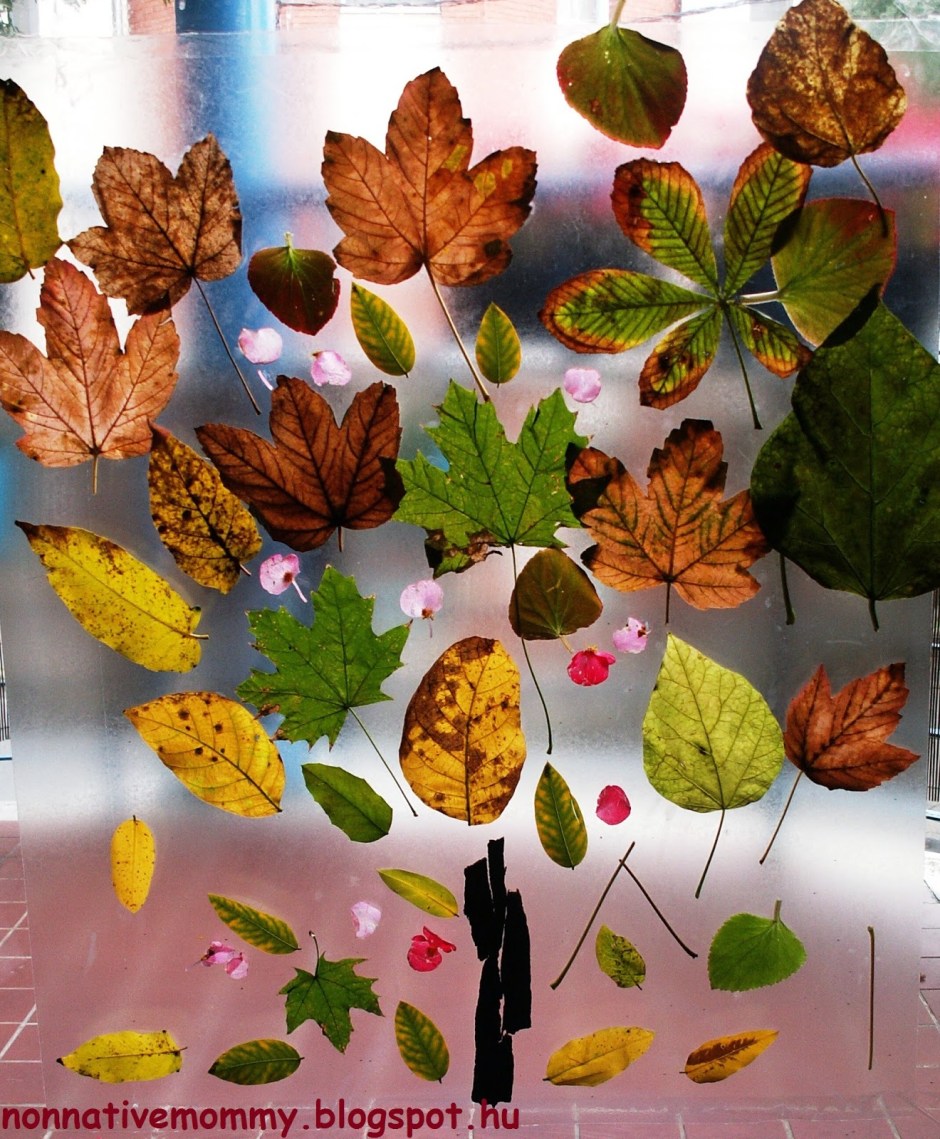
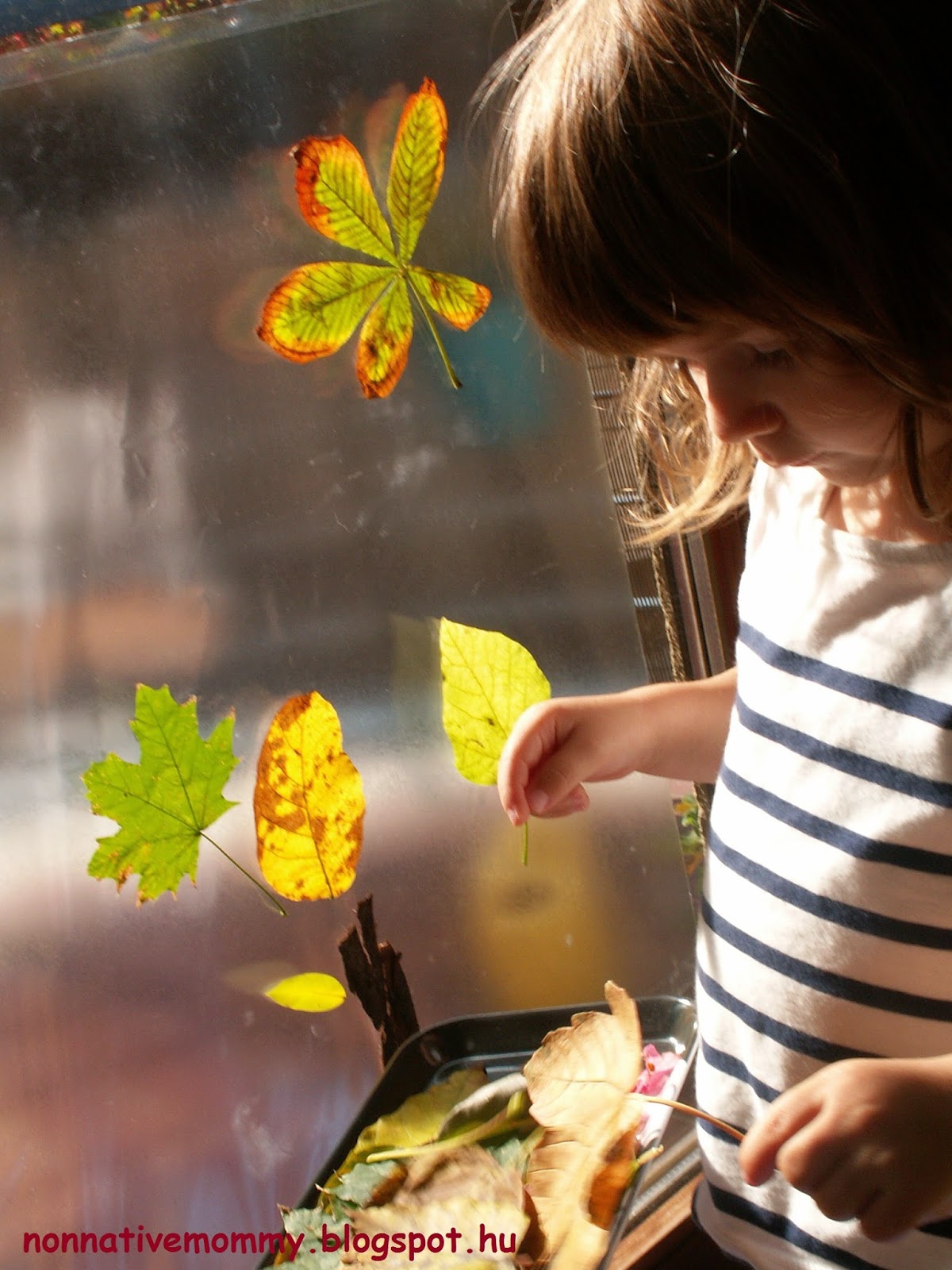
I put some contact paper on the window (sticky side out) and on a tray I prepared all the leaves we’d collected. And the sticking started.

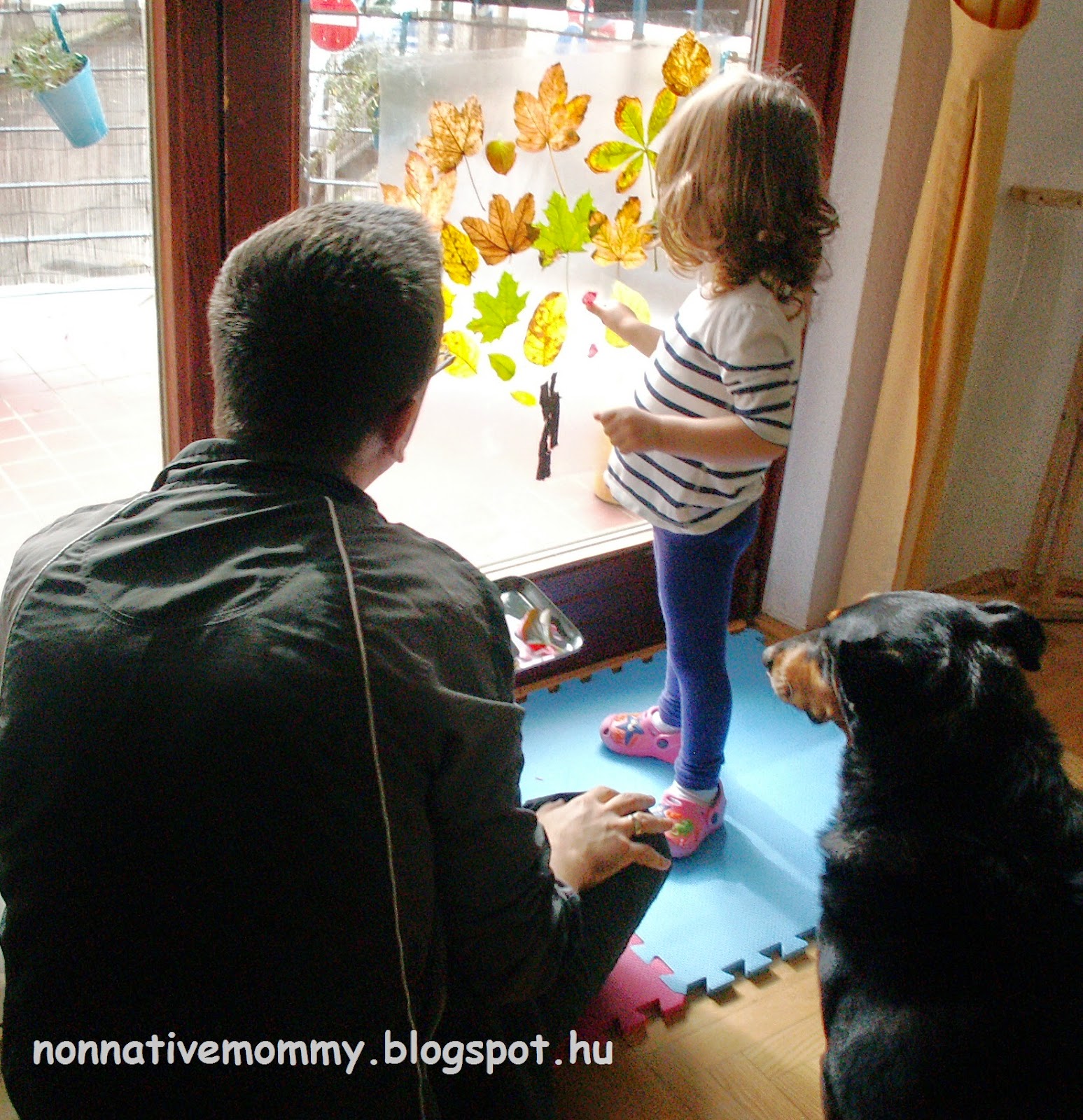
Daddy assisted the little artist.

Art critic: Doggie. He sniffed the leaves then moved away.
Final art piece: Autumn leaves are falling down (and some petals)

Another project of ours with the autumn leaves was making a hedgehog. I saw this ideas here. (You can find a hedgehog template there that you can easily print.)

I drew three hedgehogs (as this was also a family project) and we glued the leaves on their backs.

Serious gluing in process

Final pieces of art

Another leaf craft we’ve made with crepe paper:

More gluing and more sticking

End result 🙂

More autumn crafts are on their way. Stay tuned!

Test – meeting a native cousin

This weekend is all about relatives and languages. This is E’s first real life test of her English (apart from our native Nanny). My husband’s brother (M) and Spanish speaker wife (V) came to visit (they live in Germany) and I also had a little chance to practise my Spanish (which is surprisingly good, taken into account the little I’ve had to study in the last couple of months). This was my test.

E’s test was to meet her 7 year old native English speaker cousin (K) as my husband’s uncle and his family also came home for a visit (they live in the UK).

To cut the long story short, it was fantastic.
K and E played as if they’d known each other for a long time and language problems were nonexistent. There were some issues because of the age gap between them but not because they did not understand each other.
First, K came up with an idea to make a princess dress for E. So she took some paper, I found some crayons and markers and the work started. Drawing, colouring, sticking, trying on. 
preparing the dresses
They interacted with each other in the most natural way: asking for a marker, saying thank yous, offering paper and Cellotape to each other and ask what the other is drawing/doing.
Let’s try it on. I’ll help you.
A beautiful princess
The magic wand was a great hit when they showed the outcome to everybody around the house.
Magic wands
Then they continued playing: I’ll turn you into a … magic wand game. E understood it very quickly and started to say: Mommy, I’ll turn you into a bed.
So I lay down and they both climbed and lay on me. But we were frogs, babies, chickens, bum-bums 😀 , horses, cats, princesses and so on.
After this the “Five little monkeys jumping on the bed” game came with a lot of jumping and falling, then they went on to play hide and seek. And this wasn’t the end. K improvised a hopscotch, then we watched some Mother Goose Club videos on YouTube. 3 hours flew by really fast, we hardly noticed it. I should have taken more photos but to be honest I just wanted to enjoy the time with them.
We had a lovely time together and loads of fun. E passed her first “test” with flying As. She wanted to play with K no matter what (once K wanted to lift her up and dropped her. E cried for 2 minutes then running after K asked her to play more).
I was so proud of her managing in English and enjoying herself with an English speaking child to a great extent. The best feedback ever!!!

Housework fun

As E. doesn’t really like playing alone and wants to be with Mommy all the time we need to do housework together. Actually, she is a great helper and likes taking part most of the times. I’ve read a lot about Maria Montessori and her method on the net and in this book:

I do not wish to popularise her method, I just found some interesting points I can build in my parenting theories and also in our bilingual journey. One of them is:

“He who is served is limited in his independence”

Doing housework together means a lot of language input, quality time together and E’s preparation for real life assisting her in her developing independence.

IN THE KITCHEN

– Preparing food for cooking

Opening pea pods help to develop E’s fine motor skill.
She could examine how the peas are in the pod.
She also learnt a sequence: taking one pod out of the bag, putting the peas in a bowl, placing the empty pod in the rubbish bag.
She can help wash the peas, but as soon as I turn the hob on she is finished in the kitchen.

Vocabulary newly learnt or practised:

     green peas
     pod

     crack

     separate

     throw it away
     grub
     off
     tiny


cutting the butter-bean up

examining the inside
placing the beans into a pot
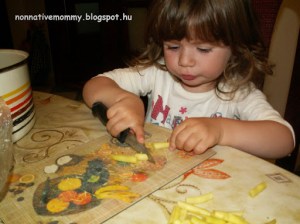
Using a knife is something E has been longing for. With my very close supervision she had the chance to try it and found it hard: – Mommy, cutting is difficult.
Helping make the bean dish didn’t mean she ate it 😦 although according to some blogger moms, their children became really enthusiastic to eat the food they prepared themselves.
Vocabulary newly learnt or practised:
   chopping board

   knife, knives
   pot (stripy, big, empty, full)

   butter-bean

   bean dish
   What’s yummie for you? (offers the practice or revision of a lot of food)

   wash

   dirty, dirt

– Baking:

whisking

I made this rhubarb cake


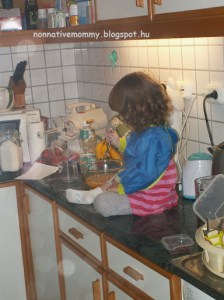
Baking a cake has a better chance of success in the eyes of your child. They are more likely to consume what they made. It also involves a lot of kitchen tasks and equipment and the activities have to follow each other quickly, which keeps up the interest of a young kid. Developing gross motor skills is also a key point here, like whisking, mixing, measuring, stirring, pouring etc.

Vocabulary newly learnt or practised:
   flour
   baking powder
   rhubarb

   cake
   scales

   measuring spoon
   wooden/mixing spoon
   bowl
   whisk
   mix
   stir
   grab

   crack an egg
   white/yolk
   lick the spoon 

   apron
   delicious
   tasty
   sweet
   sour
   hot
   dangerous

   baking try
   heat the oven

– Packing in and out of the dishwasher:

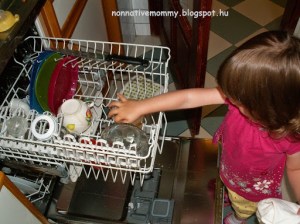
emptying the baby bottle into the sink

putting the baby bottle into the dishwasher

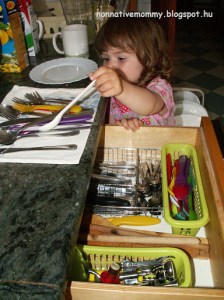
placing the cutlery into their draw

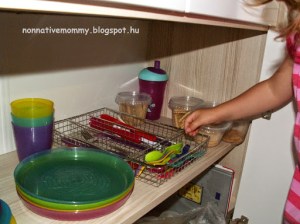
 After a while I rearranged a shelf so she can easily reach her spoons, plates and glasses.


This is E’s favourite household chore. No matter when I ask her to help with it, she never refuses. (It’s not the case with hanging the clothes to dry). Also, she practises with this chore how to select and group similar objects, to name the objects and say their colours or material. She also learns where to find things she needs around the house.

Vocabulary newly learnt or practised:
   cupboard

   cutlery
   tablespoon
   fork
   knife
   teaspoon
   ladle
   glass
   mug
   cup
   pot
  bowl
  plate
  draw
  sharp
  dangerous
  carefully
  place
  baby bottle
  plastic
  steal

IN THE BATHROOM

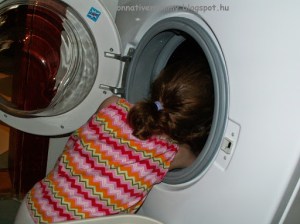
Another pleasant activity for E is to help with the laundry. Packing the clothes in the washing machine is not as much fun as pulling the wet clothes out.

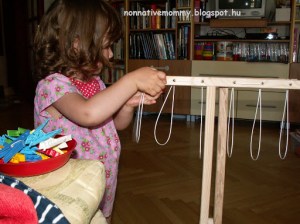
 Usually we put some of her clothes in a separate basket and while I’m putting the adult clothes on the rack, she is putting hers on a smaller rack (which we bought at REGIO toy shop but also available at Fakopáncs online toy shop)

hanging the clothes
opening the dry rack
fixing it with a peg
socks
matching socks with Daddy
on the way to the draw to put the socks away

This is not her favourite activity but she uses her English (and Hungarian) a lot when she is in the mood to help.

Vocabulary newly learnt or practised:
   washing gel
   softener
   dry rack
   hang
   line
   clothes peg
   match
   carry
   fix
   dry
   still wet
   pull out
   pack in
   laundry basket
   dirty
   clean
   take off
   names of clothing (socks, tights, trousers, shorts, T-shirt, blouse, panties, vest etc.)
   Daddy’s, Mommy’s, E’s

MISCELLANEOUS

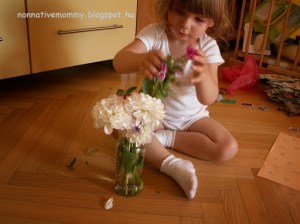
The best part for me is when we decorate our home together. Of course, when she paints or creates something I put it on the wall or in her room. However, she takes pleasure in decorating for us not only for herself. At the market we bought 2 bunches of flowers and she made them into 4, arranging them in small vases.

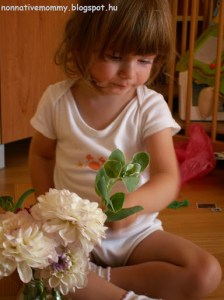
adding some green leaves to the dahlias

we need some pink in this composition

She also enjoys watering the plants on the balcony.

Involving her in the household chores was one of the greatest idea and I’m really glad she likes it, too. It gives us the opportunity to be together, to practise her languages, to experience some practicalities of everyday life and to help her become more and more independent.