Helpers

To reach our goals I am not enough as the only English speaker in E.’s life.
First, I tried to find native playmates for E., but she was too little for them. But I’ll try it again when she starts being interested in playing with others, as now, at the age of 11 months, she just plays NEXT TO another child, but not WITH them.


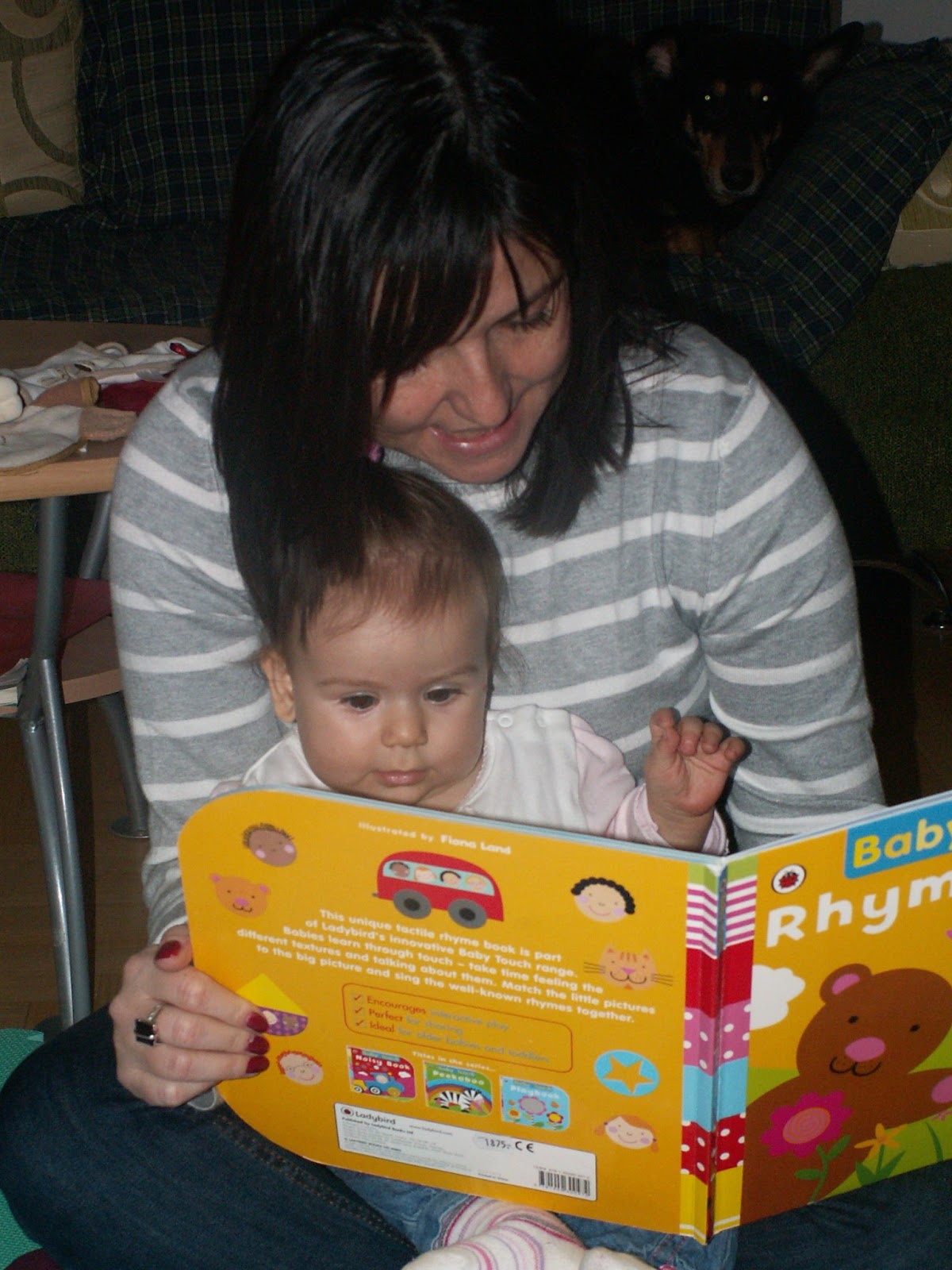
B. is reading with E. (who is 7 months old here)

I arranged  with my best friend, B., who is an English teacher as well, to talk to E. in English only. So every Friday when she has no lessons or other programmes she comes over and plays, chats, reads out to E. It’s real fun as I can be with my friend and E. is also entertained IN ENGLISH. There are other family occasions where B. is also present (name days, birthdays, Easter etc), and even at these times when Hungarian is the major language used, B. speaks English to E. Sometimes it’s a bit chaotic and quite challenging for B. to share her attention between two languages, but we have succeeded so far. (By the way, B. speaks four languages at a near-native level: Hungarian, Romanian, English and German). Nice example for E.


Another helper of ours is A., our British nanny. A. comes once a week (on Thursdays) for 2 hours to play with E. She loves A., smiles at her as soon as she arrives, screams and babbles a lot while A. is at our place. I may claim that E. “talks” to A. the most compared to how rarely they meet. A.’s main task is to talk, talk and talk to E. Another reason why it is so useful for her to be present in our life is that I can brush up my English. If I don’t know the exact, or natural expression for some object, activites, baby language, A. is here to help me out. In the future I would like A. to come more frequently or come out with us to the playground or to the zoo. If I go back to work (which will be soon even if it’ll be only part-time) I would be happier if an English speaker took care of E. while I’m away. If she has time for us as she is quite popular with moms. A. could be a kind of replacement for me.  I know this idea won’t be very welcomed by the Grandmas.


A. is talking to E. (10,5 moths old) about animal flashcards

At the Helen Doron Early English class, our teacher, Zs., is also a kind of helper. She provides us with another occasion to practise and learn English out of our home. E. can see that other people also use this form of communication. And it is also important that she is with other kids, too.

The same applies to MEC (Mums’ English Club), except for the fact that it takes place in our home, in E.’s comfort zone.

My plan for the near future (as soon as E. can walk) is to find a playhouse where native or non-Hungarian mommies go with their little one.
Weekly-daily schedule

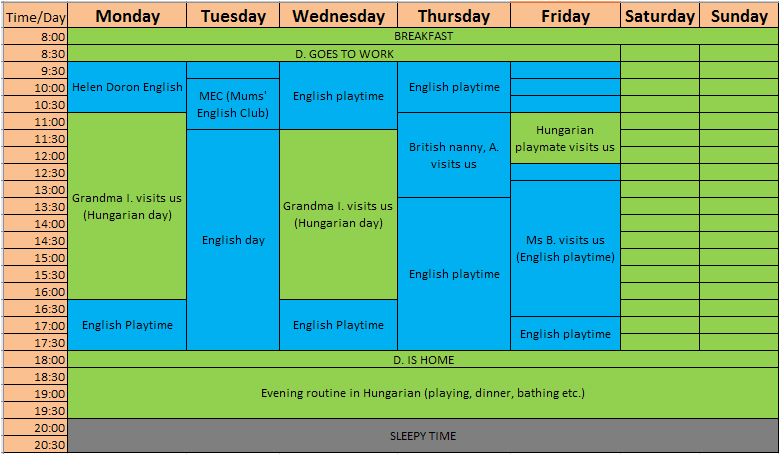
Our daily schedule concerning English has developed slowly. E. is 11 months old and for a month now we’ve had a more or less fixed weekly agenda. Here it is:

60% is in Hungarian and 40% is in English – I wish we could keep this balance

We’ve just started Helen Doron English (in a later post I’ll write about our experience), but it definitely increases the time spent on English and we are not at home using the minor language at last. Tuesdays and Thursdays are clearly dedicated to English. Mondays and Wednesdays are the Hungarian days. Still, on these days we have 2 or 3 hours of English input. (What is not in the chart is the 20-30 minutes when D. takes the dog out for a walk in the evening. E. and I change into English and lay the table, put away the toys or watch some videos or books in English while they’re away.)

Fridays are changeable, but in general half of the day goes in Hungarian, the other half in English. Before our Hungarian playmate comes to visit us, we go out for a walk together or to the market and then we use Hungarian as English would be unnatural.

My only problem is the weekends. As the whole family is together, it’s really difficult to find time and natural situations when we can use English. At weekends 1 hour of English per day is “forced” into our programme (singing, video watching, reading out) but not real communicative interactions. I’ll try to find out something for the weekends. If you have any suggestions, just feel free to share it with me.

In the table above you can’t see food time (which is in the given language according to which day it is) and daily sleeping time, however the latter takes away 2-3 hours per day.

At the beginning of January we took up baby swimming on Saturday mornings. I found a course at Budapest Moms (you can find the group’s facebook page here), which was held in two languages. The tutor is Hungarian and in the water one of the moms do the interpreting. As the swimming pool echoes a lot it is hard to hear the Hungarian words, not to mention the English ones, however, we met a lot of non-Hungarian families (Russians, French, Dutch, Canadians etc). As for the English language, it doesn’t make a big difference whether we take part in this swimming course or another, but the trainer is really professional and the pool is clean, the water is warm. So all in all we, and most important of all, E. enjoy it. It’s a good family programme for the weekend. The course is finished in a week, now we are thinking of continuing it, but not sure. Good weather has arrived, we might want to spend time outside instead.

I’m a little worried about being able to keep this schedule. One thing is permanent in a baby’s life that nothing is permanent. As I’m planning to work part-time soon, probably in a month or two our agenda needs to be revised.

Singing and signing

I promised a post on singing nursery rhymes together with MAKATON signing. So here it is.

The MAKATON signs can be used while you sing the traditional nursery rhymes as the Signing Hands do. These two ladies sign while singing. Have a look at this song, which is the well-known ‘Ba Ba Black Sheep’ with signs.

Easy to learn, right? Their songs, which are available on the net, give us the opportunity to learn more signs.

Some more common songs with MAKATON signs:
The Wheels On The Bus
Row row row your boat
Old MacDonald Had a Farm
We wish you a merry Christmas Little Peter Rabbit
Something Special, the BBC series, also includes some songs like the Rainbow Song. On the link you can find Mr Tumble singing and signing it.

After you have learnt a lot of signs, you can use them with other songs or rhymes.
Within 1-2 months you can learn 50-70 signs without an effort. Of course, it doesn’t mean you HAVE TO use all of them. You’ll see what the two (three) of you really need.

How we did it when E. was 6-8 months old:

When she couldn’t sit properly, but could only crawl, she got tired easily and became grouchy. This was the time when I made her lie on her back looking at me. Then I sang the songs and a signed along. She smiled and even laughed out loudly. She could enjoy it even for 15-20 minutes. This was enough for her to be refreshed and we could play again, or have her food etc.

Now, when she’s 11 months old it’s changed a little:

E. can stand and cruise (tiptoe along some furniture) so it’s very difficult to keep her in one place. I don’t bother to make her lie down any more. When we play and she sits for a while I sing two or three songs followed with the signs. No more because she moves on quickly and doesn’t really care any longer. But she is screaming and/or flapping her hands with joy during the songs. We do the short singing/signing sessions twice or three times a day.

(Have you noticed how easy to misspell or misread the two words singing and signing? 🙂

Plans, aims and strategies

I might have started with this post at the beginning.

  1. Why do we want E. to be bilingual?

    First of all, nowadays one language is not enough in our globalised world. If you want to study or work abroad, it is a must to have the English language. Second, our native language is Hungarian, which is far from a world language. A language, which can be used nowhere else in the world but in Hungary. Life in Hungary is not what everybody dreams of. One or two more languages give the opportunity for E. to choose where to live. Third, having another language in our life opens the mind to the other culture; one becomes more empathic, understanding and approachable. When making friends or new connections, language obstacles are non-existent. Last but not least, as far as I have experienced it, language learning is fun, a kind of intellectual entertainment.

    I could go on listing more and more reasons why we want our little one to speak both Hungarian and English on the same (near) native level. And this leads us to the next point:

  2. Main aim

    Perhaps it’s a little far-fetched but a sophisticated, near-native level is the main target concerning E.’s level of English by the time she’s 18-20 years old. In the short-term, until she’s at home with me up to the age of 3 – 3,5, I’ll be the main English input with the assistance of some helpers. Whenever we are the two of us we’ll speak English (which means now I speak and she babbles). In the long-term, I’m not so sure: English nursery, English speaking school according to the Hungarian national curriculum, moving abroad… these are all question marks. But now I’m trying to concentrate on the short-term aims (loads of English input of different kinds: spoken interactions, songs, rhymes, books, videos, native playmates, Helen Doron Early English… whatever).

  3. Strategy

    Our strategy is simple. I speak English to E. whenever we are alone and there is no Hungarian relatives or companion around. D. speaks Hungarian to her daughter, but there are some activities which they do together in English (such as using the computer or later watching TV etc.). Later on, when I’ll spend less time with E. we will introduce ‘Language by Time’ strategy. It means there are given time periods when only English will be used (e.g.: Saturday mornings, every day after nursery/school from 4-6, craft activities etc.) Another possibility is ‘Language by Situation’ i.e. every breakfast, homework doing, or bathing is in English. We can also introduce the ‘Language by Location’ strategy. In this case we would use English at the kitchen or bathroom, at a special playhouse, or at a playmate. At the Helen Doron Early English school. I haven’t decided which suits us more (maybe a combination), but we’ll try it when the time comes and I’ll let you know about the advantages and disadvantages.

And now only one more point is missing: HOW we are doing it. So the rest of the posts will be about our daily life using English (and Hungarian).

      MAKATON – sign language

      M., who I met on the facebook, in connection with MEC, advised me to have a look at the MAKATON signs that she uses with her daughter to connect the two languages. No matter which language you use, use the same sign for the same thing, so the child can learn to connect the meaning. You can find out your own signs as well, or do a signing course in Hungarian. I don’t want to recommend any courses as we didn’t take them. Just google it: baby sign language course Budapest.

      Here are some examples, signs we use on a daily basis:

       
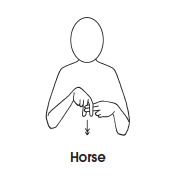
      Though we sign the horse in a different way:
      You can find more signs here.

      You can also learn from a special BBC programme for kids with special needs. The programme itself is called Something Special.
      Each programme sees Justin and Mr Tumble (played by Justin) out and about applying signing in a variety of places. Topics covered include babies, pets, toys, weather, clothes, shops, food, all about me, where I live and colours. Mr Tumble always dresses up, wearing brightly-coloured clothes and even big shoes! He moves around clumsily and has lots of fun.

      The language used throughout each programme is supported by Makaton signs and symbols and is designed to be understood by children in the early stages of language development. (source: BBC – Something Special )
       
      Full episodes are 15-20 minutes long. What I did with this programme is that I watched them one by one on youtube and made a playlist of what I needed (20-25 videos). I learnt the signs (they are very straight forward and easy to learn) and started using them both in English and in Hungarian (same sign for the same thing). E. was 6-7 months old when I introduced signing to her. (4-5 signs at a time. When she was familiar with these I introduced new ones.) Sometimes I picked a short part of an episode (max. 5-6 minutes long) and we watched it together. This could have begun earlier as well. But never cry over split milk.

      Here is the first video I saw and really was fascinated by it:


      I don’t do the signing all the time only if E. is not paying attention or I really want to link a new expression in both languages. Most of the time signing draws her attention. In the next post I’ll write about some songs which can be followed with signing. It’s a hit with kids. They love it! You’ll love it too.