We do NOT celebrate Valentine’s Day anyway

February has arrived and Valentine’s Day is only 2 days away. In Hungary people didn’t celebrate it for a long time but nowadays it has become very popular. The only reason we deal with it at all is that E. can see a lot of shop windows where Valentine’s Day decorations are displayed and she is asking questions.

I’ve found some fun and useful activities online which have the symbols of this special occasion (hearts, roses, candies etc.) but the main focus is on something more educational.

In the last couple of days we’ve been working on these:

Valentine Patterns (from mrspspecialities.blogspot.com)

I downloaded the Valentine Patterns (freebie) and we cut them out together. This was the first time E. had been cutting properly, holding the scissors in the right way and actually cutting. What a breakthrough! I drew a smiley on her right hand thumb and she kept telling herself: 
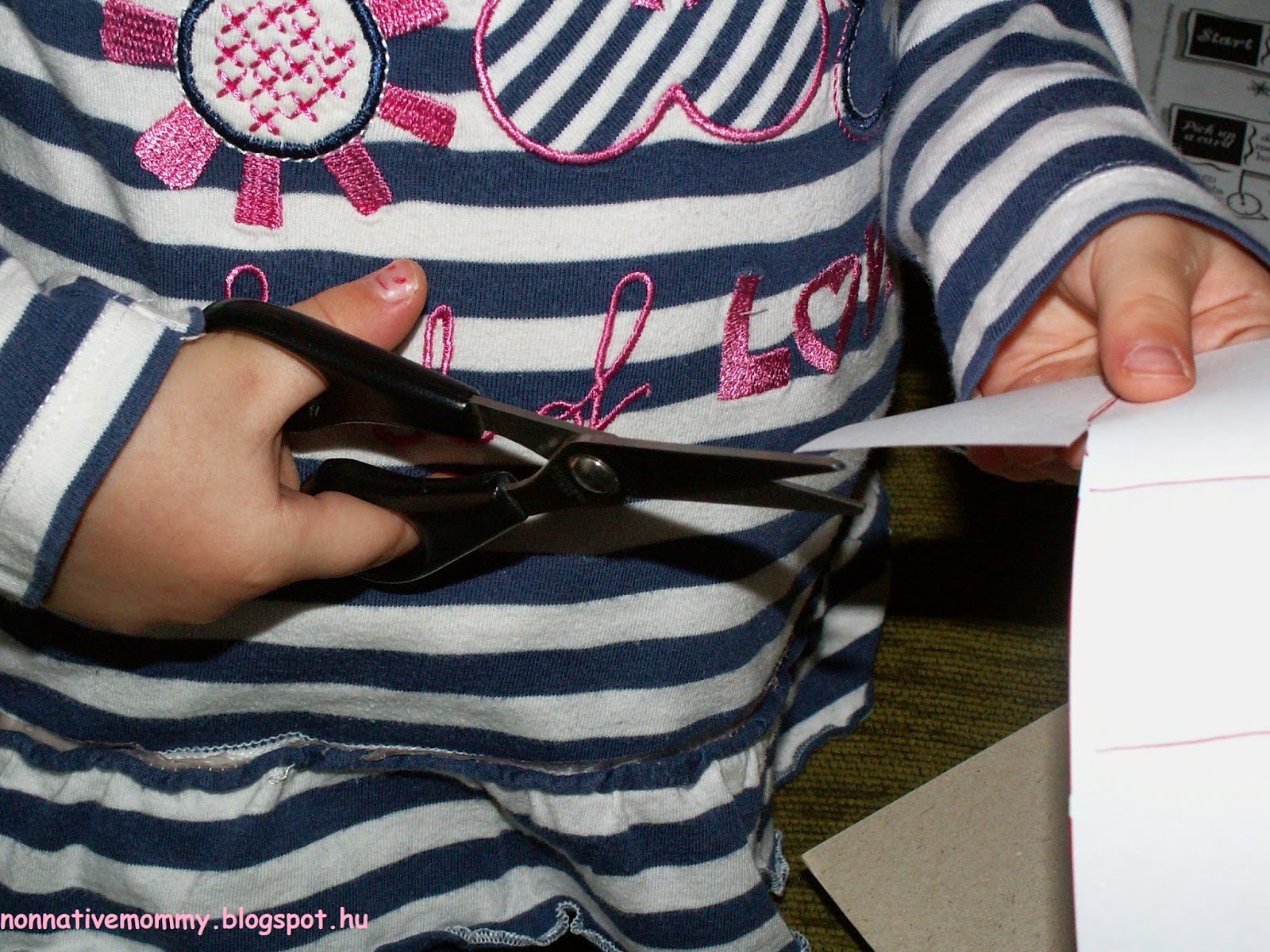
– Smiley up and I can cut.

Then we sat down to finish the patterns.

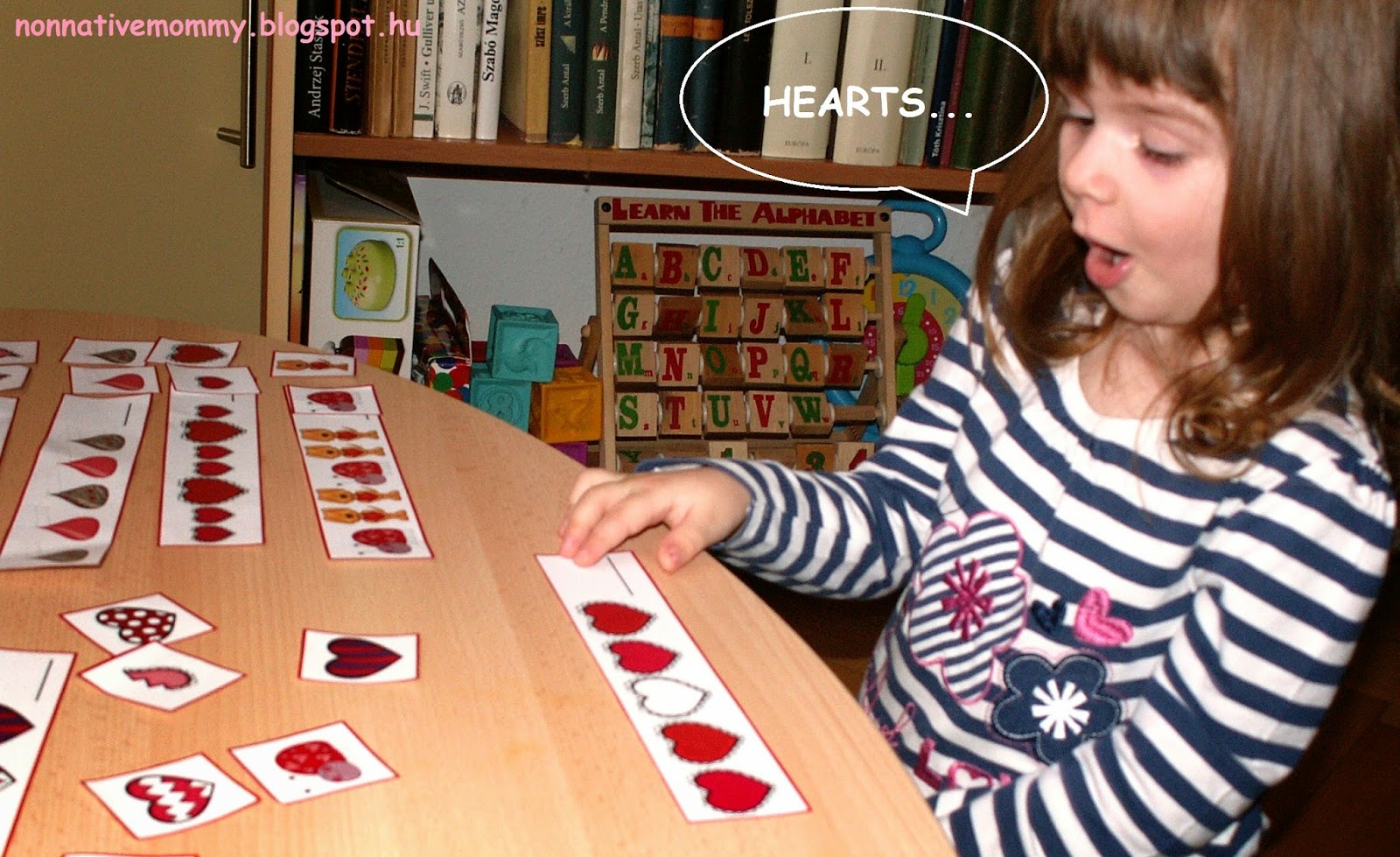
Cracked heart and broken heart

She had no problems with the ABABAB patterns

Sweets or poops?

ABBABBABB was a little more difficult

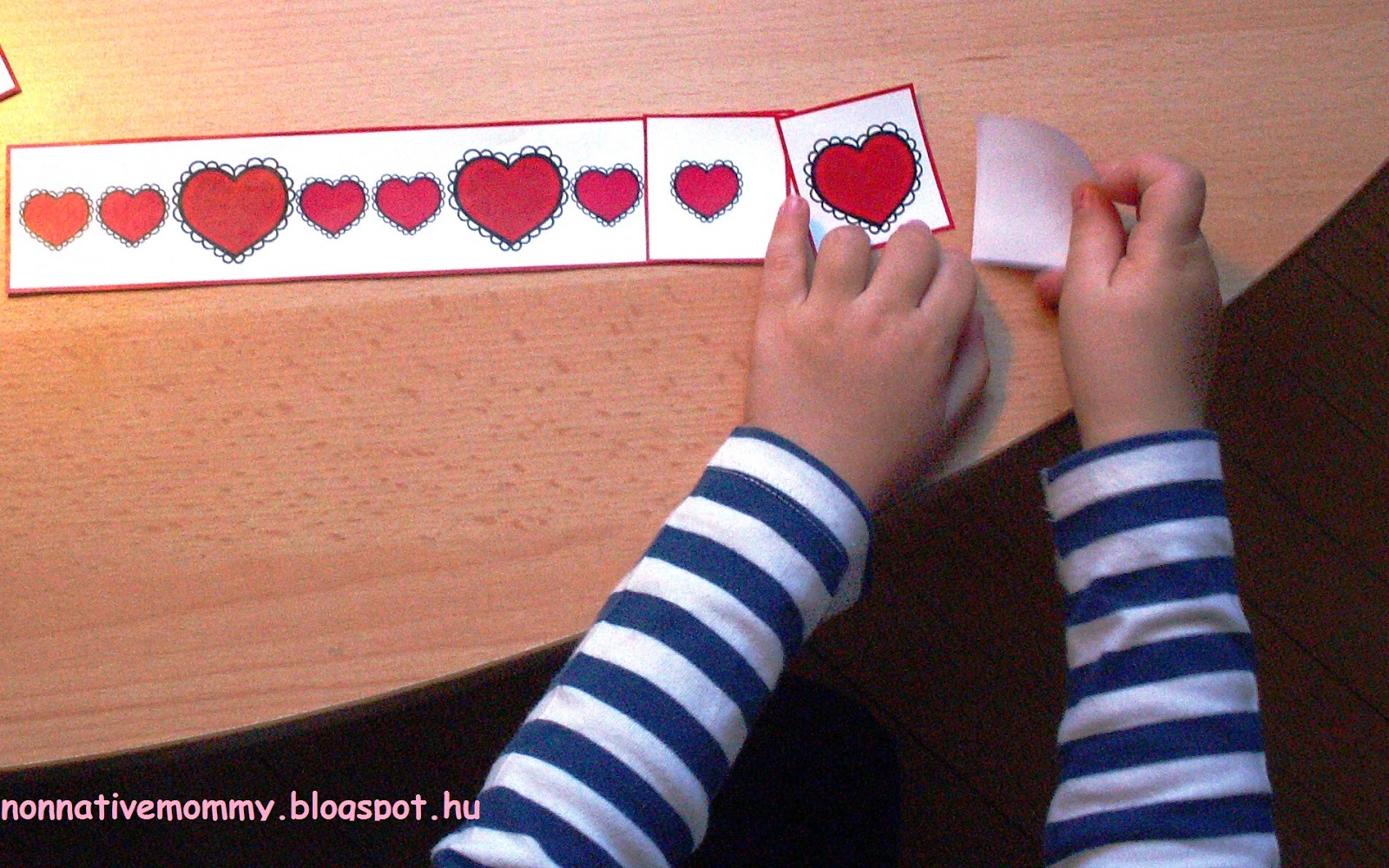
Little and big hearts

ABCABC patters were challenging

But she got the hang of it by the end

Zig-zag, stripy and spotty hearts

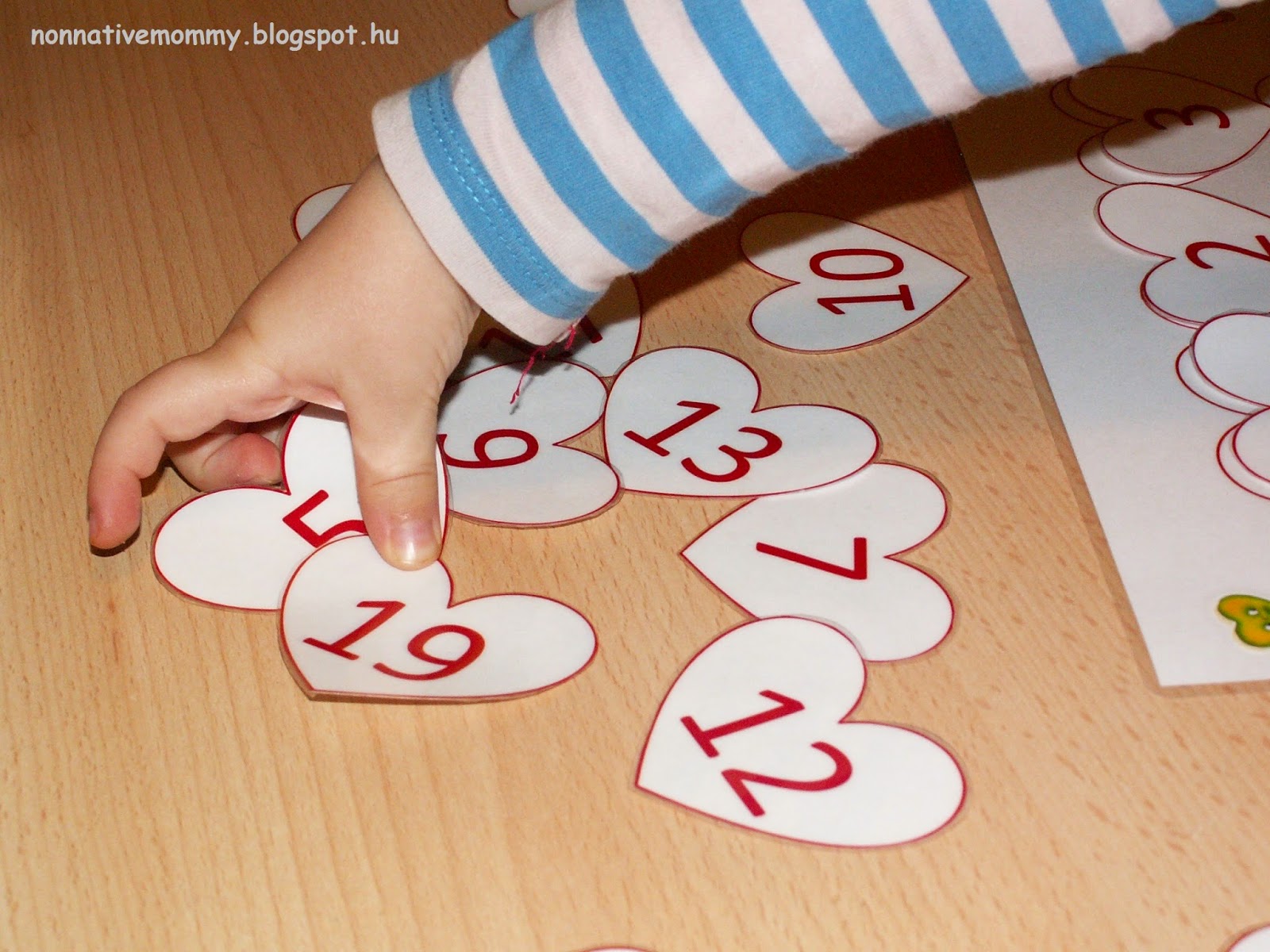
Number heart match (numbers)

I’m getting more and more fascinated by a blog I’ve found recently. At Welcome to Mommyhood you can read about healthy foods, recipes for kids and toddler activities like the Valentine’s Day number matching. This activity is more about numbers than about Valentine’s Day.

I downloaded the printable, laminated and cut the hearts out. E. liked it a lot, though she missed the zero.

I gave her all the numbers from 1 to 20 as she is an “expert” at numbers, but if you are just getting to know the numbers, first give your child the numbers from 1-9 and later the bigger numbers. 19 and 20 were on a separate sheet, but we solved this problem easily. We just put them next to 18 🙂

Look at her face 🙂


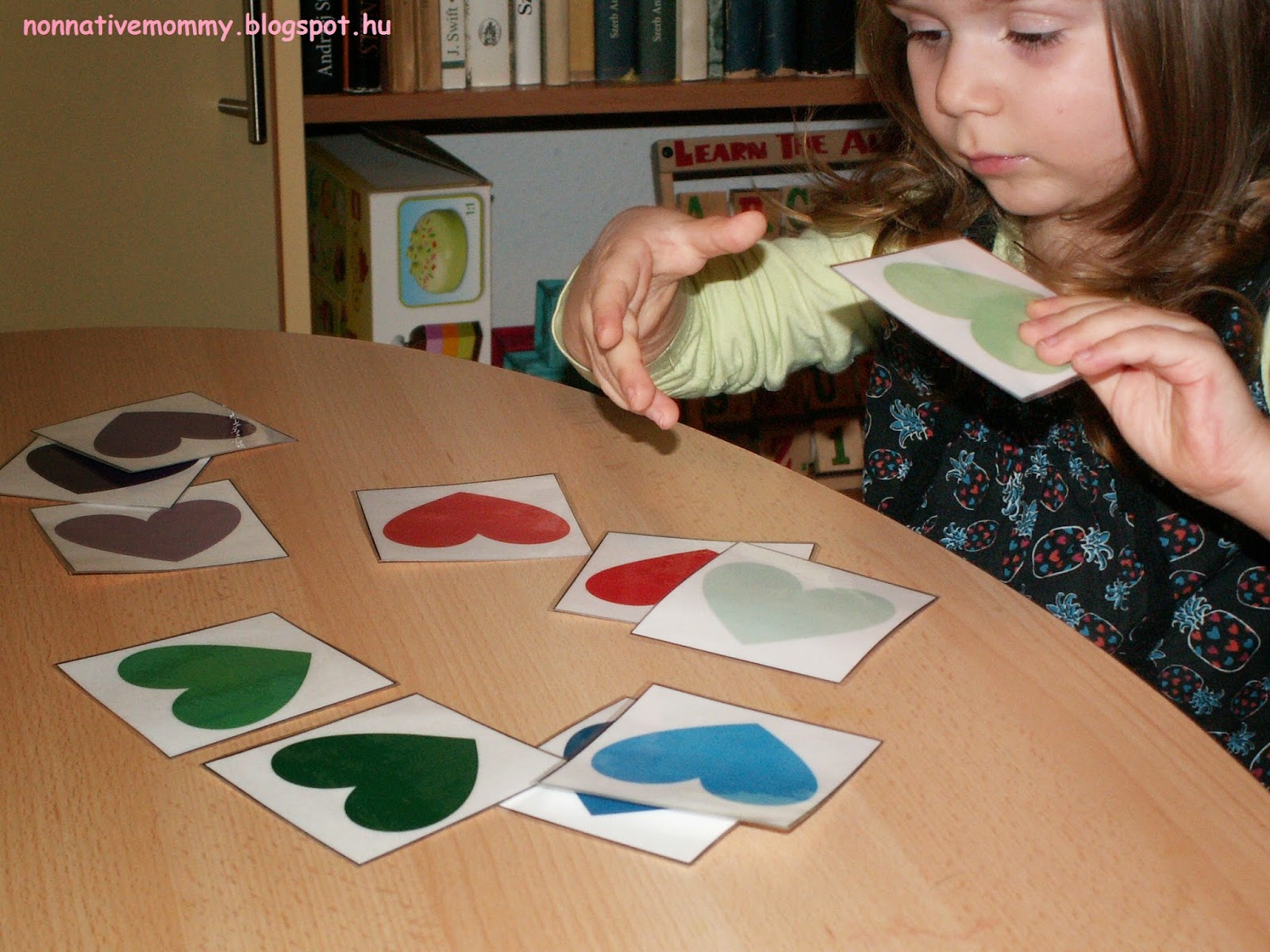
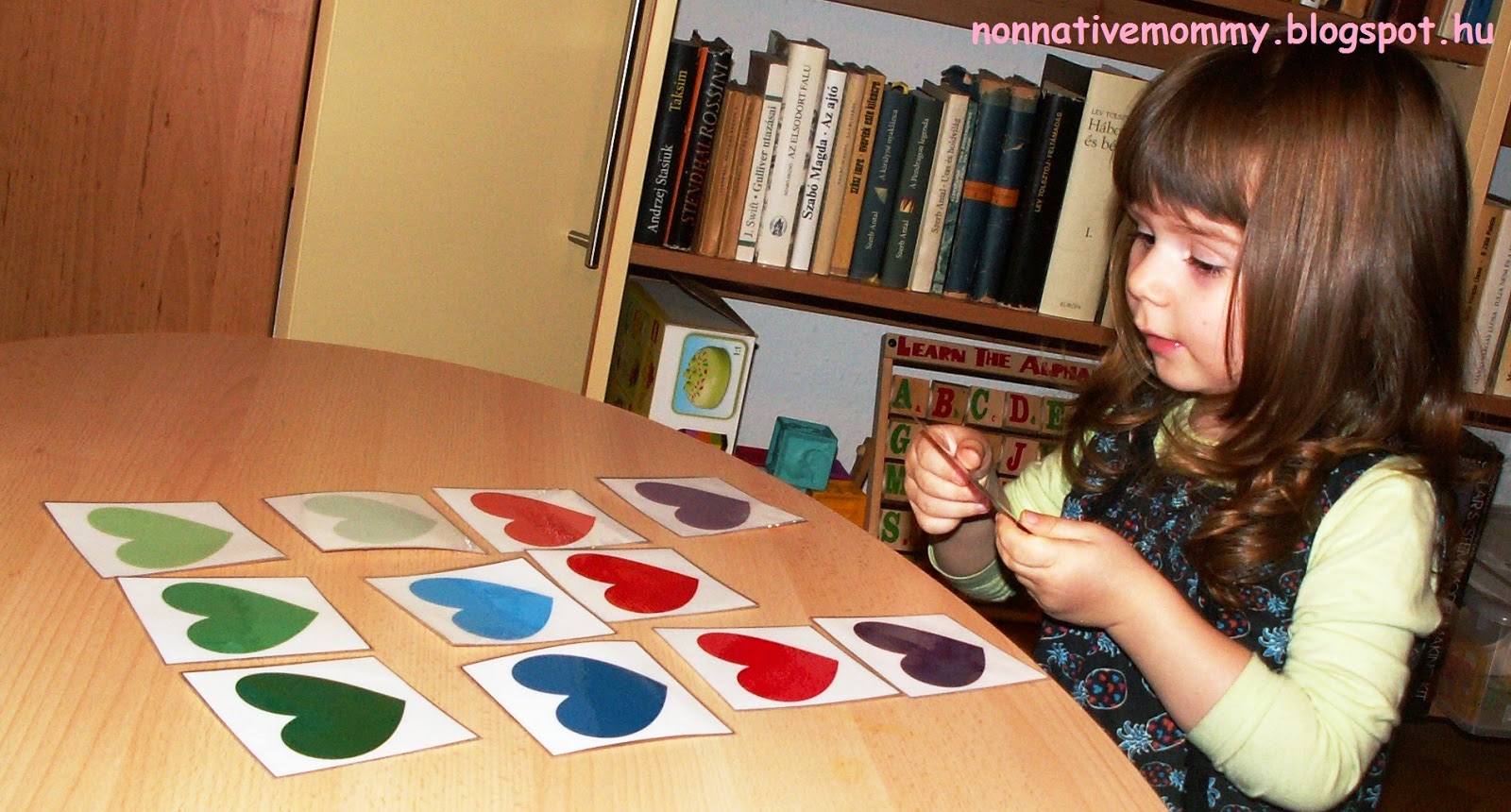
Heart colour gradients (from Welcome to Mommyhood)

E. knows her colours well but I haven’t done an activity like this before. I found the heart colour gradient printable (free!) at Welcome to Mommyhood and I thought we’ll give it a try. As this was the first time we’d done it I gave her only 3 shades then 4, but not all the six.

We also played a memory game. We turned up 2 cards at a time and we needed to name which one is dark or light (I used the darkest and the lightest colours.)
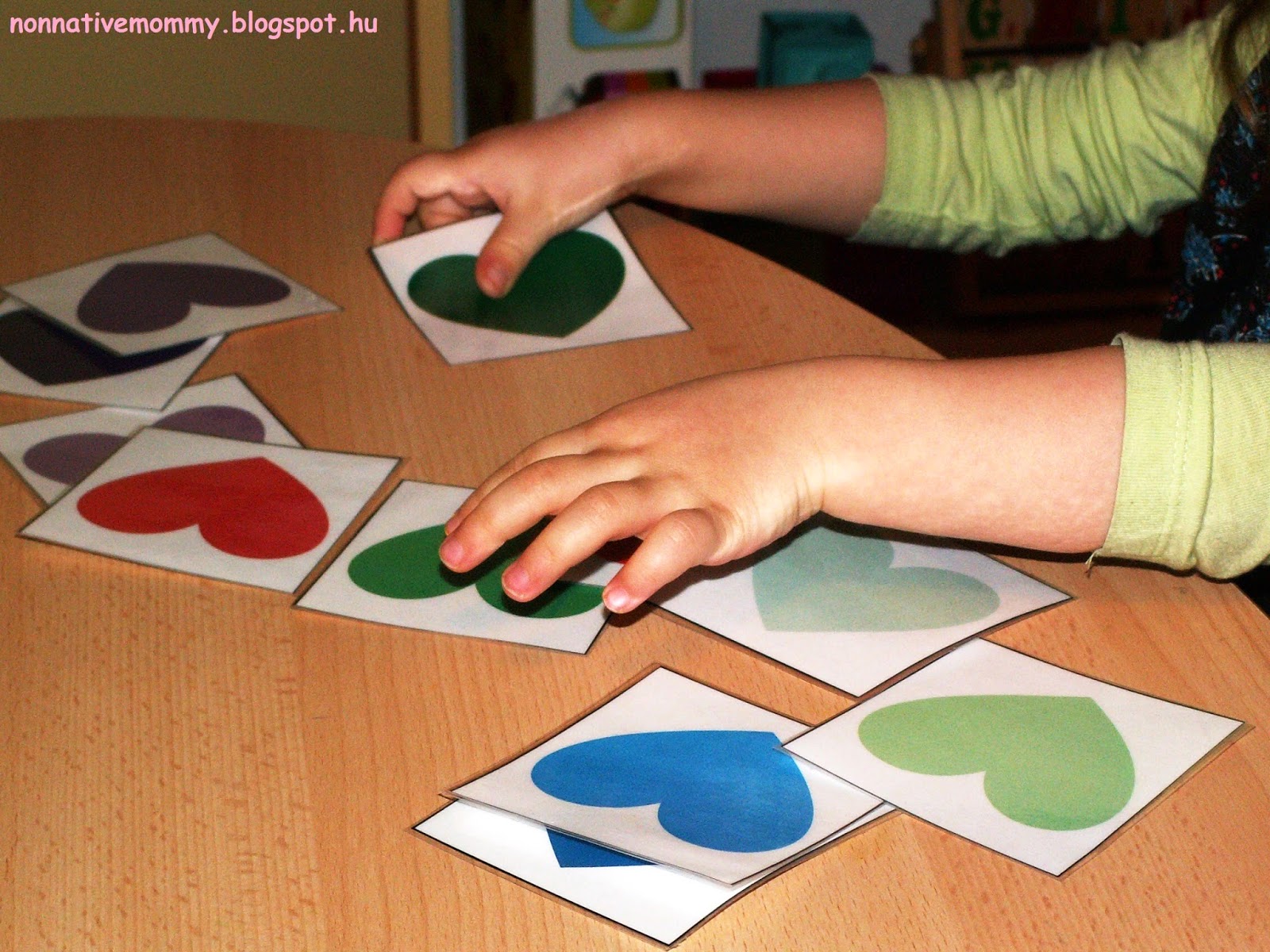


We really need to practise it more. It was a hard task, though she enjoyed it. (No photos of the memory game… sorry)

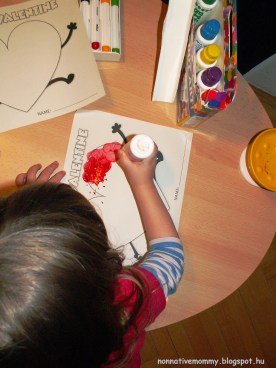
My Funny Valentine (art)

Super Simple Learning offers you a free printable Valentine’s Day craft. You can make your own funny Valentine out of eyes, noses and mouths. A great number of other Valentine’s Day activities are available there, like colouring, action songs, connect the dots activities etc.

I picked My Funny Valentine as we could talk about body parts and colours, and we could use the glue for sticking. E. loves them all.

Here is the activity step by step:


1. Paint/colour the hearts (so they’ll dry until you get to the sticking part)

2. Colour the body parts
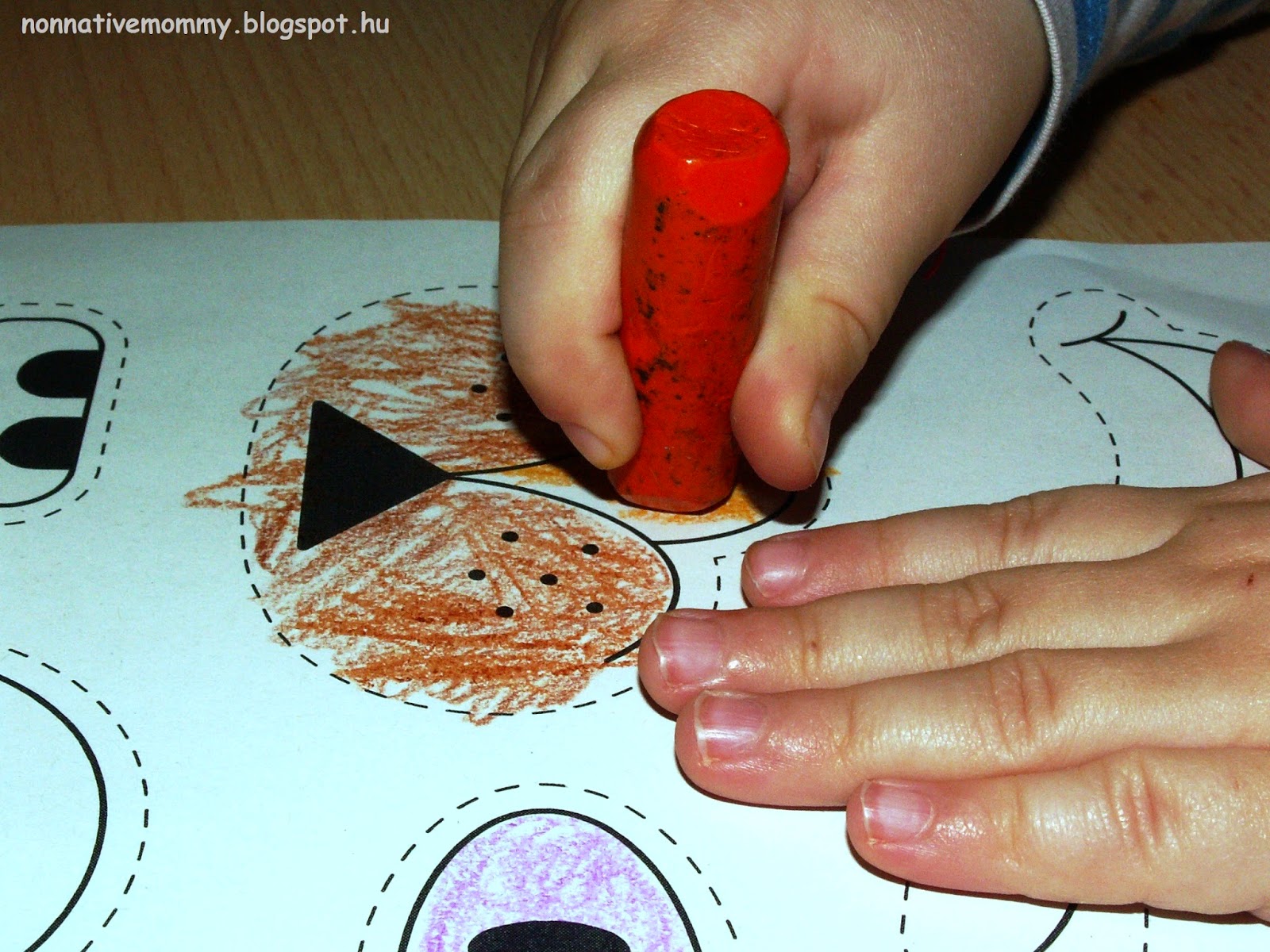
3. Mommy (or bigger kids themselves) can cut out the body parts


4. Use glue to stick the body parts on you heart(s)
5. Display it somewhere you and your child can rejoice at the final result

Extras: You can draw ears or hats/tiaras/crowns or add some presents in the other hand. You can also add a speech bubble and write in what your message is for your loved one. We didn’t do any of them as the activity was long enough for E. and she wanted to stick them on the door as soon as she finished with her hearts.

Button heart (art)

We are in the gluing phase. No matter what we glue it’s fun. So I drew 3 hearts on a sheet of paper and put some colourful buttons (that I found in my treasure box) in a bowl, plus the glue and a fun could start.

As we were doing some patterns I started the big heart with blue and white buttons and E. finished it.


Unfortunately we didn’t have enough buttons of the same colours so we needed to change the patter in the case of the smaller hearts.
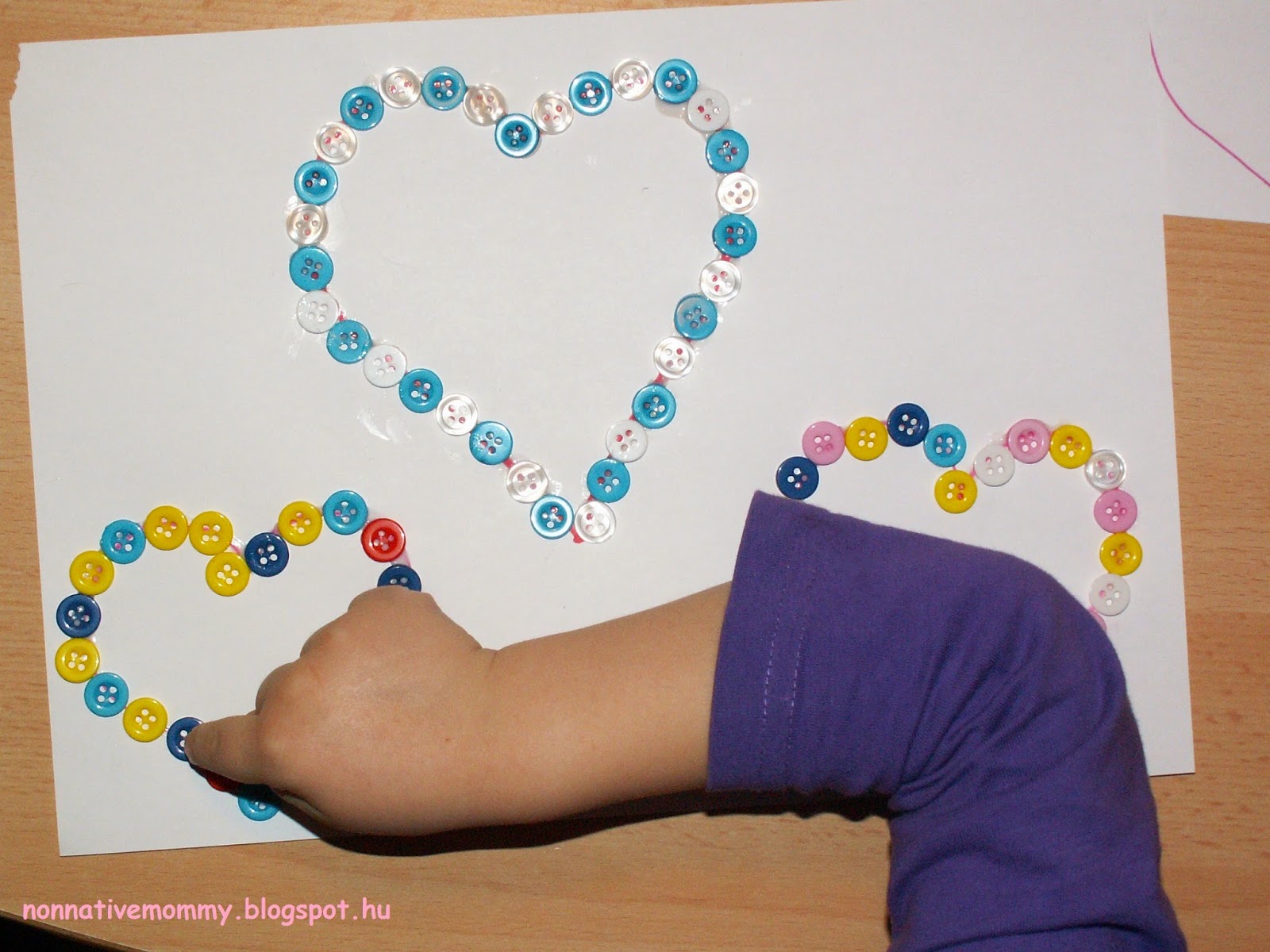
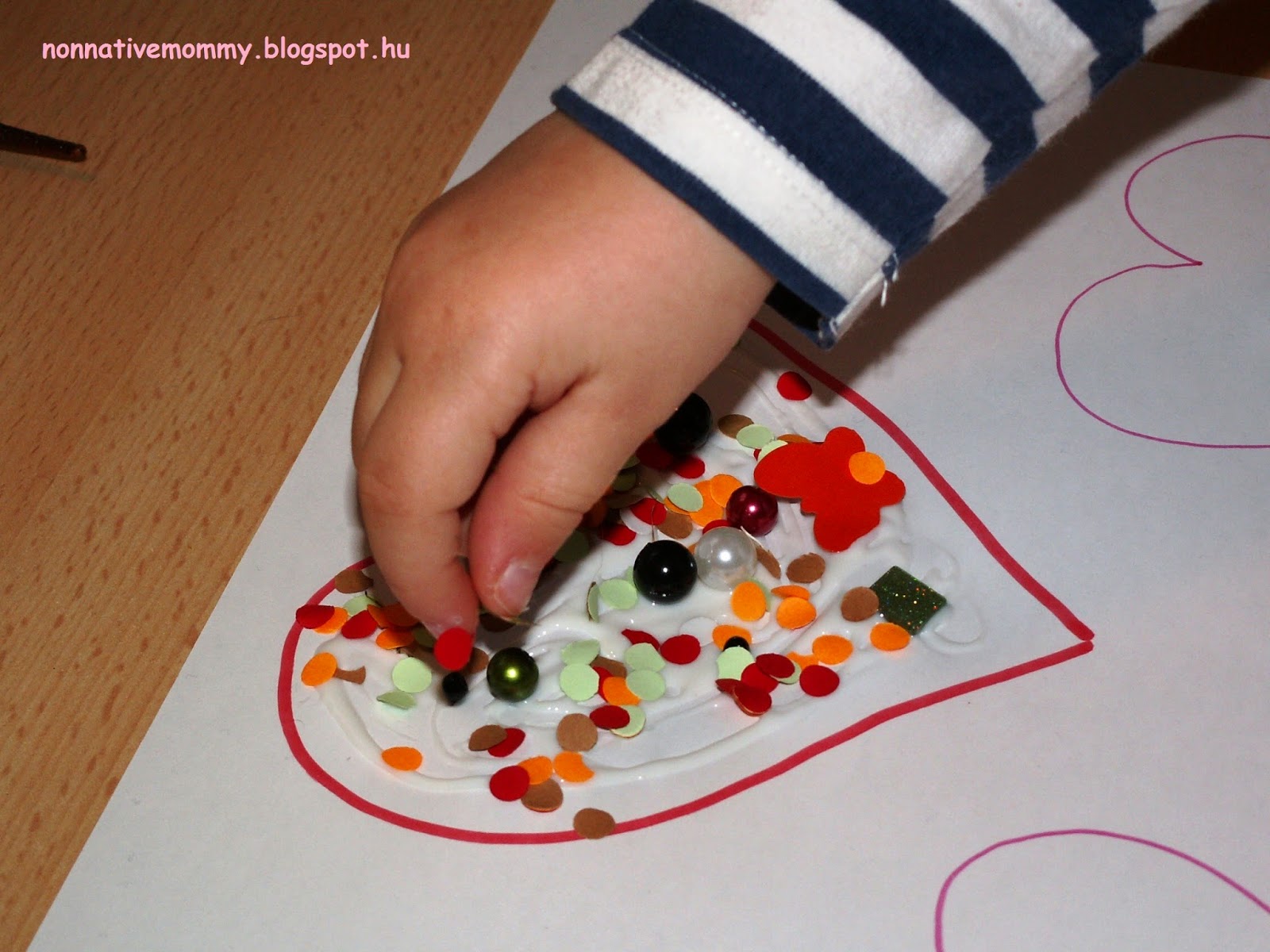
E. had no patience to make more hearts so we stopped the activity. But the next day she asked me to do something with the other 3 hearts. I just threw some confetti, beads and leftover craft stuff in a bowl and give it to her to stick. I had 10-12 minutes of freedom.


Although we signed Valentine’s Day in our calendar we won’t celebrate it (no presents, no flowers, no chocolate etc.). It’s not our holiday…

Anyways, happy Valentine’s Day!

We love numbers – Numbers II.

Every time before E. goes to sleep we have this conversation (either in English or in Hungarian):

E.: – Mommy, numbers.
M.: – Which numbers?
E.: – The little numbers.
M.: – 1, 2, 3, …
E.: – No, Mommy. Zero….
M.: – Oh, yes, sorry. 0, 1, 2, 3, 4, 5, 6, 7, 8, 9, 10
E.: – Now the big numbers.
M.: – 10, 20, 30, 40, 50, 60, 70, 80, 90
E.: – Hundreeeed (giggles)

She is so fascinated by numbers that at the age of 18 months she could read the numbers on her baby bottle from 10 to 280.

Let’s see some number games we play.

First of all, our favourite number songs:

Zero, zero, super hero

Ten in the bed

The new favourite: Ten Little Dinosaurs

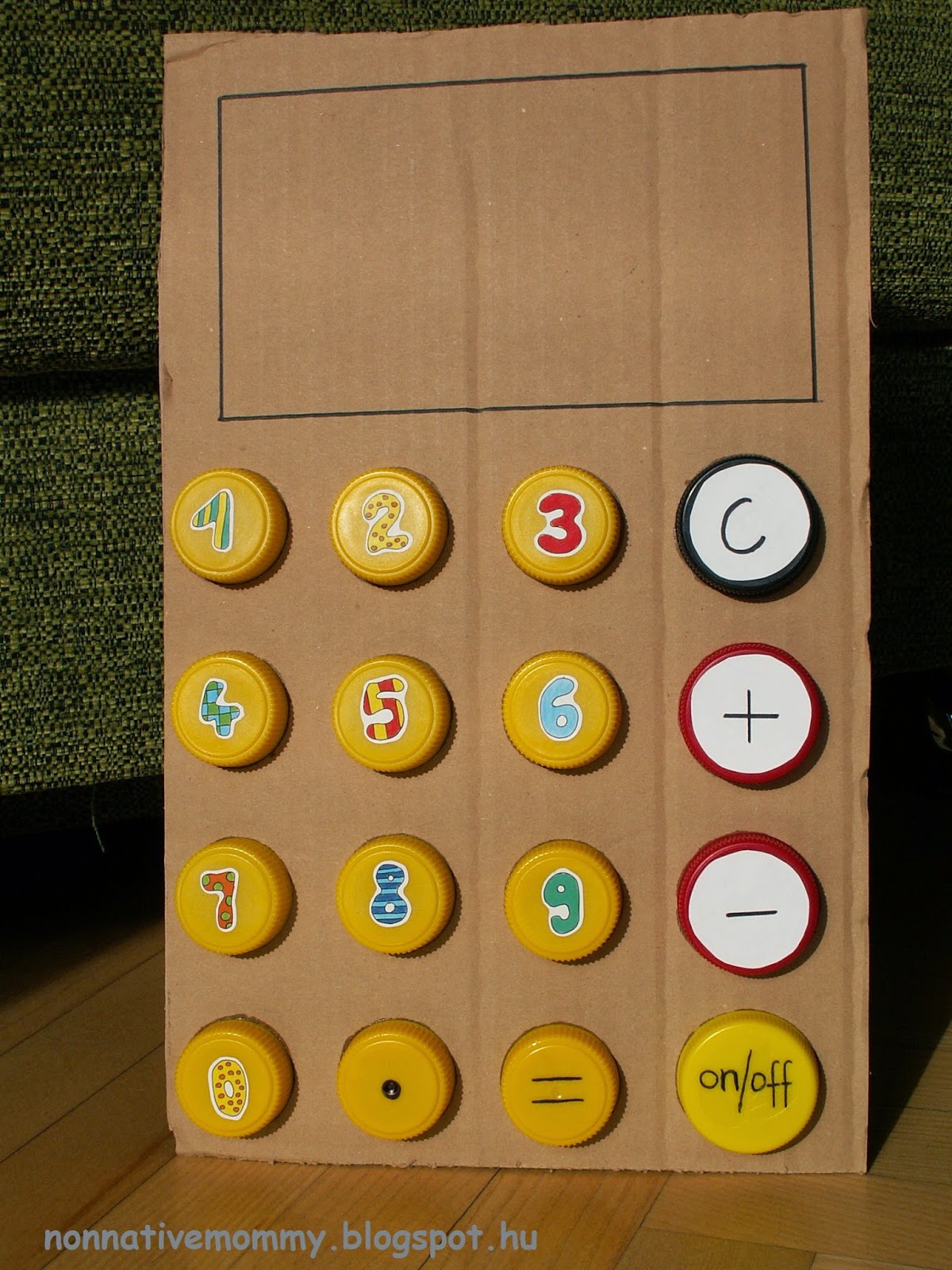
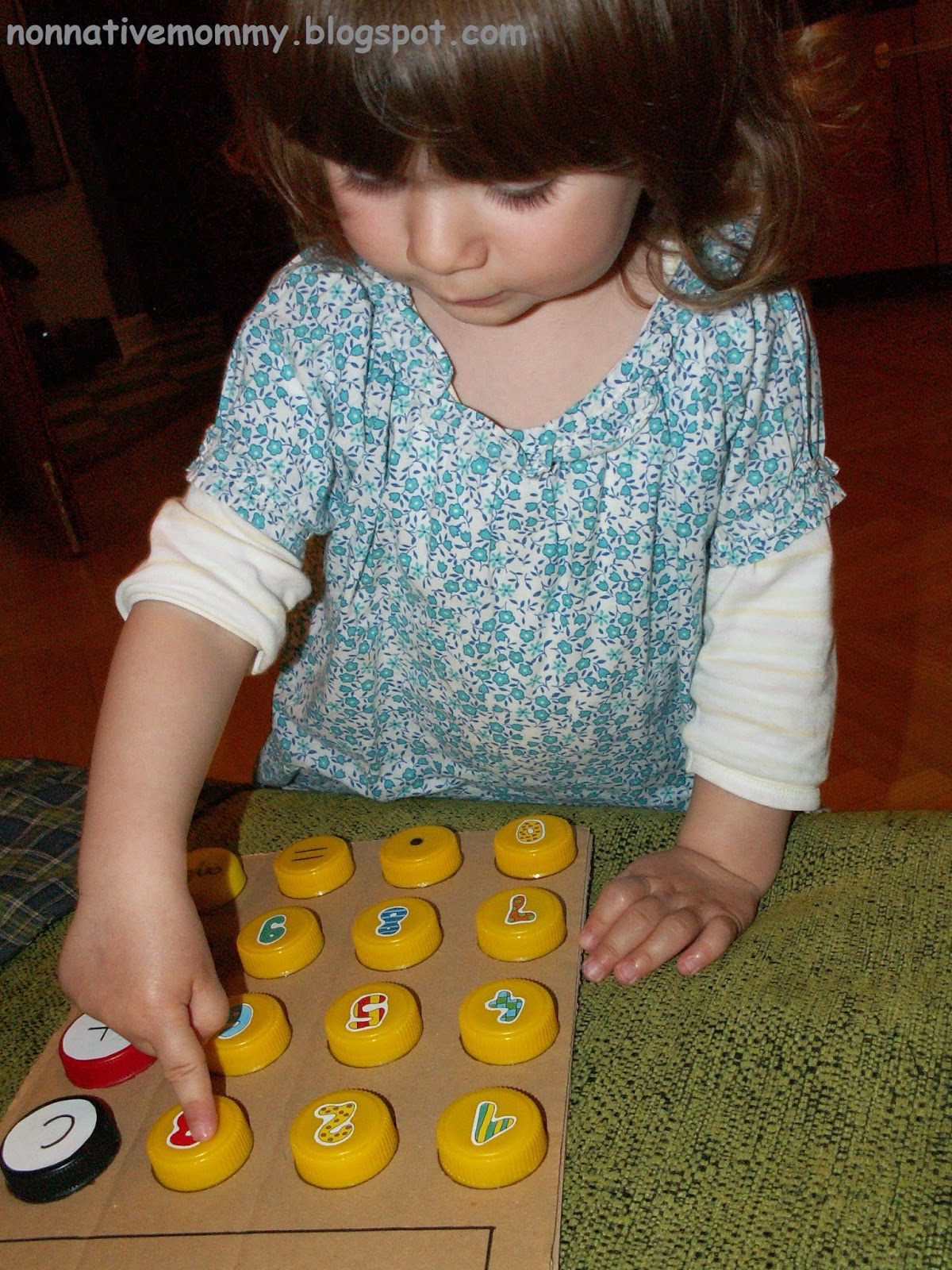
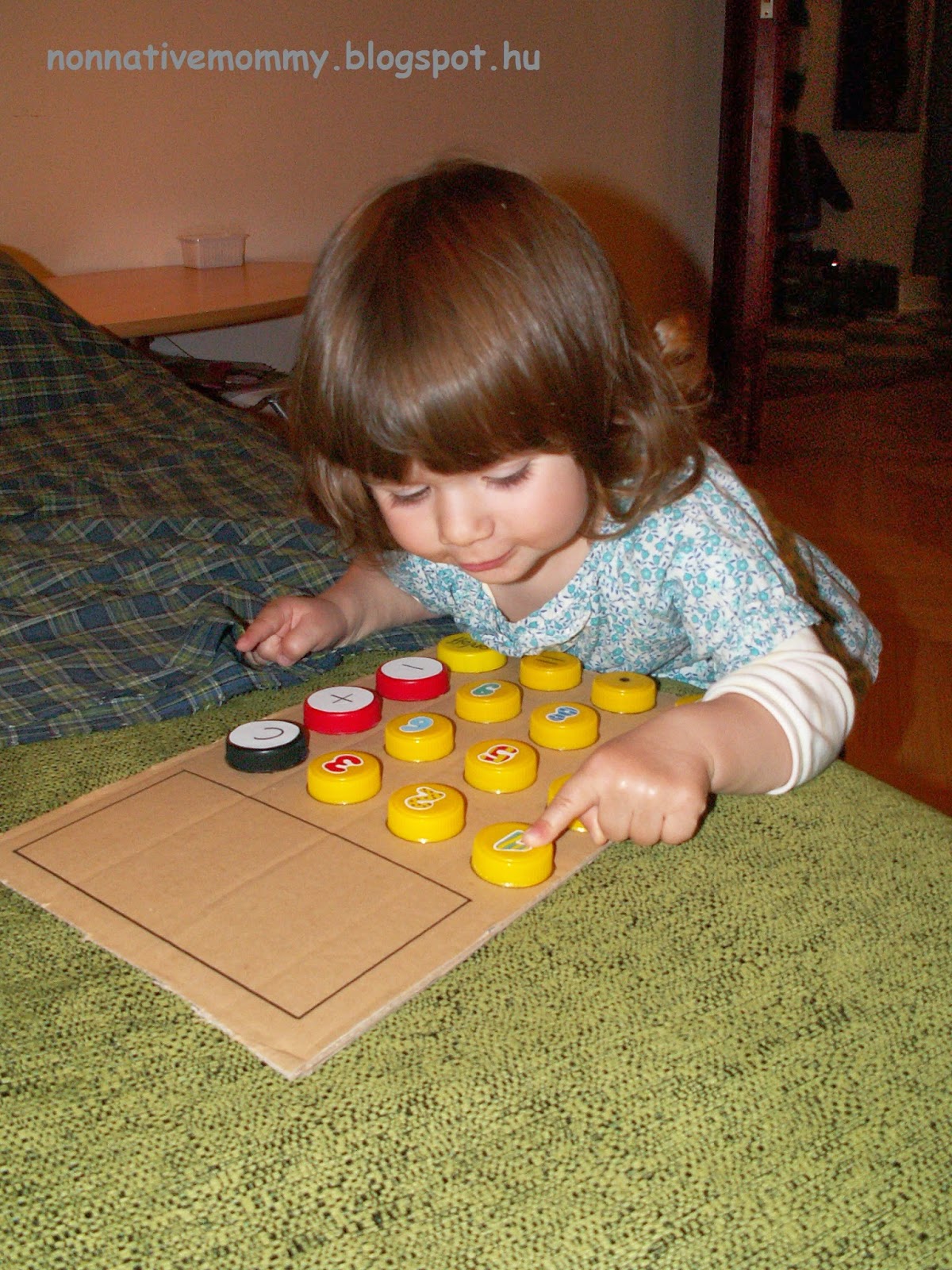
The bottle top calculator is just as much fun as pushing the buttons on a real calculator.

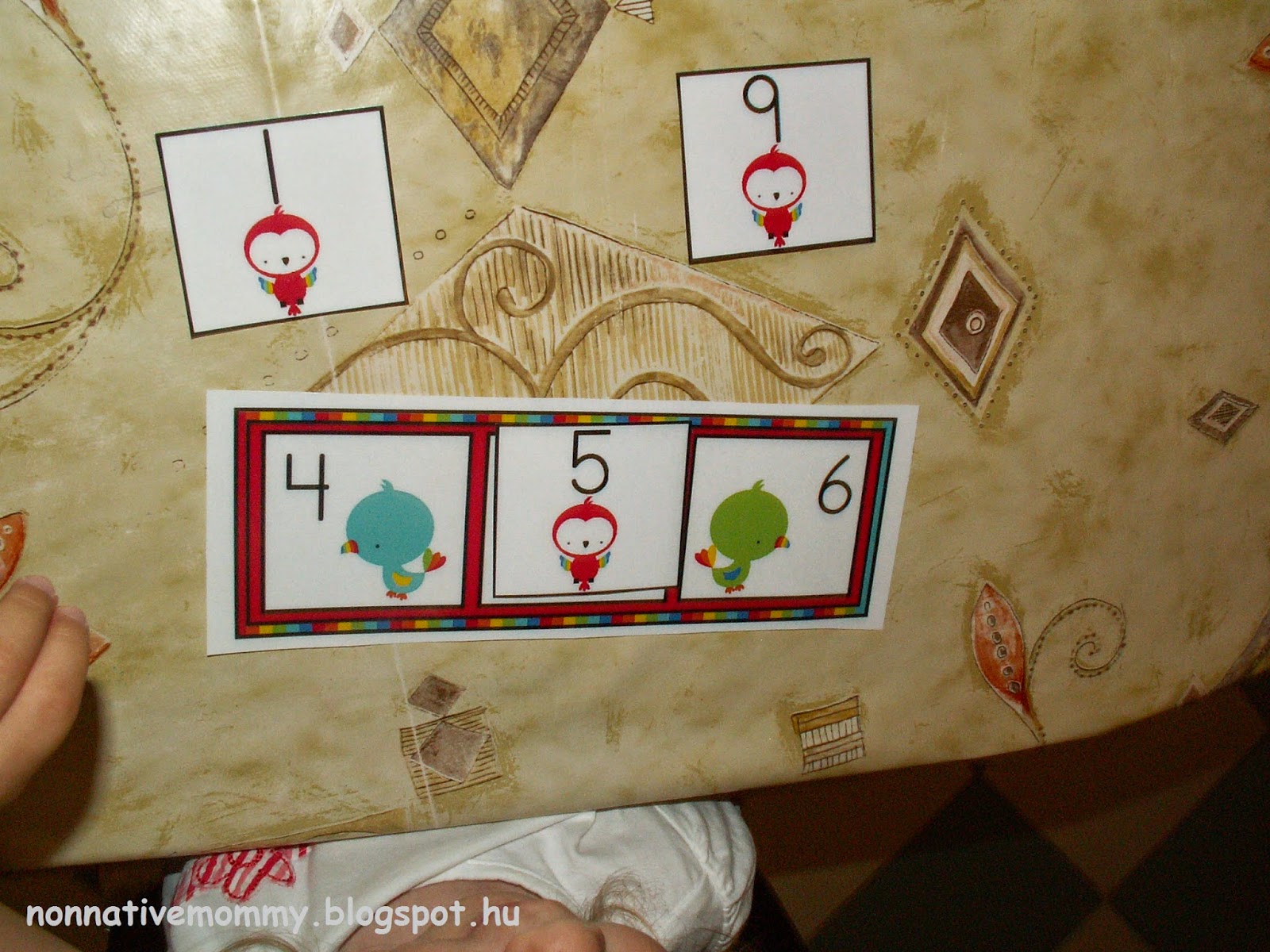
What’s missing?

I found a quite difficult number task on www.firstgradebrain.com. (I just checked the link recently and it’s not there anymore. Sorry. I’ve put it on my to-do-list to make an activity like this) What comes between? This task is more for 4-5 year old kids, but we gave it a try. I printed the sheets laminated them and at first I just put one task in front of her with 3 possible options that can come between the two numbers.

Easy-peasy lemon squeezy

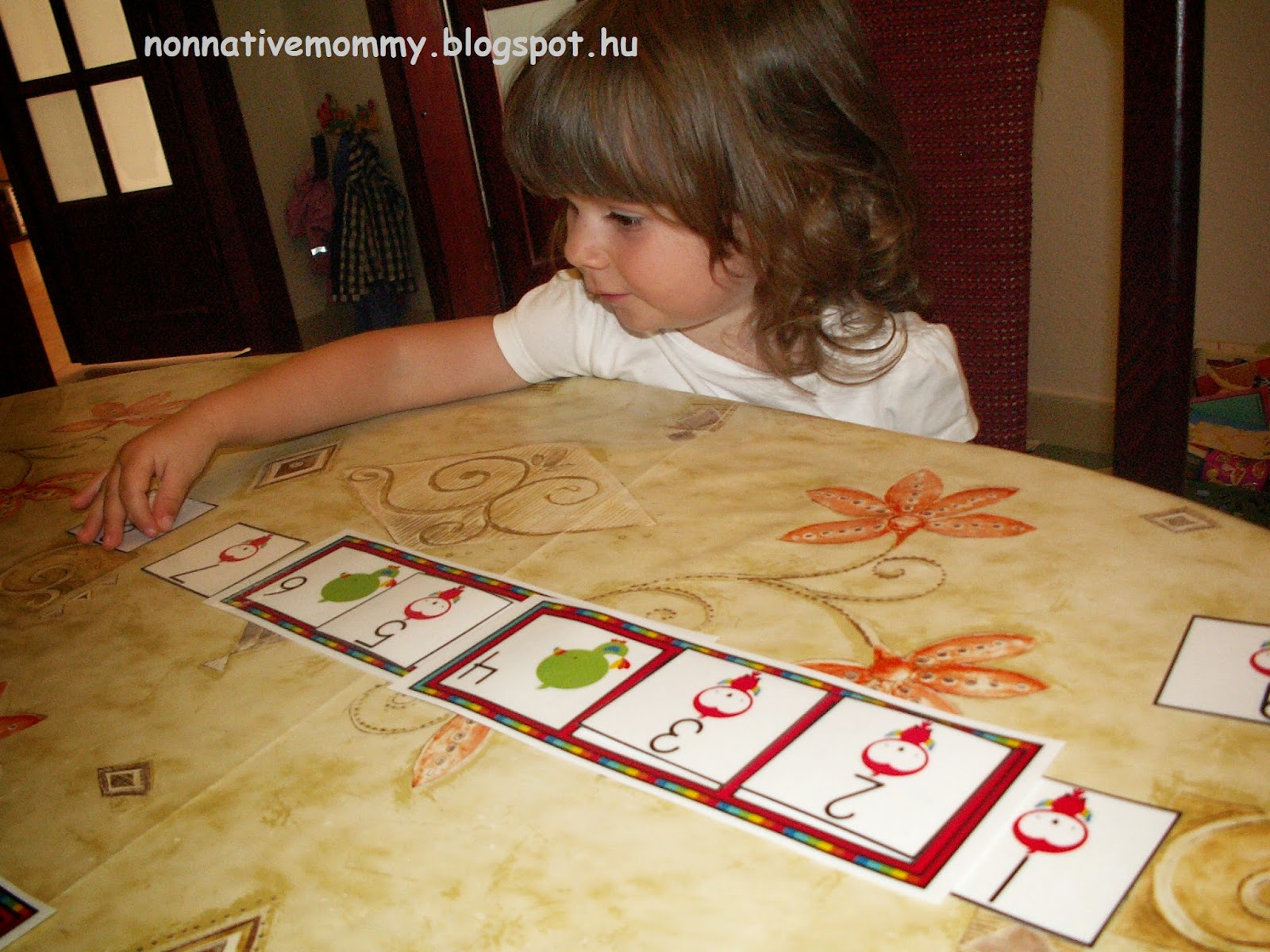
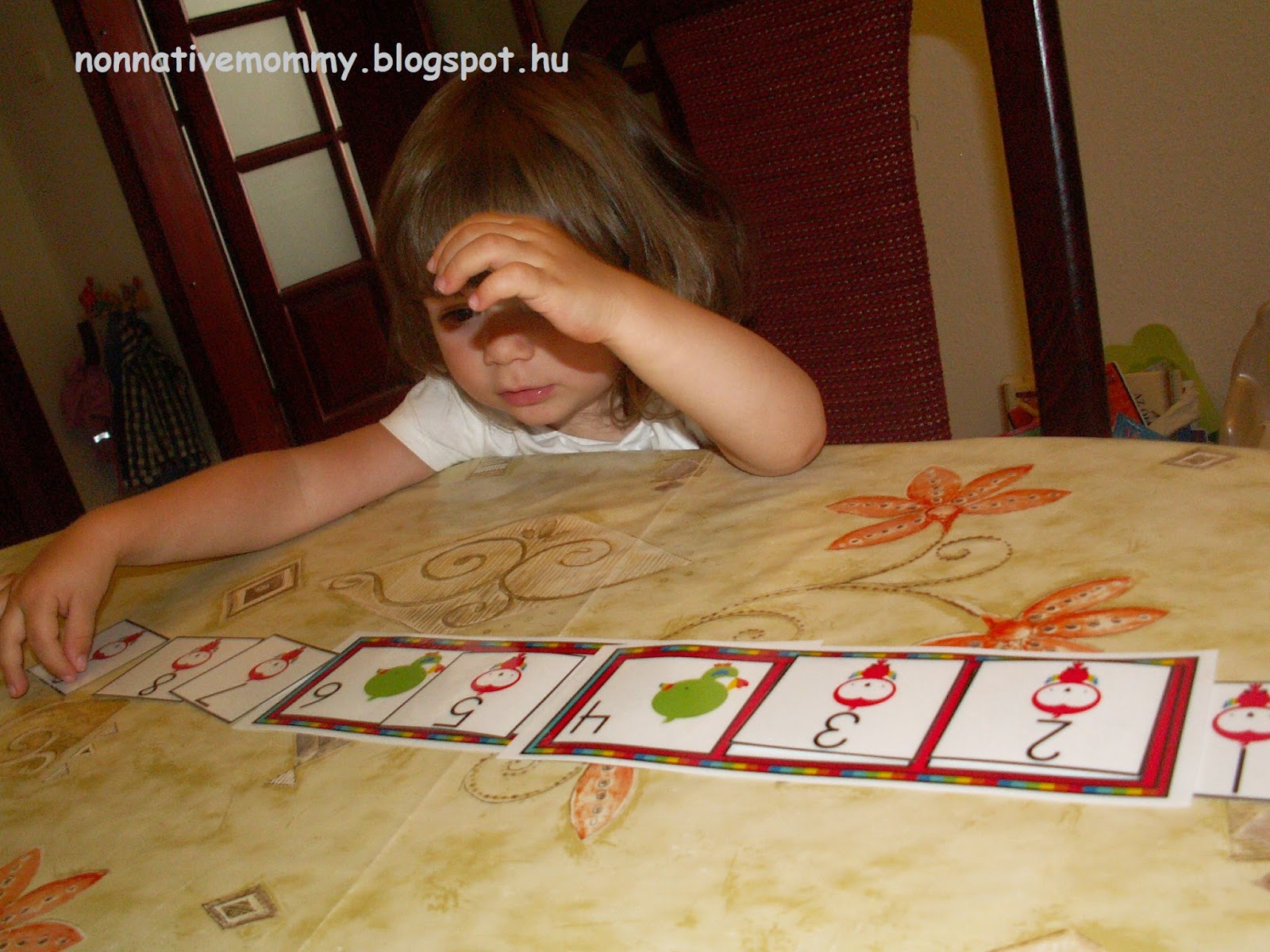
Much to my surprise it wasn’t very difficult for her. We did two more of this task then she started to order the numbers. All by herself.

There is nothing more to add 🙂

Ordering the numbers – Making big numbers

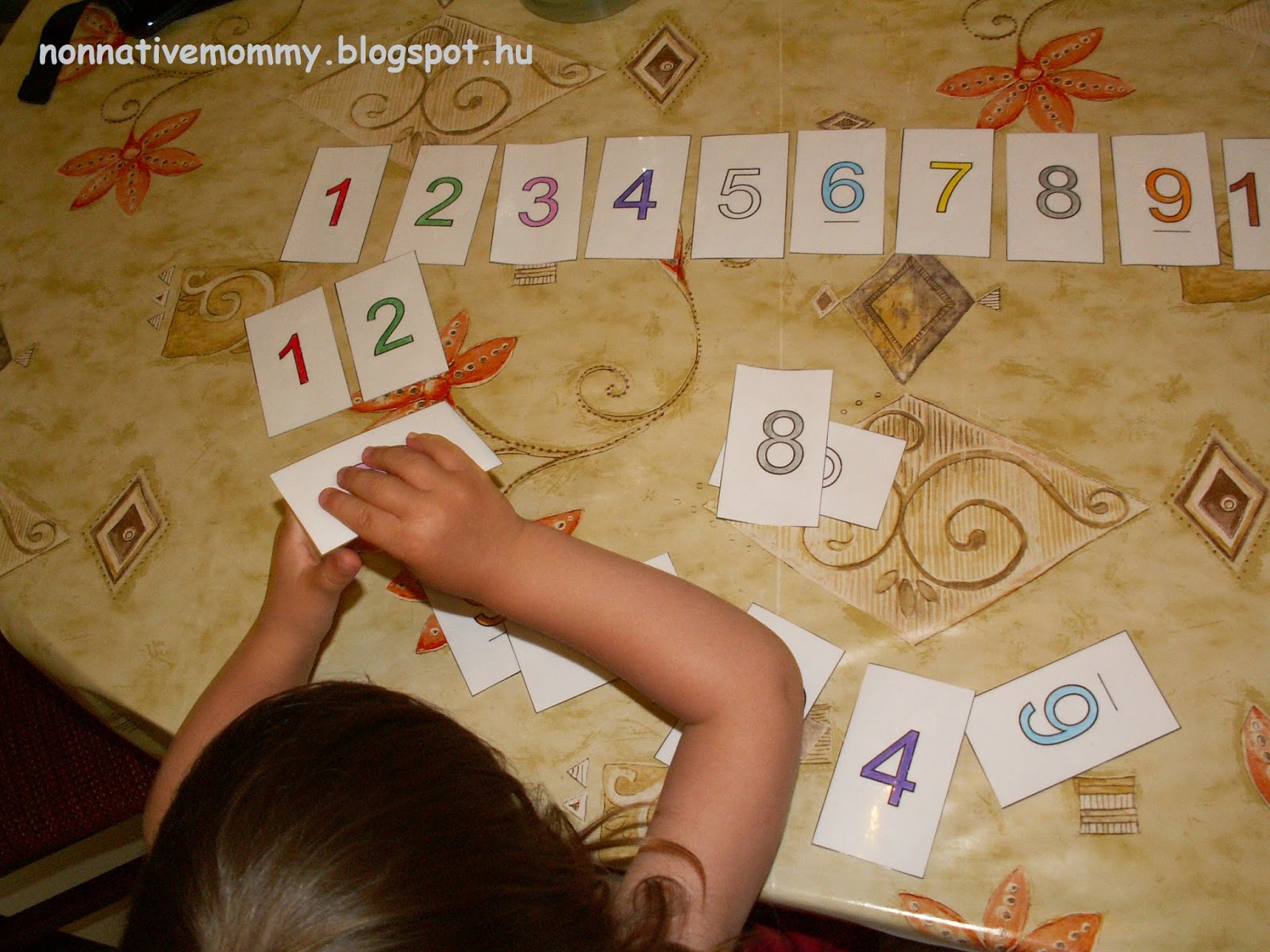
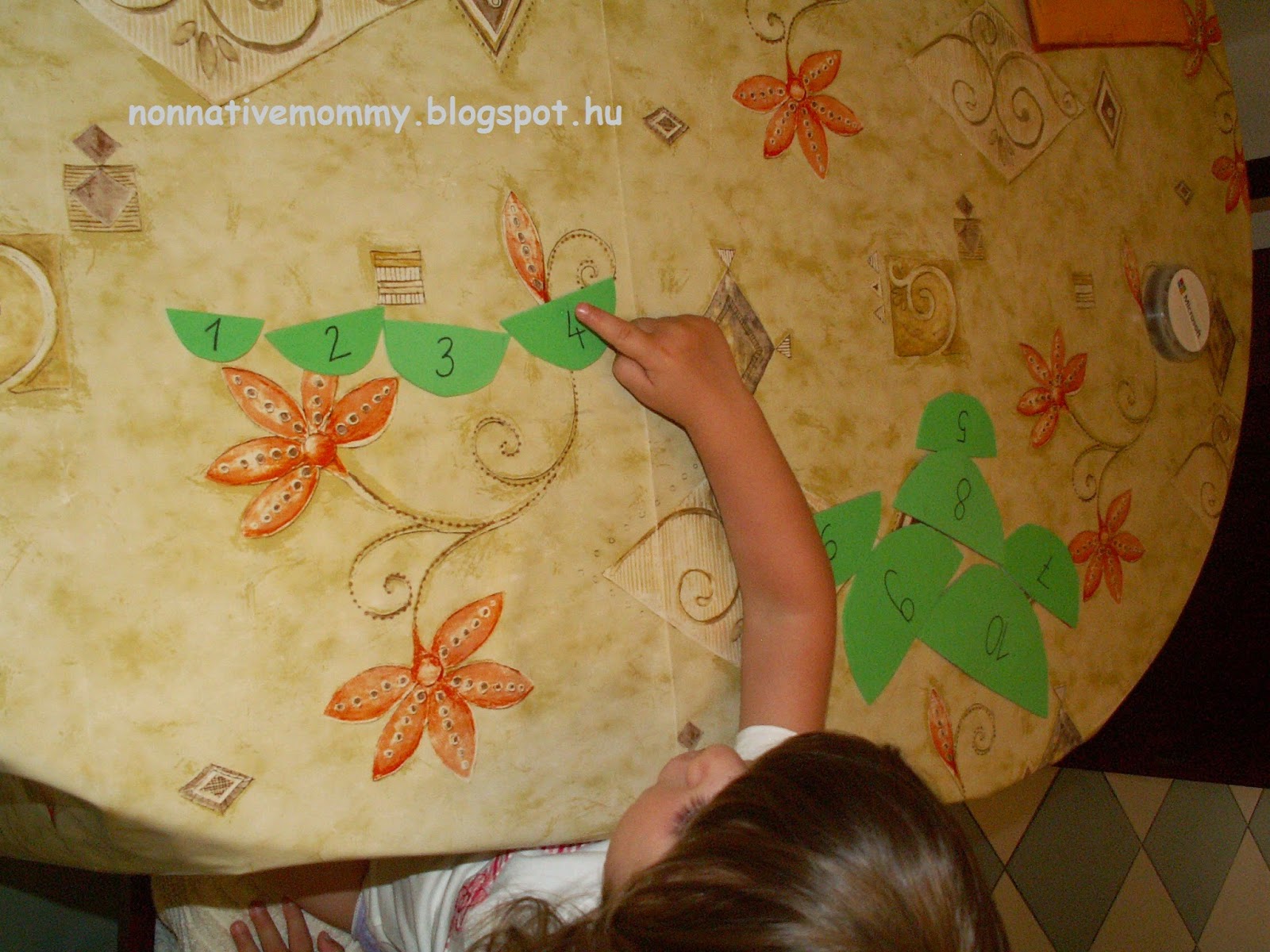
I printed the numbers from 1 to 10 in two copies. I coloured and laminated them and the fun could begin.

First, I put them in order, then she matched the other set.

We played a memory game with them. (There are ladybird stickers on one side of the cards so that you can’t see what is on the back)

I’ve found a match

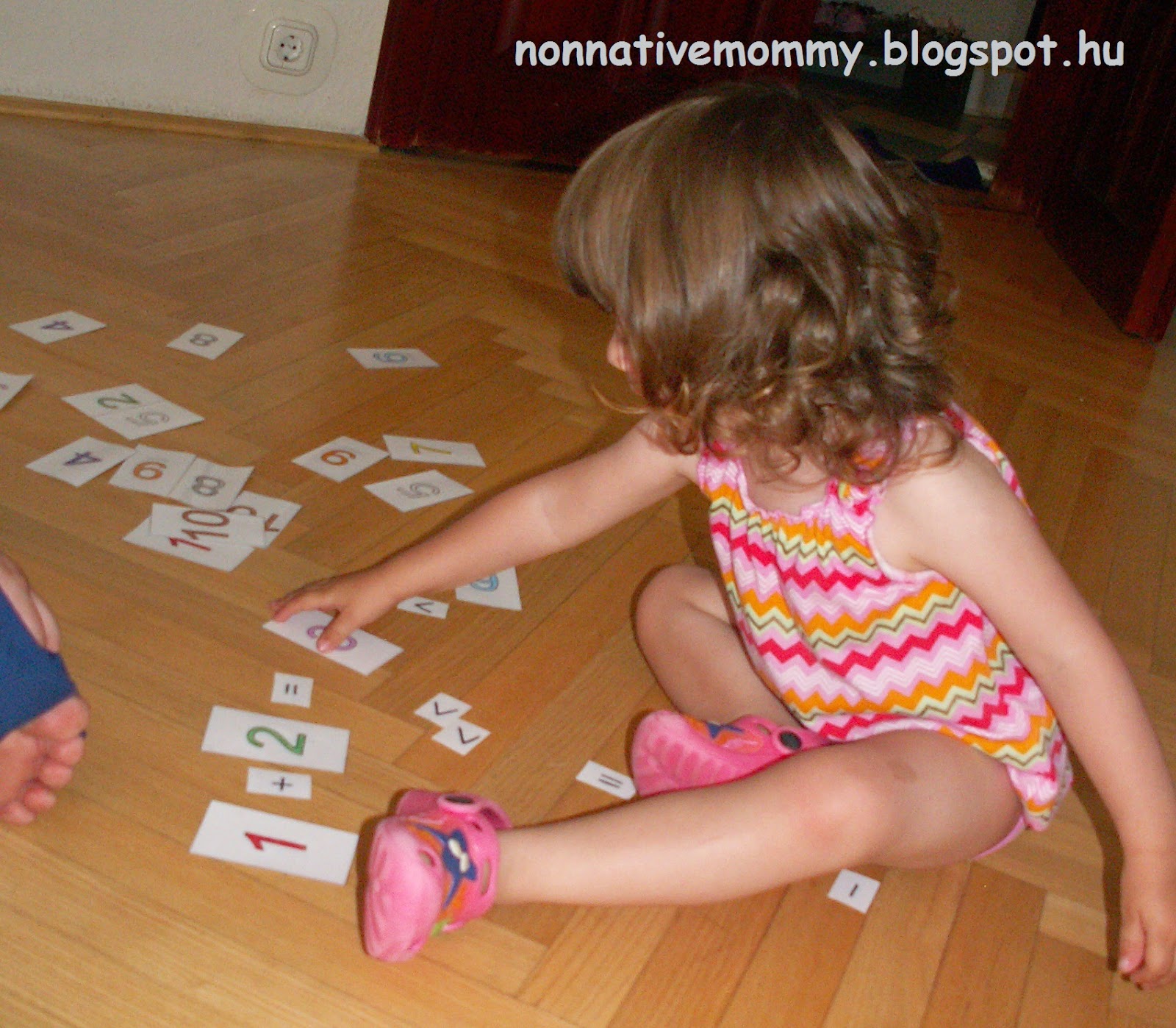
With these numbers, A., our British nanny, played another game. She and E. made big numbers putting the numbers next to each other.

110

And some basic additions.

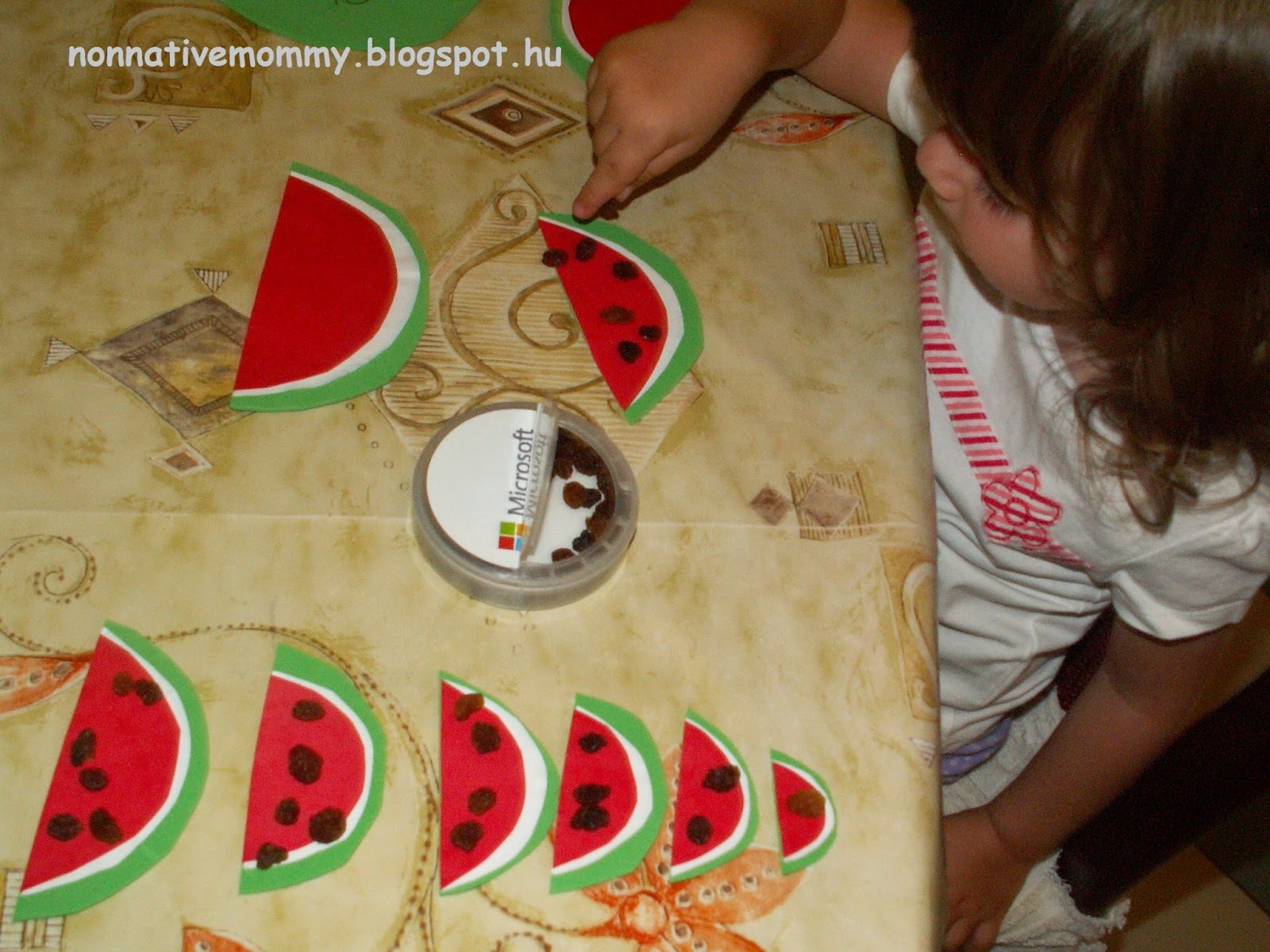
Watermelon seeds counting game

I used the watermelon seeds counting idea on Toddler Approved! which I really like following as they have great and easy-to-make ideas.

So I just made the watermelon slices out of a green foam sheet, a white and a red sheet. I glued the different coloured paper on top of each other.

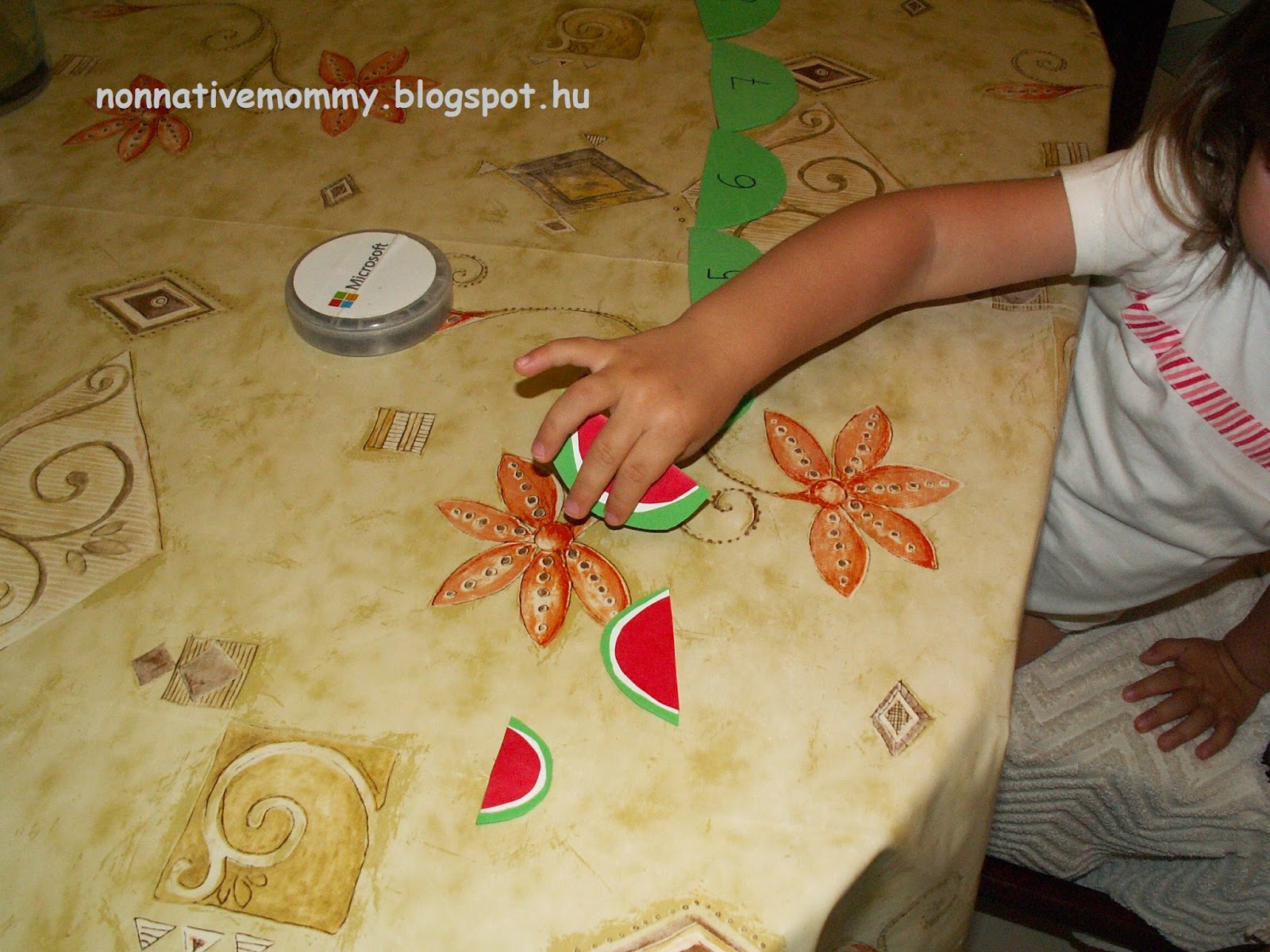
Turning the slices right side up

On the back of the slices there are the numbers written. (the slices deliberately grow in size from 1 to 10 so there is more room for the seeds and in this way we can put the slices in growing order.)

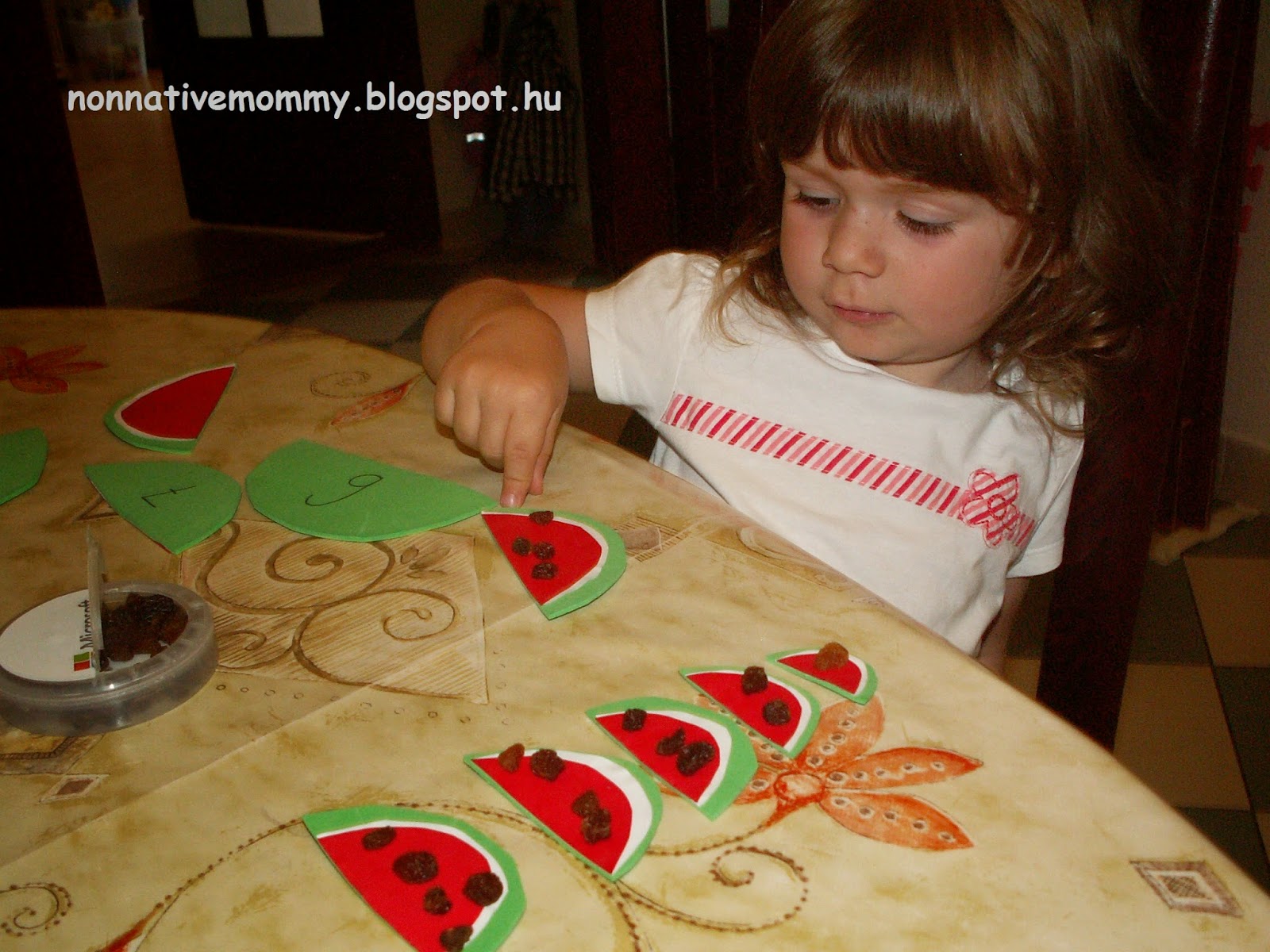
counting

I picked raisins instead of the chocolate chips recommended in the Toddler Approved blog post. Healthier and they do not leave a mark. I put them in a box and the counting started.

One raisin rolled down

We can do many other things with the watermelon slices:

  • put them in order according to the numbers (or backwards)
This is four, Mommy
  • order them according to their sizes
    1, 2, 3, 4, 5, 6 …
  • throw a lot of raisins on a slice and eat up all the “seeds” that are not necessary in order to have the number of seeds on the slice as written on the back
    yummie
  • explain how to eat up all the raisins to someone who does not know this game

Number stickers – Helping Little Mole build a house

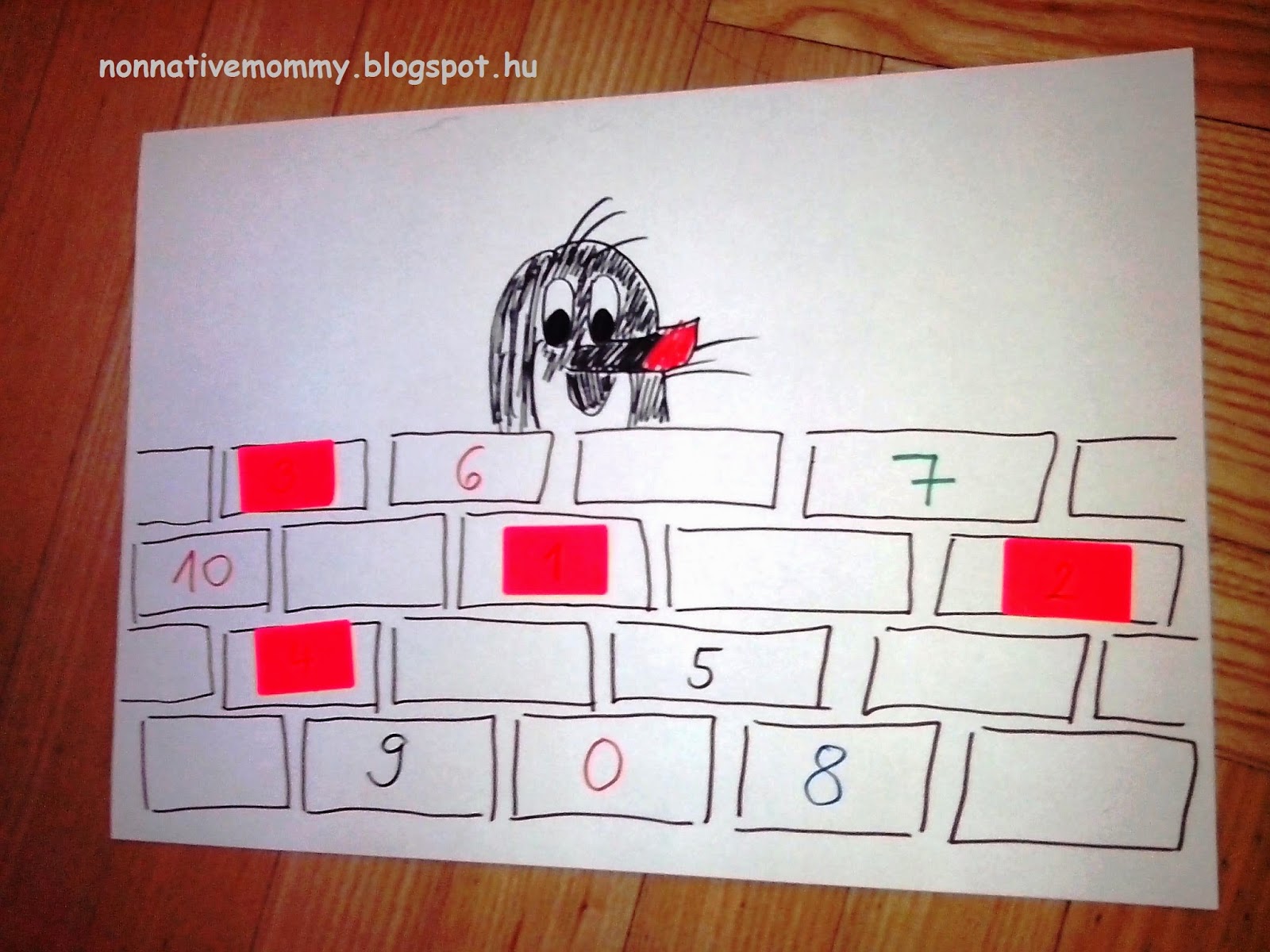
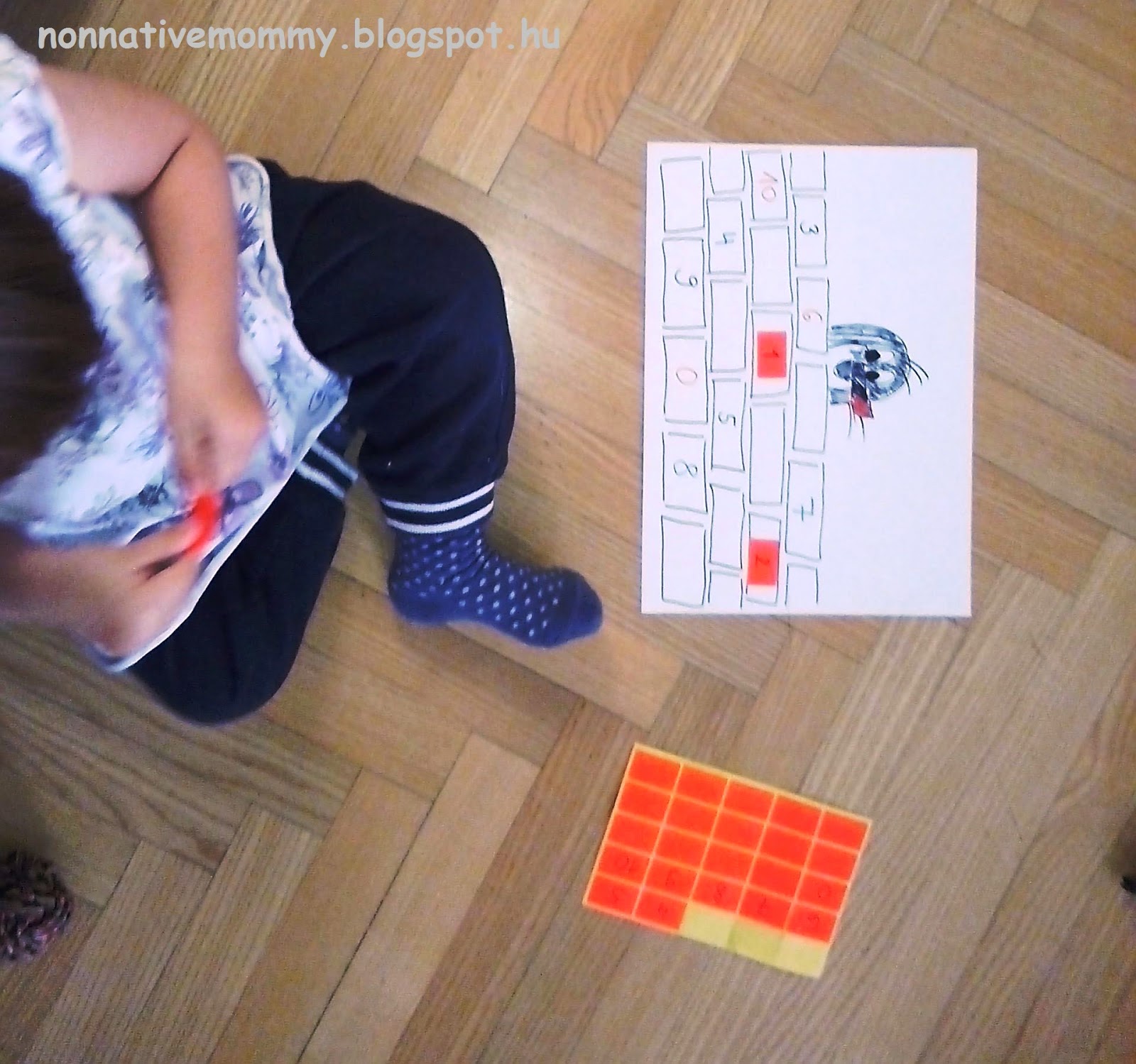
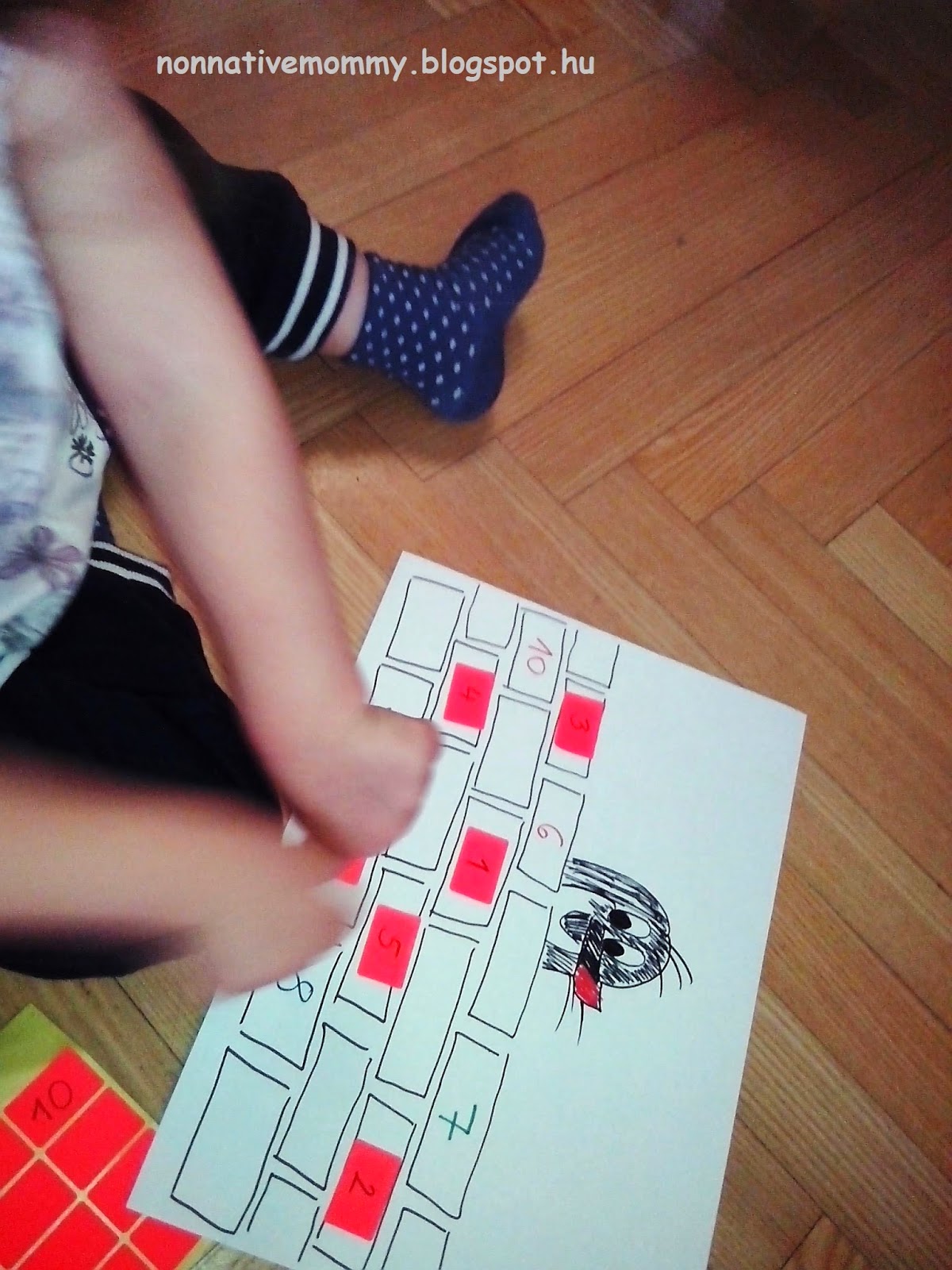
I drew a brick wall and Little Mole’s head on a sheet of paper. Some bricks had the numbers on them from 0-10. On rectangle shaped empty stickers I wrote the numbers from 0-10. E. had to build the wall putting the stickers in the right places, on the matching number. She filled the empty bricks with empty stickers. (Sorry about these photos, they were taken by my mobile.)

(You can buy these stickers at a “one euro shop” – well, in Hungary at the Chinese markets or shops)

This idea has endless varieties: with the ABC, with big numbers, matching animals, clothes, everyday objects, playing with the colours, copying patterns etc. If you have any idea how to expand this game share it with me in the comments.

Books – some fun books to finish with

Dora the Explorer – A Birthday for Boots (By Scholastic)

In this Dora book, she and her friends buy some goody bags for Boots’ birthday party, but Swiper always takes away one every page.

I bought this book when E was just 1 year old and she loved looking at the pictures. You can talk about a lot of things in the pictures. There can be a lot of counting (goody bags, candle sticks, balloons etc.) but also naming objects connected to a birthday party.

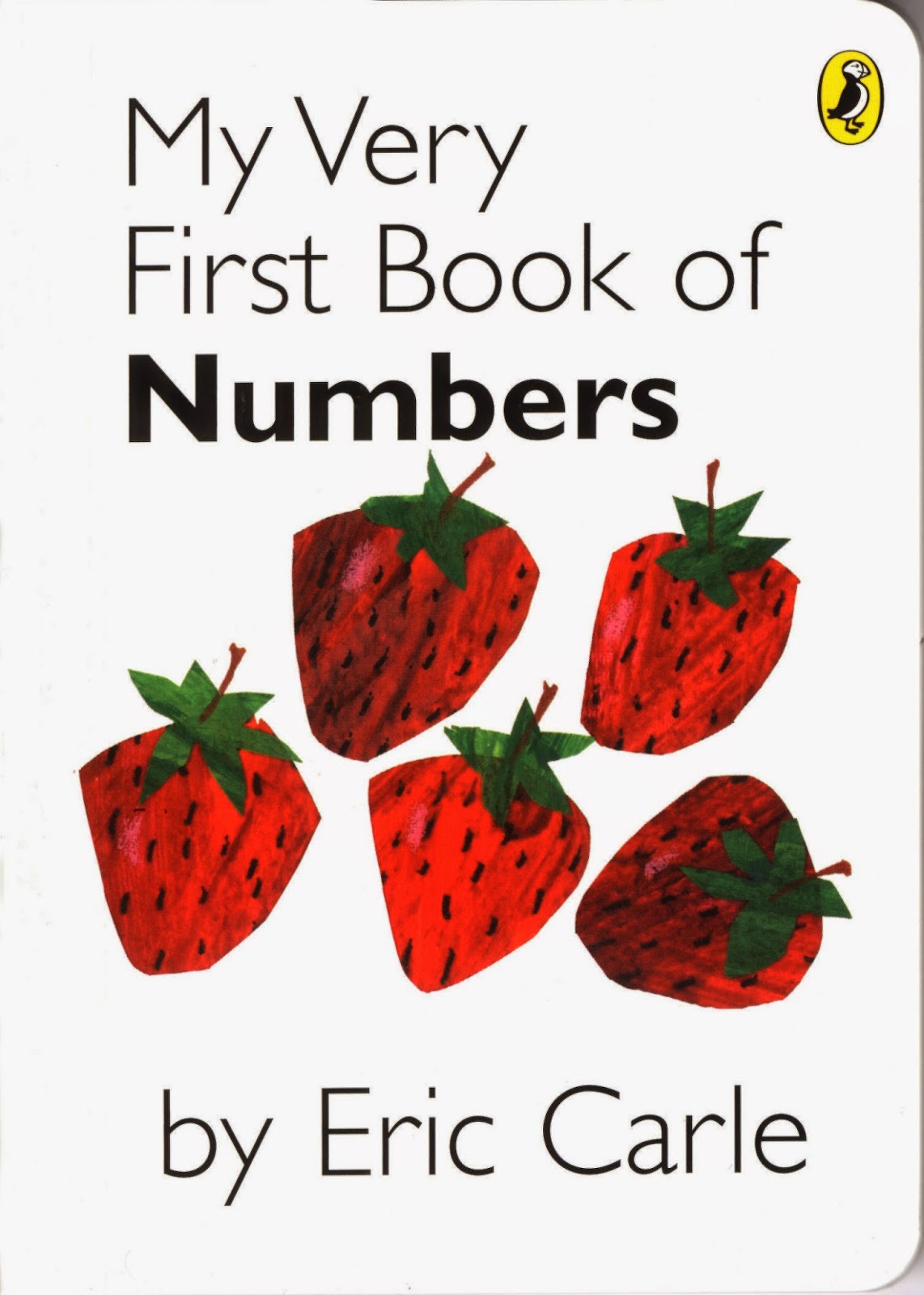
My very first book of numbers by Eric Carl

This book is divided in two parts horizontally and your child needs to find and match the fruits in the bottom part with the numbers (written in numerals and also represented with black squares). As E. has passed two years old, she doesn’t need help, but around last Christmas when she got this book she needed help with the page turning and matching.

Flip me! Counting 1-10 (By Buster Books) You can read the full review of it here. I’m quoting just the essential part of it:

“Counting 1-10 has pages divided into two panels, which kids can rearrange to match. One side has photographs of objects to count <dolls, dinosaurs, sand toys, cars etc.>, along with words identifying the number and name of the object; the other side shows the numerals from 1-10.”

Once we took this flip book on a longer car journey. While she was looking at it, E. threw up. Use it some other places. It’s quite nice.

As numbers and counting are in E’s focus, I’ll come back with some more number games in the near future.

Numbers I. – The bottle cap calculator

We’ve been playing a lot with numbers recently, so here is the first post about a calculator that is very easy to make and fun to practise numbers with.

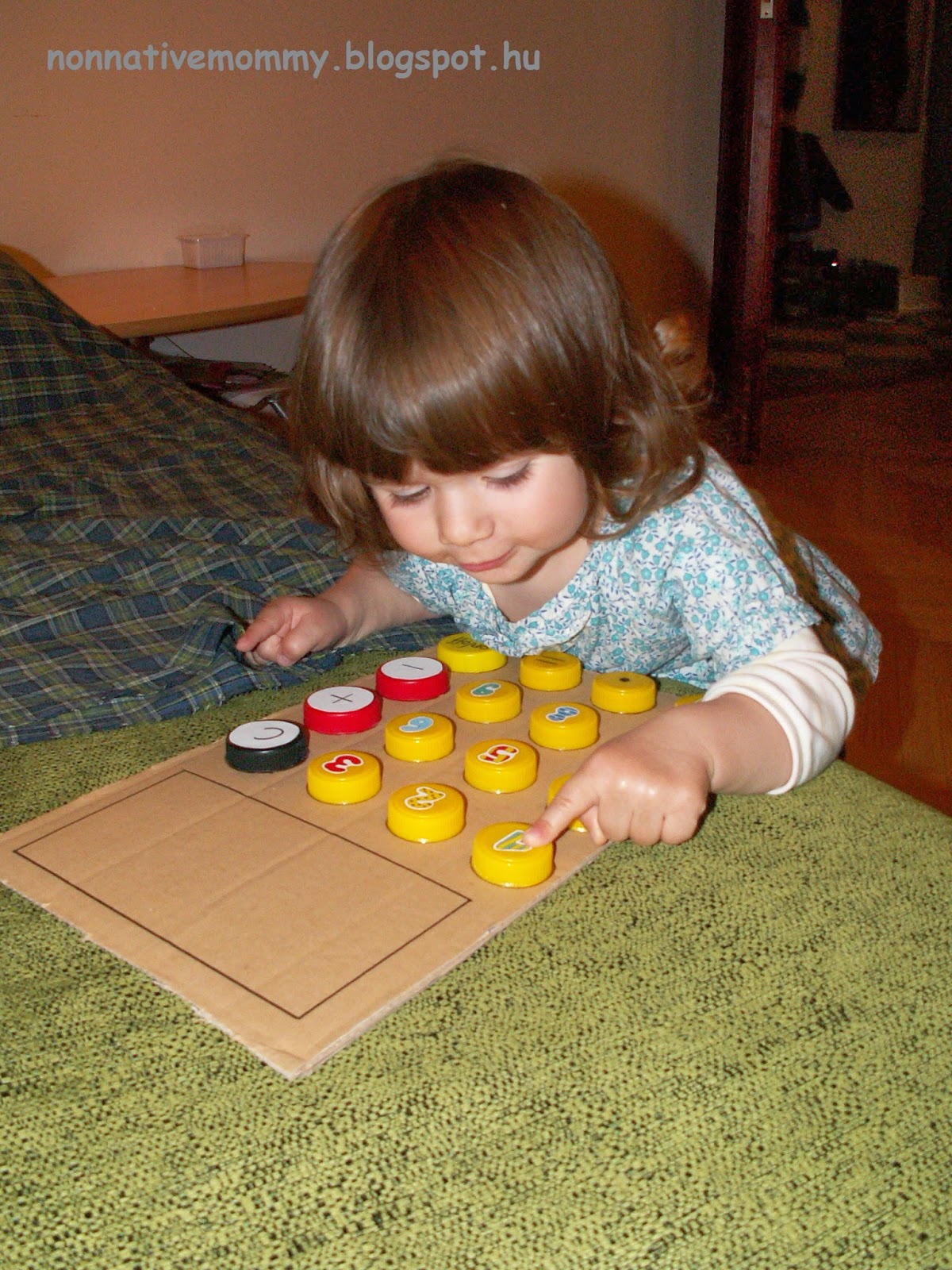
I found this idea not long ago on another blog: Learn with play at home. And I decided to make it as E. LOVES playing with calculators. Sometimes she asks for it and pushes the buttons for 15-20 minutes all by herself saying the numbers and signs (both in Hungarian and in English).

The first calculator was dropped so many times its display went wrong so we bought another, more simple one.

My idea was that she could have her own calculator that suits her little fingers.

tools

 What you need:

  • cardboard
  • 16 bottle caps (in my version)
  • scissors
  • superglue (dries withing 10 seconds)
  • markers and/or number stickers
  • ruler
  • a white sheet of paper
How to make it:
  • cut the cardboard (first arrange the bottle caps to see how big you need to cut the board)
  • stick or write the numbers and other signs on the caps
  • draw the display with the help of the ruler and the marker
  • glue the caps on the board
Sticking the caps on the cardboard is tough. I used superglue as the edge of the caps were very thin and I wanted them to dry quickly. (After few minutes of playing one of the caps came off, so this might not last as long as I wanted)

final result

The page I find this idea on also adds an extended version of the calculator game for those who have started learning to write. I’ll introduce it later if E. still wishes to play with the bottle cap calculator.


Now she is enjoying it a lot.

I managed to record a video too, but it is too dark. If you have any ideas how to lighten it let me know and I’ll attach it.

——-***——-***——-***——-***——- 27/03/2014——-***——-***——–***——-***——-

I’ve been trying to lighten the video but I couldn’t. Here is the dark video anyway.
But I also recorded another one with our native nanny today. They are playing with the new calculator.