Our daily activites – mornings and changing table time

When E. has woken up in the morning and I go into her room singing the following song while pulling up the blinds:

Good morning, good morning, good morning to you
Good morning Ms E…. cock-a-doodle-do
Good morning, good morning, good morning to you
Good morning Ms E…. cock-a-doodle-do
Cock-a-doodle-do, cock-a-doodle-do
Good morning to you.


In the original song there’s Mr Rooster, but I changed it to Ms E.’.
Even if D. goes in to her first he sings this song too. Though he continues talking to her in Hungarian.

If E. wakes up late and D. has already gone to work we start the whole day in English. So, for instance, I change her nappy and night clothes while talking in English to her:

  • asking about what she dreamt (I always wait a little for her answer)
  • what the problem was during the night (if she was up)
  • tell her milk is on the way
  • while changing the nappy we have a rhyme that I always chant several times:

    Baby’s got a dirty nappy
    What shall we do? (What shall we do?)
    Clean it up, clean it up
    For Mommy and for you

    She likes it a lot and smiles, what’s more, stays on her back patiently instead of turning onto her tummy or standing up. The rhyme is from here. You can find other games you can play, songs or rhymes to chant while your baby is on the changing table.

  • we play peek-a-boo with her textile nappy (I cover her with the nappy then ask “Where’s E.? Where’s she gone?” then she takes the nappy off – or I do it) “I see you.” or “There you are.”. Another variation is I hide behind her feet and ask “Where’s Mommy?” or “Where’s Mommy gone?” Then I open her legs and say: “Here I am” or “Peek-a-boo”
  • there’s a shelf over our changing table and at the bottom of it I stuck up wooden, painted animals, so I name them, make the sounds they make, or sing a song about them. E.g.:

    Ladybird, ladybird fly away home,
    your house is on fire, your children are gone
    All, but one her name is Ann,
    and she has crept under a frying pan.

    (I couldn’t find the tune online,but I’ll link it as soon as I do or please put it in a comment if you know where to find it)

    or

    Five little ducks went swimming one day
    Over the pond and far away
    Mommy duck said: quack-quack-quack
    But only four little duck came back

    Four little ducks went swimming one day
    Over the pond and far away
    Mommy duck said: quack-quack-quack
    But only three little duck came back
    (on the changing table I usually start with 3 ducks and by the time I finish changing the nappy or clothes we’ll get to the end)

  • still on the changing table we play “This little pig went to market“. E. likes this most on her toes. I grab each of her toes on one foot one by one and wiggle them a bit as I say the rhyme.

    This little pig went to market;
    This little pig stayed at home;
    This little pig had roast beef;
    And this little pig had none;
    This little pig cried, “Wee, wee, wee!
     All the way home
    . (I tickle the bottom of her foot)

  • While I’m putting on her clothes I usually name her body parts and what clothes go where:
    “Here’s your left arm, it goes into this sleeve”
    or
    “One foot goes into the tights, then the other foot goes into the tights” etc.
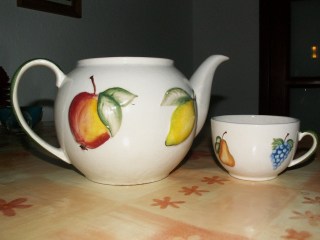
  • at the breakfast table we play with the coffee cup and the matching teapot. Both have four fruit on them and I name them; she loves the grapes and screams with joy when we get there. And of course, we can’t miss singing “I’m a little teapot” (4 or 5 times – in fact, this is MY favourite song)
  • E. didn’t use to like brushing or combing her hair, but when we sing along she enjoys it:

    This is the way we comb (or brush) our hair
    Comb our hair, comb our hair
    This is the way we comb (or brush) our hair
    Every day in the morning
    (I sing it twice as she expects me to comb my hair too)

  • she often watches me brushing my teeth while she is sitting in her high chair after breakfast. Then we brush her teeth (or rather she just plays with the toothbrush) and I sing “This is the way we brush our teeth” (same as the combing song, the tune has several verses – see an example here )
  • she sometimes watches me clear the breakfast table. I always tell her the name of the objects I put into the dishwasher, and I also tell her what I put into the fridge (the latter is more fun for her as I see because of the colourful things she can have a look at)
  • if E. is whiny in her high chair then I put her into her playpen where she plays alone. This is the time when she listens to her collection of music (compiled from youtube and added the Helen Doron songs). In the meantime I can do some housework.

Yeah, I sing a lot and keep talking all the time. Sometimes by the afternoon I can hardly talk, am totally tired of speaking, not to mention singing. Thank Goodness for coffee. It always gives a little energy back.

When we have our Hungarian sessions we do more or less the same. The morning routine is the same, the games are the same, only the songs are different. Sometimes I sing the combing/teeth brushing song or “I’m a little teapot” in English as I don’t know any good Hungarian versions of them.

    MAKATON – sign language

    M., who I met on the facebook, in connection with MEC, advised me to have a look at the MAKATON signs that she uses with her daughter to connect the two languages. No matter which language you use, use the same sign for the same thing, so the child can learn to connect the meaning. You can find out your own signs as well, or do a signing course in Hungarian. I don’t want to recommend any courses as we didn’t take them. Just google it: baby sign language course Budapest.

    Here are some examples, signs we use on a daily basis:

     
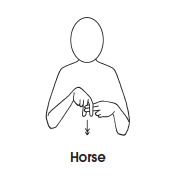
    Though we sign the horse in a different way:
    You can find more signs here.

    You can also learn from a special BBC programme for kids with special needs. The programme itself is called Something Special.
    Each programme sees Justin and Mr Tumble (played by Justin) out and about applying signing in a variety of places. Topics covered include babies, pets, toys, weather, clothes, shops, food, all about me, where I live and colours. Mr Tumble always dresses up, wearing brightly-coloured clothes and even big shoes! He moves around clumsily and has lots of fun.

    The language used throughout each programme is supported by Makaton signs and symbols and is designed to be understood by children in the early stages of language development. (source: BBC – Something Special )
     
    Full episodes are 15-20 minutes long. What I did with this programme is that I watched them one by one on youtube and made a playlist of what I needed (20-25 videos). I learnt the signs (they are very straight forward and easy to learn) and started using them both in English and in Hungarian (same sign for the same thing). E. was 6-7 months old when I introduced signing to her. (4-5 signs at a time. When she was familiar with these I introduced new ones.) Sometimes I picked a short part of an episode (max. 5-6 minutes long) and we watched it together. This could have begun earlier as well. But never cry over split milk.

    Here is the first video I saw and really was fascinated by it:


    I don’t do the signing all the time only if E. is not paying attention or I really want to link a new expression in both languages. Most of the time signing draws her attention. In the next post I’ll write about some songs which can be followed with signing. It’s a hit with kids. They love it! You’ll love it too.

    From birth to the 6th month

    As I have already mention my determination to raise a bilingual child didn’t realise at the very beginning. I did it half-heartedly after E.’s birth. I was singing a lot to E., who really enjoyed it, more than the Hungarian songs. She calmed down more quickly when I sang two of the songs: Lavender’s blue dilly, dilly and Hush little baby. So there was time when she couldn’t calm down and I was singing these two songs for 30-40 minutes without any break.

    During this first period I started to read books on the topic: Make your child multilingual by Silke Rehman and 7 Steps to Raising a Bilingual Child by Naomi Steiner and I found both of the books very supporting and practical, still they don’t deal much with a totally monolingual environment, where the second ‘mother tongue’ is a learnt language for the parents, and it’s the parents decision to raise the child bilingual. They mainly focus on mixed marriages, where one parent speaks a language and the other speaks a different one, or monolingual families living abroad and the countries language is the dominating one. Both books  discuss more or less the same topics focusing on determination of the parents, the consistency and a flexible plan. I do not want to go into details and give a review as I’d like to concentrate on what we actually do in our everyday life, but definitely these two books were really good theoretical and practical basis.

    The authors emphasise the TIME factor a lot; how much time is spent on the languages. They recommend 30-40 percent of the child’s day to be spent on the minor language, which is English in our case.

    So I “wasted” the first 6 months. If I could start it again I would speak English to E. from the very beginning in a natural way as in Hungarian, but I did not. So she heard natural spoken English every now and then for 6 months. The positive side of it is regularity, which is also a very important factor. Every day I sang songs for her or told her rhymes no matter how our days were going.

    Around the 3rd month we started to watch videos on youtube, though only for 5-10 minutes per day. I know there are a lot of different views on the topic (whether to let a baby watch moving images at this early age or not, but I found 5 minutes per day won’t do any harm. According to some viewpoints, moving images have a bad effect on the child’s brain, imagination).
    She liked watching these videos so slowly we increased the time for 10-15 minutes per day until the end of the 6 months.

    The following videos were and still are her favourites by KidsTV123:
    The Animal Sound Song
    The Shape Song
    Red Rabbit Green Gorilla
    Phonic song
    Twinkle, twinkle little star

    Of course, the list has grown by now but I’ll write about it later.

    We usually watched the videos 2 or 3 times a day for 5 minutes each occasion. When E. got whiny it was a great way to refresh her, or keep her busy when she was a little bored. From one week to the other she enjoyed it more and started to smile at the characters. She also recognised the song when the first image came up or the song began.

    In this period my main focus was on fun and regularity. We didn’t overdo it, just enjoyed being with E. and see how her intellect opens up.