Helen Doron Baby Days

We took part in the so-called baby days at Helen Doron Language School. During the summer holidays (in July and August) a one-week intensive course (in both months) is organised by the school not to waste the whole summer.

This month we participated in the first 3 days only, as our native nanny comes twice a week now (Thursday and Friday mornings). I wouldn’t like to miss her.

The baby days are different from the usual course. The days are organised around a topic or more (because of the revision). There were two moms and their little ones from our group and 5 other kids (aged about 1,5-2). The 9-o’clock start was a little rough but we made it.

First day:

The colours and shapes were introduced, (or for the bigger kids) practised during the lesson. So all the toys and games were played focusing on the basic colours: red, blue, green, yellow, white, and much to my surprise, purple and orange.
There were colourful flags, a new colour song (Colours for everyone) and of course, the old songs as well (Waving song, Uppety song just to mention one or two). The colourful balls also came out of the box, much to E.’s delight, not to mention the building blocks (together with the Stacking song), though E. can’t really build yet, but destroy.

I would like to emphasise one of the activities that E. liked the most and I’m planning to make it for her. Matching colours activity: pieces of coloured paper are cut, laminated and a piece of Velcro is stuck on the back. Kids need to stick the right colours to their places on a sheet of paper where the colours are signed. I’ll attach a photo to the home-made tools post as soon as I make it.

Second day:

The colours and shapes were revised a little bit (the best game was colouring shapes with baby paint or crayons – see the picture above – that we could take home) and then means of transport were introduced: cars, trucks, buses, tractors, aeroplanes, wagon, bicycle (I didn’t really understand why we didn’t use bike instead of bicycle or plane instead of aeroplane)

Again there were a lot of moving around (with paper plates that have cars, trucks or buses on them – we were imitating driving them)

Third day:

Daddy took E. to the lesson where, apart from the previous days revisions (shapes, colours, transport), there were some coloured paper planes to fly through a ring and numbers were covered as well (counting pegs etc.) . There was a new song: Elephant song also connected to counting up to 5. Alas, Daddy could not remember all the details of the lesson, so that’s all I know about it.

All in all, these three days were fun, the only drawback was that we were too many (8 moms with 8  kids). However, I think we are going to pay for the next session in August, too.


Potty training

Potty training gives us another chance to widen our vocabulary and we can make it fun (in English) for E. to sit on it.
Potty place

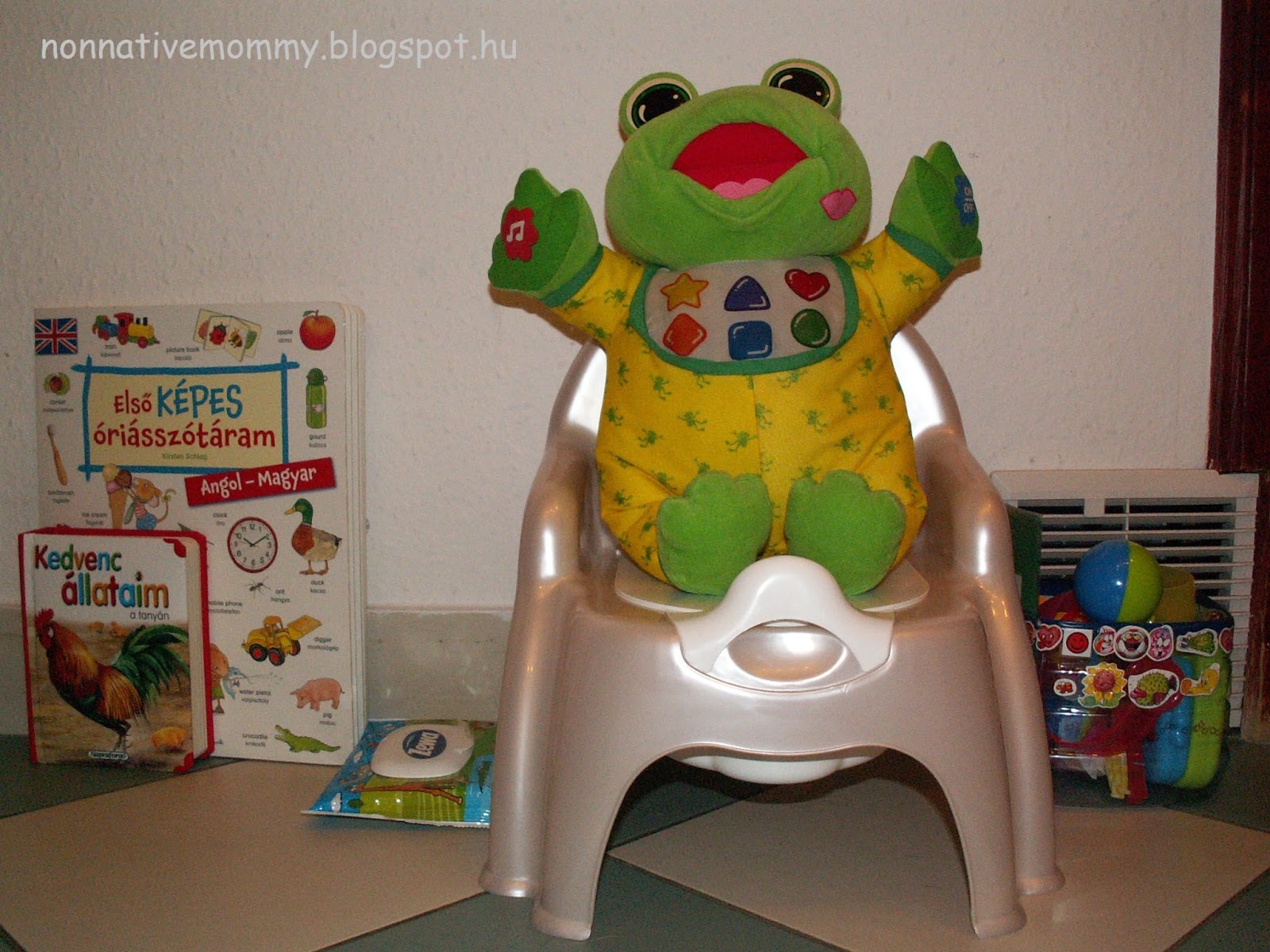
For her 1st birthday E. got a potty from I. Granny. I thought it was a little early to start, but as soon as she got hold of the potty, she sat on it swaying her legs with a wide smile on her face. So this was a sign she is open to sit on it at least. I assigned an area for the potty and made it into a fun place as you can see below.


I was lucky as after a few goes she peed and after a week she also pooped into the potty. But it takes time to sit and wait for the outcome, so while she is sitting on the potty I’m next to her and entertain her both in English and Hungarian, depending on which day or which time period we are in.
These toys and books can be played with when E. is sitting on the potty, so when she goes there to play, I put her on the potty. Then comes the potty song. The tune is the same as Twinkle, twinkle little star and the lyrics:

Tinkle, tinkle little tot,
Now you sit
upon the pot
Any second you will see
Sprinkle, splash as you go pee
Tinkle, tinkle little tot,
Now you sit upon the pot
(I found it on baba-angol.hu, but I couldn’t link it properly for some reasons)

While E. is sitting on the potty we are looking at the books. Sometimes she points at a picture and I say the name, but nowadays if I ask: “Where’s the teddy?” or “What’s this?” She can point or tell me the thing I’m pointing at.

The following words she can say from the books:

 
English:                                       
apple
pear
nana (banana)
tick-tock (clock)
teddy (plus showing the sign)
ant
baby
ye (yellow)
blue
teeth
head
bread
red
ack (black)
book (plus showing the sign)
duck
neigh (horse)
mun (monkey)
bib
tree
meow (cat)
coocoo (pigeon)
baa-baa (sheep)
dod (dog)
eat (plus showing the sign)
 
Hungarian:
eper

inni

még (shows her self-created sign)
ebből (picking which bottle she wants to drink from)
dinnye
apa
anya (said first on Father’s Day – ironically)
Mana (our dog)
éni (én is – me too)
i-á (for the donkey)
légy (fly- her favourite animal)
hinta (and she starts swinging)
kicsi (said only once)
pá-pá (waving goodbye when we finish with the book)
bé (béka – frog)
She can point at several other pictures if I say their names. What we often play is that she chooses two or three pictures and she points at them one after the other and I say their names (or if it’s an animal I give the sound they make). She enjoys it a lot and points at the different pics faster and faster, then laughs out loud.
 
Other activities:
 
When we have finished with the books, we can look at flash cards (I change the flash cards – 5 at a time – every third or fourth day). We have a lot of animal cards, as E. is crazy about them, but I also made some fruit, vegetable and flower cards too. I’m in the process of making body parts, musical instruments and colour cards since she is starting to be more and more interested in them.

Another great activity she loves playing is counting the clothes pegs. Actually, I saw the Helen Doron teacher using pegs during the lessons and E. liked it a lot. So I put five pegs of different colours in a plastic cup and we count them or I name the colours then E. repeats them. The same goes with the plastic bottle caps – in the name of recycling. Yellow is her favourite colour. It’s hard to take it away from her when we have finished. When D. is playing with E. on the potty, he shakes all the five caps in his big hands, then spread them on his palms and E. has to point at the colour D. is saying. It’s also quite enjoyable.
 
Potty toys
As you can see in the picture above, we have some musical instruments and a toy mobile phone, a FisherPrice Frog  which sings English songs if you push the flashing shape on his tummy and a peek-a-boo doggy. (The mobile and the frog are from a secondhand shop for half the price of the original) Well, I won’t go into details in connection with them. Use your imagination. 🙂
 
You can put ANYTHING next to the potty to play with. These are just a few ideas. Our only rule is that she can play with these things when she is sitting on the potty (both in English and Hungarian). But, to be perfectly honest, she sits there happily even for 10-15 minutes if she is in the mood to play with these potty toys. Sometimes I can hardly make her leave the place.
 
And a little extra: I believe in rewards. So if we find something in the potty after getting up, E. gets a sticker (you can see the plastic box in the top right corner with a lot of stickers on). In fact, she gets one sticker for pee-pee and two for poopy. Now she can (or at least tries to) stick them on by herself.
 
The box is almost full of stickers 😀 I need to make another one from a 5-litre plastic bottle.


Bilingual créche and nursery

We visited Mini Klub Bilingual Crèche and Nursery in Budapest, 4th district. We have it in mind that it might do good to E. if she is among other kids. As we wouldn’t like to decrease the amount of time spent on English, I checked what possibilities we have concerning a bilingual nursery. (I also checked the English-only nurseries but both they are far from us and their price range is high above what we can afford.)

Playground area

So I would like to share my experiences in connection with our visit.

D. took a day off and all three of us could go and visit the institution in the afternoon. The building itself is a detached house with its garden full of playground games (swings, seesaws, climbing castle, slide etc.). The gate is locked in order not to let in strangers and not to let out the kids. Kati néni opened the gate for us. She was very welcoming and kind. Inside we met one of the crèche nurses (her name I’ve forgotten). In the hall area you can take off your shoes. It’s all colourful and nicely decorated. Even if it is the entrance full of shoes and coats, it’s neat and well organised.

The crèche area (nursery for babies under 3) is separated from the nursery. There is a kitchen area where they prepare elevenses and afternoon snacks for the kids, or heat up the food they order for lunch. There are 2 playing rooms for the little ones (i.e. there are two groups), maximum 8 babies in each. The youngest child now is one year old (just like E.) as the nurse told us. The playroom is full of colourful toys (everything had been put back on the shelves and into cupboards as it was after 15:30 and all the babies had been take home already). E. started to cruise along the furniture and pack down the toys. She had a wide smile on her face. She felt comfortable immediately. And we, parents as well. We asked our questions and got very impressive and informative answers. Here are some of them which I found important to know:

  • every group has 2 nurses: one Hungarian-speaking, one English-speaking (still the latter is Hungarian nationality)
  • the English-speaking nurse communicates in English with the kids all day (food time, preparation for sleeping, potty training, activities etc.)
  • every day different skills are in focus (visual, musical, movement etc.) in both languages
  • English activities are in the afternoon (short ones in the crèche and longer sessions in the nursery) with a teacher who is specialised in kid’s English
  • there’s a native nurse in the nursery – the natives are there for 6-week periods – they are kind of trainee nurses (at the moment they have one from Australia) and spend time both with the little ones and the older kids too
  • they close only for 2 weeks in the summer

Of course, we were talking about food, and food time, sleeping time, arrival and departure, play time, potty training etc, but concerning the language development I found the information above  the most essential. You can find more information about other details on their homepage, or you can visit the after contacting the director via email.

We look around in the other playroom, checked what beds they use, we also saw the little toilets (which were very clean and the kids’ stuff in nice order). Then we had a look at the playground, and much to my surprise, the native nurse, who was sitting by the side of the sandpit where a little boy was playing, didn’t say a word to him. On the other hand, 2 little girls (4-5 years old) were playing in English, though there were no English speaking adults around them.

Our overall impression was great. They reacted at our enquiries very quickly, the staff are young, energetic and kind, with some elderly members – as the warm-hearted Granny substitutes. The atmosphere is cosy and relaxed, there is order and organised system. The English language is also in focus all day (though I can’t say it for 100% sure, only after E. has started going there). There are lot of other activities one can choose from (see also their homepage). Last but not least, their monthly fee is reasonable (basic price: 55 000 HUF/ month and 700 HUF/day for food plus extra activities – optional).

What we have decided to do is to wait one more year and from 2014 September E. will attend the crèche, first, one or two days a week, then slowly more. Then I’ll come back to this topic and share our experiences.

Books we are using

E. is extremely interested in books and  we, as a family, find it important to have a good and varied library at home. If you raise your child bilingual, having great books is essential from the very beginning. Quality counts more than quantity. We also use some Hungarian books in English and vica versa. I would spend my husband’s monthly salary on books if I could. So far I’ve managed to collect a few books both in English and Hungarian:

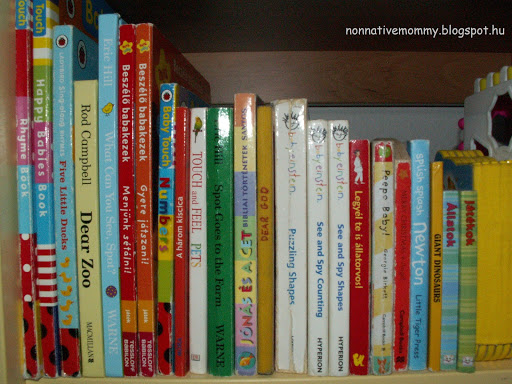
Our small baby library

The books you can see in the photo above are the ones that are available for E. at any time she wants them. I also have some more rhyme books, fairy tale collections and other stories in paperback format. I rather keep them away from her at present as she is living her life through experimenting (chewing, tearing, hitting, folding etc.) with everything.

Reading out loud to your child, no matter in which language, is a must. Even at a very young age. In our case both in English and in Hungarian.

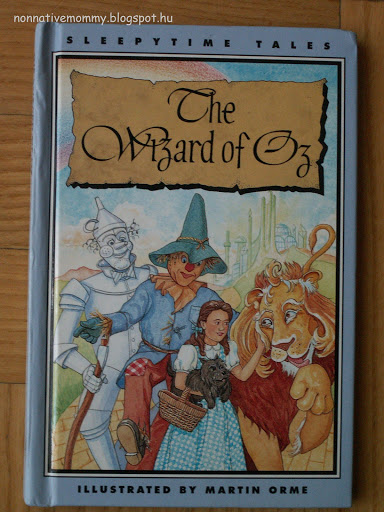
E.’s biggest favourite is The Wizard of Oz at the moment. She is now a year old. And of course, we did not start it with this story. What we have is not a board book so she can’t have it; I take it only when we read it, so it is not available to her 7/11. Probably this is also part of the magic. I bought this book in a second hand Hungarian (!) book shop for 100 HUF:
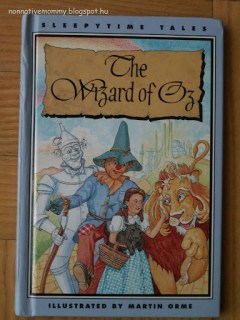


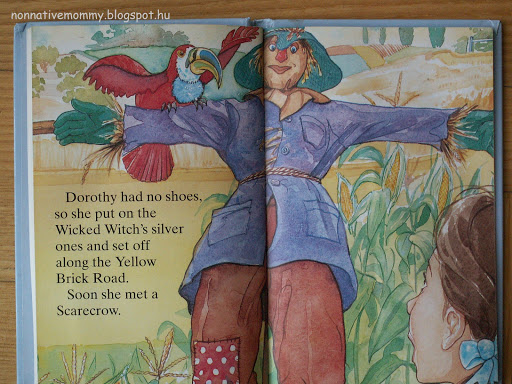
I try to read it out with sound effects. The characters have different tones of voice, when the storm is coming I say whoooosh or sssssshhhhh, when the lion appears I roar, when the wizard prepares the balloon I imitate the blowing of a balloon etc. E. really loves all the sound effects. After I have read the book, she can get it for a short while. E. tries to turn the pages (it’s not easy for her as she is used to board books) and while we are looking at the pictures I tell her what we see in a few words. Then we put the book back to its place. This is when she starts whining, sometimes crying but it’s quite easy to direct her attention to something else, luckily.

But I should start with the beginning. Let’s go in chronological order:
At the very beginning, from birth to 6 months I used three CLOTH BOOKS.


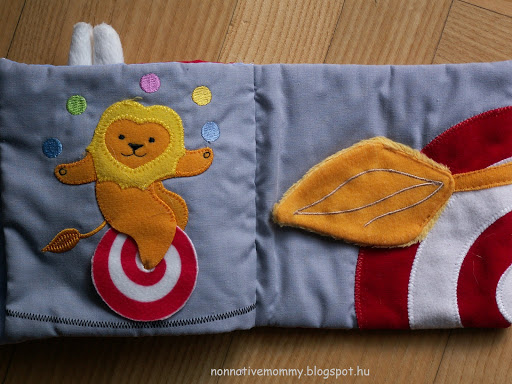
IKEA cloth book – The Giant Elephant’s Circus
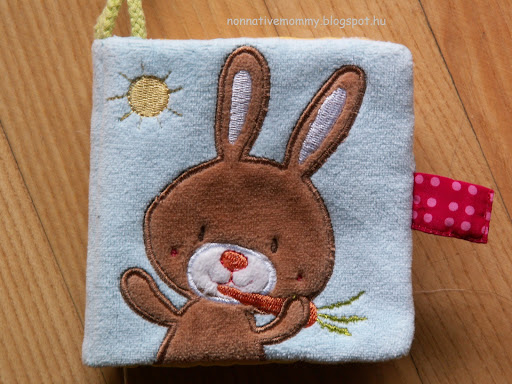
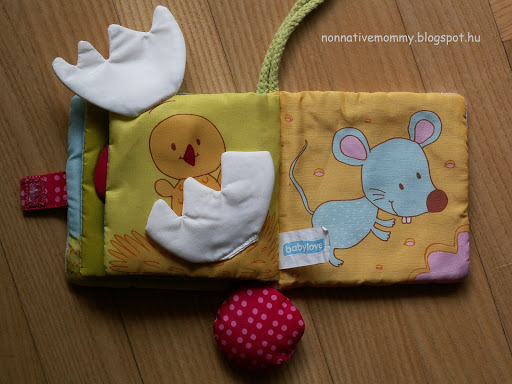
One from IKEA, and two from DM (we got them all as presents). When she couldn’t move around too much and too fast, I just put down the book so she could see it and told a story (The Giant Elephant’s Circus, The Rabbit’s Carrot Garden, The Secret Treasure – the latter is an underwater story with sea animals, alas, I have no pics of it as it landed at one of the Grandmas). She paid really close attention. Then by the time she could touch the book, I described the sounds they made (crackle and rustle), the different surfaces they had (rough, smooth, soft). Later on I stared to name the colours, the very simple sentences got more complex, though the main story line remained the same.


Babylove cloth book -The Rabbit’s Carrot Garden


The first thing E. could do with her hands after grabbing an object is turning the page of these books, and after a while BOARD BOOKS. It was after the age of 6 months, but this time she was just interested in turning the pages. When she was around 8-9 months old she was closly examining certain pages and skipped others.

I, myself, LOVE the Ladybird series. They have so many great books for all ages. The Baby Touch series is what suits a child under 3 the most. We have 2 of these colourful, vivid fun books which can be touched, scratched, pushed and licked:
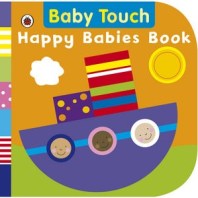

In case of the Rhyme Book, I say the rhyme or sing the song which is on the given page while E. is touching and licking the different surfaces. I often ask her questions about the pictures (Where’s the Teddy? or Are these flowers the same? What colour is the pussycat?) and then I answer them (There he is, No, they’re different, She’s orange), but nowadays she’s started to answer me babbling or pointing or even saying some wordlike utterances.

In case of the Happy Babies Book, we mostly touch and scratch, or wave hello or bye-bye to different creatures. Also, I say a lot of colours here. If I’m a little bored with it then I sing along a song which could be connected to the pictures. E.’s favourite page is the last one, so we just sit over it and push and lick the squishy, circle and the shiny, silver triangle.

Another number 1. book with small kids is the Spot series by Eric Hill. Here is a video where Eric Hill himself is reading out one of his books, Where’s Spot?. The little hands love turning the flaps (but be careful, they can tear them off in the twinkling of an eye). Spot is very well supported online as well. Have a look at Spot’s homepage.

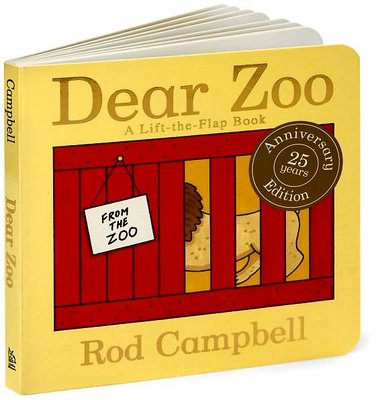
E. enjoys flap books a lot. Another one in our library, which is “read” on a daily bases, is Dear Zoo. You can have a look at the inside in this funny video.

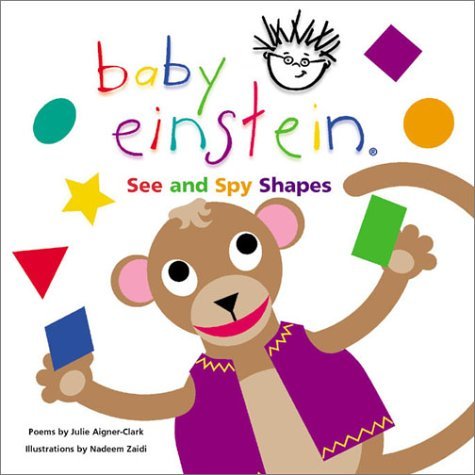
There are some educational books for early learning purposes. The market is vast for these books and there are a great number of them. What we have are some Baby Einstein books about shapes and numbers (I managed to get 3 of them at a mom-to-mom sale in the local youth centre for a few hundred HUF). 
 

I could go on and on listing the books we love using or would love to buy but there would be no point. As far as I’ve experienced it, it doesn’t really matter what books you have, and how many you have as long as you open them regularly, on a daily bases, or as frequently as your child is interested in them. Even if you don’t have a well lined purse (well, well it’s not a surprise that these baby books cost a fortune) you can find discounts and second hand books too.

Check out the following sites:


Angolkönyvek.com

There’s a site (bookdepository.com) where delivery is free. What’s more, you can read to your child online for free (though it’s not really for babies, or at least my little one doesn’t really enjoy it that much yet): wegivebooks.org . Another possibility is to make your own book, but it’ll be another post.

 
And to finish this post, here is a photo of E. reading her favourite book:
 

First bithday – first words?

Wow! A year has passed. It was a really emotional day with a lot of English.
Both of our helpers (A. and B. – haha) were here.

A. told me after she had been playing for 2 hours with E. that she was trying hard to say words in English. Yes, the first words are coming… and they seem to be English ones. Here are some words E. has been trying to pronounce lately:

English word
E.’s utterance
bib
bab
duck
dut
ball
ba or da (it’s more like the Hungarian word for it)
lamp
bamp
book
boo
apple
a or ap

It’s great feedback for me. I’ve been waiting for her first close-to-a real-word utterances so badly.

Since the weekend party when she received tons of presents, she’s been playing a lot with the new wooden fruit cutting set. Now she’s trying to say banana (in E.’s language “nana”)

 I guess we are on the right track.