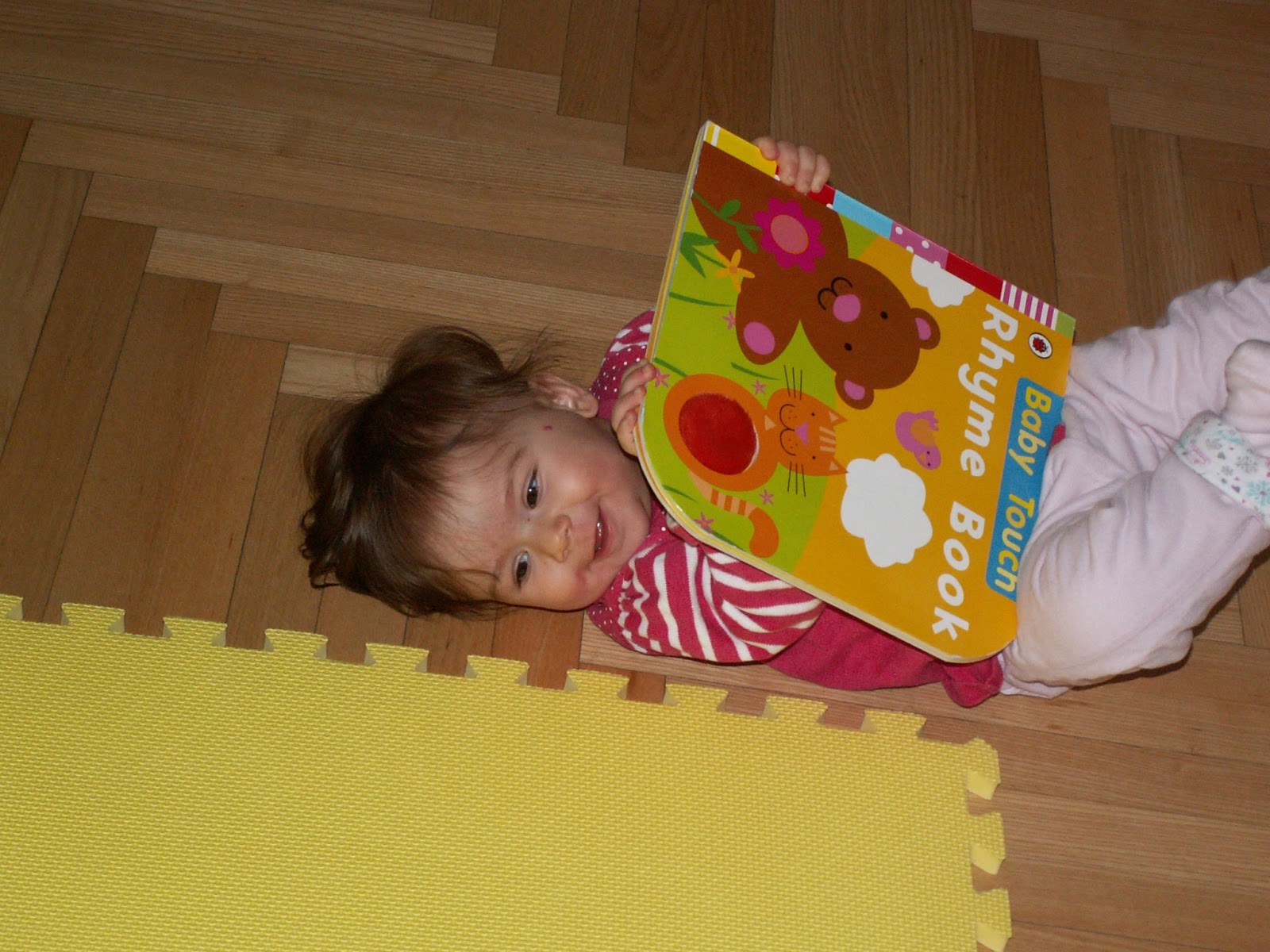
Plans, aims and strategies

I might have started with this post at the beginning.

  1. Why do we want E. to be bilingual?

    First of all, nowadays one language is not enough in our globalised world. If you want to study or work abroad, it is a must to have the English language. Second, our native language is Hungarian, which is far from a world language. A language, which can be used nowhere else in the world but in Hungary. Life in Hungary is not what everybody dreams of. One or two more languages give the opportunity for E. to choose where to live. Third, having another language in our life opens the mind to the other culture; one becomes more empathic, understanding and approachable. When making friends or new connections, language obstacles are non-existent. Last but not least, as far as I have experienced it, language learning is fun, a kind of intellectual entertainment.

    I could go on listing more and more reasons why we want our little one to speak both Hungarian and English on the same (near) native level. And this leads us to the next point:

  2. Main aim

    Perhaps it’s a little far-fetched but a sophisticated, near-native level is the main target concerning E.’s level of English by the time she’s 18-20 years old. In the short-term, until she’s at home with me up to the age of 3 – 3,5, I’ll be the main English input with the assistance of some helpers. Whenever we are the two of us we’ll speak English (which means now I speak and she babbles). In the long-term, I’m not so sure: English nursery, English speaking school according to the Hungarian national curriculum, moving abroad… these are all question marks. But now I’m trying to concentrate on the short-term aims (loads of English input of different kinds: spoken interactions, songs, rhymes, books, videos, native playmates, Helen Doron Early English… whatever).

  3. Strategy

    Our strategy is simple. I speak English to E. whenever we are alone and there is no Hungarian relatives or companion around. D. speaks Hungarian to her daughter, but there are some activities which they do together in English (such as using the computer or later watching TV etc.). Later on, when I’ll spend less time with E. we will introduce ‘Language by Time’ strategy. It means there are given time periods when only English will be used (e.g.: Saturday mornings, every day after nursery/school from 4-6, craft activities etc.) Another possibility is ‘Language by Situation’ i.e. every breakfast, homework doing, or bathing is in English. We can also introduce the ‘Language by Location’ strategy. In this case we would use English at the kitchen or bathroom, at a special playhouse, or at a playmate. At the Helen Doron Early English school. I haven’t decided which suits us more (maybe a combination), but we’ll try it when the time comes and I’ll let you know about the advantages and disadvantages.

And now only one more point is missing: HOW we are doing it. So the rest of the posts will be about our daily life using English (and Hungarian).

      MAKATON – sign language

      M., who I met on the facebook, in connection with MEC, advised me to have a look at the MAKATON signs that she uses with her daughter to connect the two languages. No matter which language you use, use the same sign for the same thing, so the child can learn to connect the meaning. You can find out your own signs as well, or do a signing course in Hungarian. I don’t want to recommend any courses as we didn’t take them. Just google it: baby sign language course Budapest.

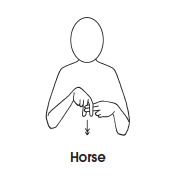
      Here are some examples, signs we use on a daily basis:

       
      Though we sign the horse in a different way:
      You can find more signs here.

      You can also learn from a special BBC programme for kids with special needs. The programme itself is called Something Special.
      Each programme sees Justin and Mr Tumble (played by Justin) out and about applying signing in a variety of places. Topics covered include babies, pets, toys, weather, clothes, shops, food, all about me, where I live and colours. Mr Tumble always dresses up, wearing brightly-coloured clothes and even big shoes! He moves around clumsily and has lots of fun.

      The language used throughout each programme is supported by Makaton signs and symbols and is designed to be understood by children in the early stages of language development. (source: BBC – Something Special )
       
      Full episodes are 15-20 minutes long. What I did with this programme is that I watched them one by one on youtube and made a playlist of what I needed (20-25 videos). I learnt the signs (they are very straight forward and easy to learn) and started using them both in English and in Hungarian (same sign for the same thing). E. was 6-7 months old when I introduced signing to her. (4-5 signs at a time. When she was familiar with these I introduced new ones.) Sometimes I picked a short part of an episode (max. 5-6 minutes long) and we watched it together. This could have begun earlier as well. But never cry over split milk.

      Here is the first video I saw and really was fascinated by it:


      I don’t do the signing all the time only if E. is not paying attention or I really want to link a new expression in both languages. Most of the time signing draws her attention. In the next post I’ll write about some songs which can be followed with signing. It’s a hit with kids. They love it! You’ll love it too.

      Finding more inspiration – MEC

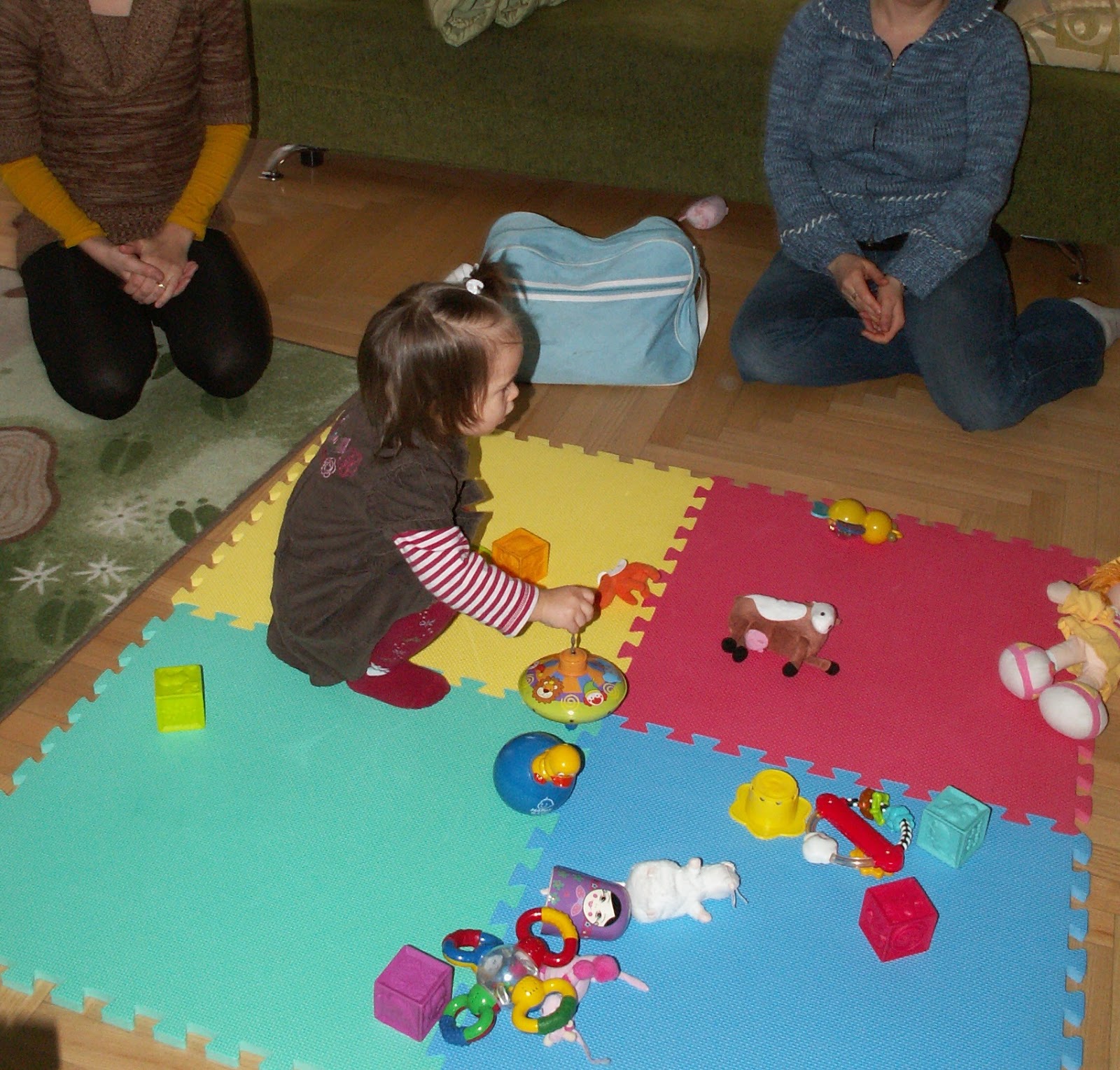
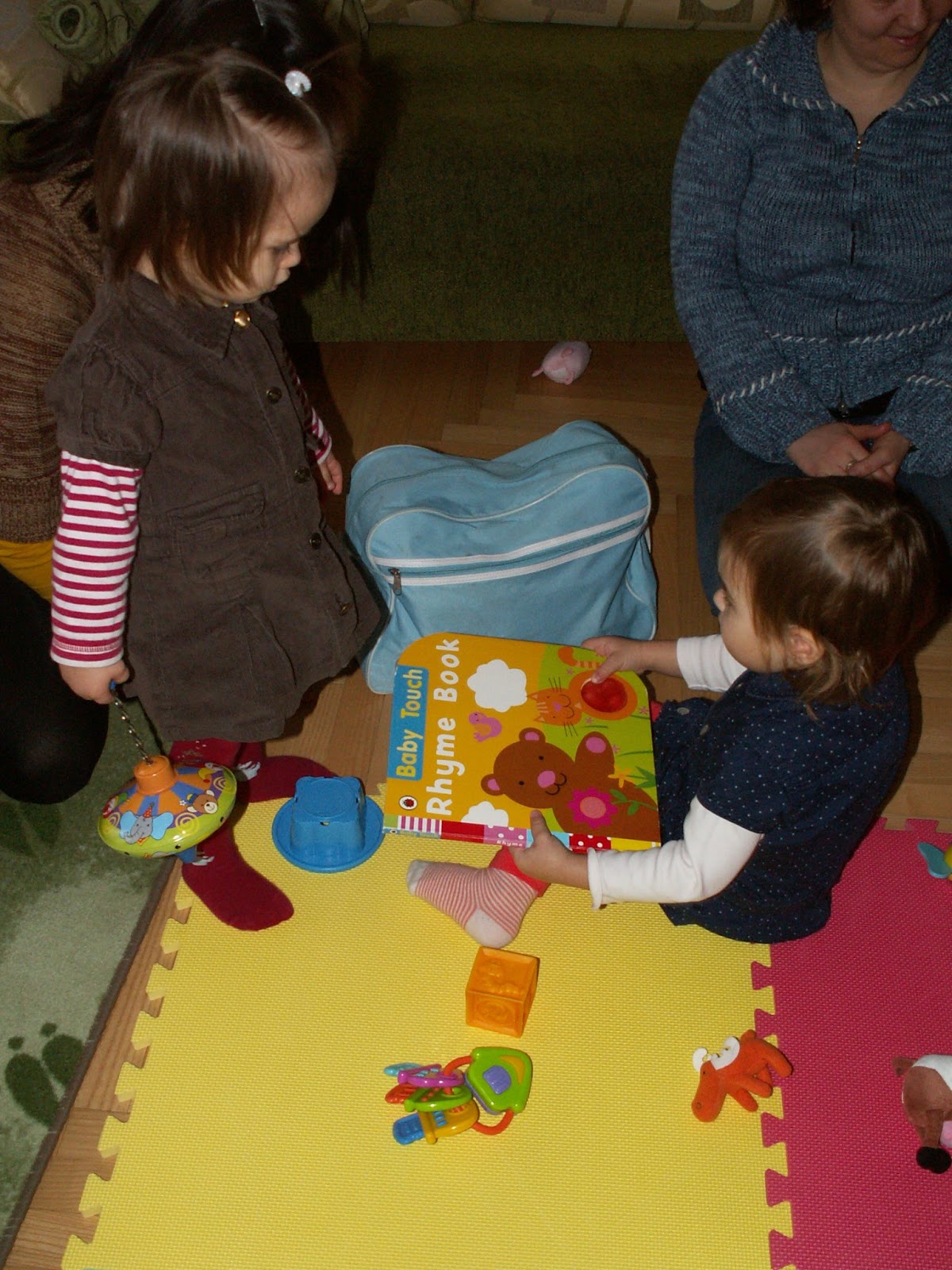
      When E. became 6 months old, I was on the net all the time when she was sleeping to find more inspiration on raising a child bilingual here in Hungary. I wanted to find other moms who were in the same shoes as me. And I found one on facebook: M. organised  the so-called Mums’ English Club (MEC) in her district in Budapest. It was totally free of charge. M. raises her daughter bilingual, too. MEC is and hour/hour and a half get-together where moms and their babies come together. Moms chat while the kids are playing. Baby rhymes and songs in English could be included but it’s not a must. The main point of the club is to create an English environment for the children, where they can hear that English is another, natural way of communicating with one another.

      I was over the moon to find M. who is working on the same, creating as many opportunities for her daughter to be in an English-speaking environment. We corresponded a lot, she supported me, and helped me in numerous ways:

      1. M. inspired me to organise a MEC in my district
      2. She introduced me to MAKATON sign language as a possible link between Hungarian and English (I’ll write about it in details in another post)
      3. M. recommended many books for babies – self-made, translated, or originals (see a later post)
      4. She encouraged me not to give up, or shilly-shally when facing difficulties or disappointment

      Thanks you, M.

      You can find this group of Hungarian and non-Hungarian moms here on facebook. And this community is growing, you can find some groups in the country-side, too. It might happen that one day it’ll be a Hungary-wide project.

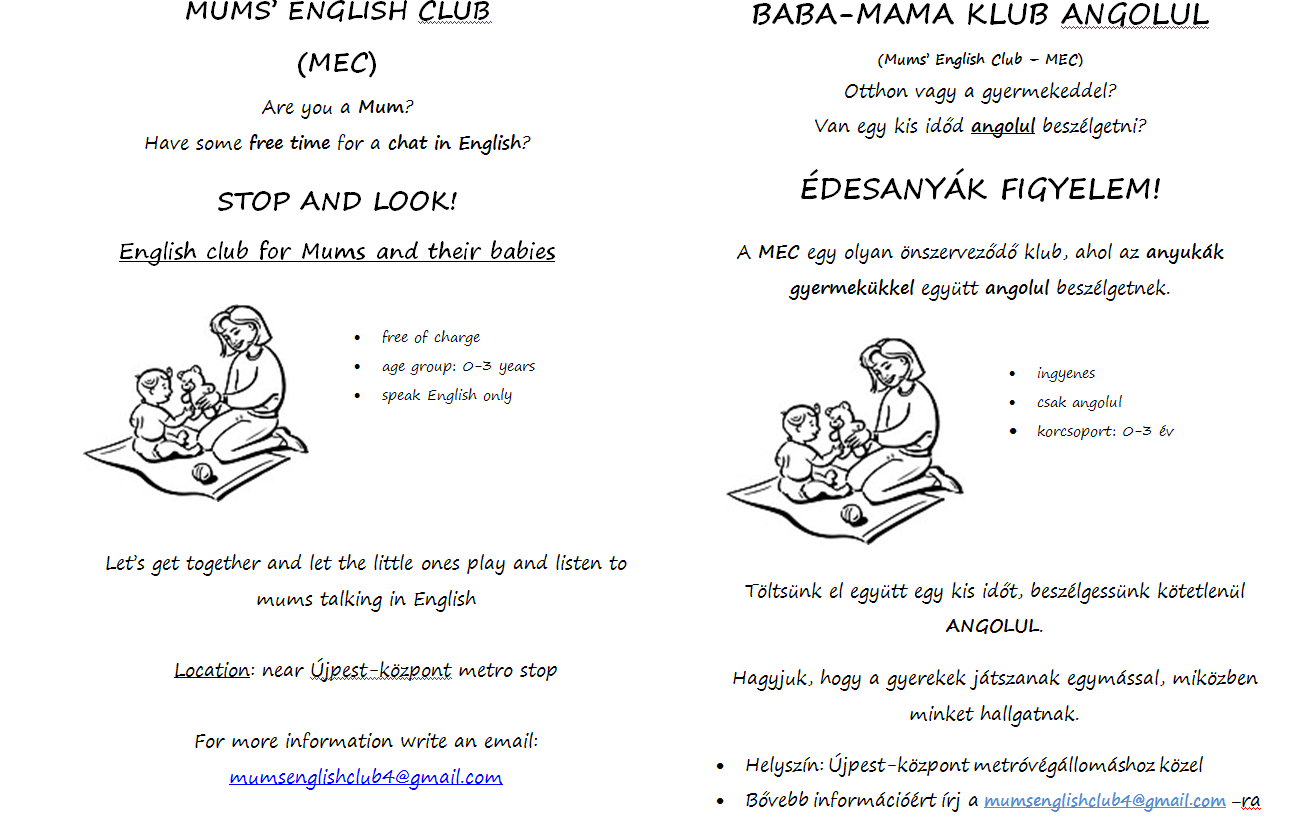
      After all, I made a poster and advertised our MEC in the library nearby, and on the net.

      Soon the first MEC took place 22 January 2012. It was an hour long and only one mom and her 11-month-old baby came. Still, it was such a victory. Something I managed to make up in order to get closer to my aim.


      Later on, within a month, 2 other moms contacted me and by the end of February we were four moms and four kids chatting and playing and having fun in English. Now we meet on a weekly basis, if holidays, sickness do not chime in. If the above ad has drawn your attention and you feel like joining us, do not hesitate to contact me.

      Unfortunately, two of the moms are going to take their children to nursery as they’re going back to work, so I need to put out some more posters in the area again to find new moms, new playmates.

      From birth to the 6th month

      As I have already mention my determination to raise a bilingual child didn’t realise at the very beginning. I did it half-heartedly after E.’s birth. I was singing a lot to E., who really enjoyed it, more than the Hungarian songs. She calmed down more quickly when I sang two of the songs: Lavender’s blue dilly, dilly and Hush little baby. So there was time when she couldn’t calm down and I was singing these two songs for 30-40 minutes without any break.

      During this first period I started to read books on the topic: Make your child multilingual by Silke Rehman and 7 Steps to Raising a Bilingual Child by Naomi Steiner and I found both of the books very supporting and practical, still they don’t deal much with a totally monolingual environment, where the second ‘mother tongue’ is a learnt language for the parents, and it’s the parents decision to raise the child bilingual. They mainly focus on mixed marriages, where one parent speaks a language and the other speaks a different one, or monolingual families living abroad and the countries language is the dominating one. Both books  discuss more or less the same topics focusing on determination of the parents, the consistency and a flexible plan. I do not want to go into details and give a review as I’d like to concentrate on what we actually do in our everyday life, but definitely these two books were really good theoretical and practical basis.

      The authors emphasise the TIME factor a lot; how much time is spent on the languages. They recommend 30-40 percent of the child’s day to be spent on the minor language, which is English in our case.

      So I “wasted” the first 6 months. If I could start it again I would speak English to E. from the very beginning in a natural way as in Hungarian, but I did not. So she heard natural spoken English every now and then for 6 months. The positive side of it is regularity, which is also a very important factor. Every day I sang songs for her or told her rhymes no matter how our days were going.

      Around the 3rd month we started to watch videos on youtube, though only for 5-10 minutes per day. I know there are a lot of different views on the topic (whether to let a baby watch moving images at this early age or not, but I found 5 minutes per day won’t do any harm. According to some viewpoints, moving images have a bad effect on the child’s brain, imagination).
      She liked watching these videos so slowly we increased the time for 10-15 minutes per day until the end of the 6 months.

      The following videos were and still are her favourites by KidsTV123:
      The Animal Sound Song
      The Shape Song
      Red Rabbit Green Gorilla
      Phonic song
      Twinkle, twinkle little star

      Of course, the list has grown by now but I’ll write about it later.

      We usually watched the videos 2 or 3 times a day for 5 minutes each occasion. When E. got whiny it was a great way to refresh her, or keep her busy when she was a little bored. From one week to the other she enjoyed it more and started to smile at the characters. She also recognised the song when the first image came up or the song began.

      In this period my main focus was on fun and regularity. We didn’t overdo it, just enjoyed being with E. and see how her intellect opens up.

      About our family

      The most important of all is that the close family are all Hungarians. There might be an exception in the near future. My sister-in-law-to-be is a Spanish speaker, which is great news for us if we take the possible other languages for E. to learn apart from English into account.

      D. is daddy, my husband who I met in 2009 December.
      2010 (July): we moved to our newly bought home
      2011 (May): we got married
      2012 (May): E., our daughter was born

      D. speaks several languages: English and German in the first place on high levels. He also speaks Spanish and French. I don’t know much about his other languages, like Italian Serbian, Croatian, Chinese as I haven’t heard him talk in these languages but he spent several years learning them. No comment I guess.

      My brother-in-law lives in Germany with his Spanish speaker girlfriend. So he has English, German, Spanish, too. (July 2013. – they got married so official we are a multilingual family 🙂 )

      E.’s grandparents on D.’s side speak German as well. One of D.’s uncles lives in the UK with his Spanish speaker wife. Their daughter is probably the first bilingual in the family as she speaks Spanish and English as well. What a pity they don’t pay attention to her Hungarian so much. She would be multilingual then.

      My Mom learnt Russian as everybody else here in Hungary at her school time, but, alas, she has forgotten all of it, though she used to be really good at it.

      I, myself, speak (and teach) English, but also learnt German and French. Unfortunately, they are so deep down I cannot see them anywhere in me. However, in the future I’ll brush them up, when E.’s going to learn some other languages.

      As for languages, we are well-off. We can’t complain.

      If you are more interested in our family in more detail you can find it on a separate page.