We love numbers – Numbers II.

Every time before E. goes to sleep we have this conversation (either in English or in Hungarian):

E.: – Mommy, numbers.
M.: – Which numbers?
E.: – The little numbers.
M.: – 1, 2, 3, …
E.: – No, Mommy. Zero….
M.: – Oh, yes, sorry. 0, 1, 2, 3, 4, 5, 6, 7, 8, 9, 10
E.: – Now the big numbers.
M.: – 10, 20, 30, 40, 50, 60, 70, 80, 90
E.: – Hundreeeed (giggles)

She is so fascinated by numbers that at the age of 18 months she could read the numbers on her baby bottle from 10 to 280.

Let’s see some number games we play.

First of all, our favourite number songs:

Zero, zero, super hero

Ten in the bed

The new favourite: Ten Little Dinosaurs

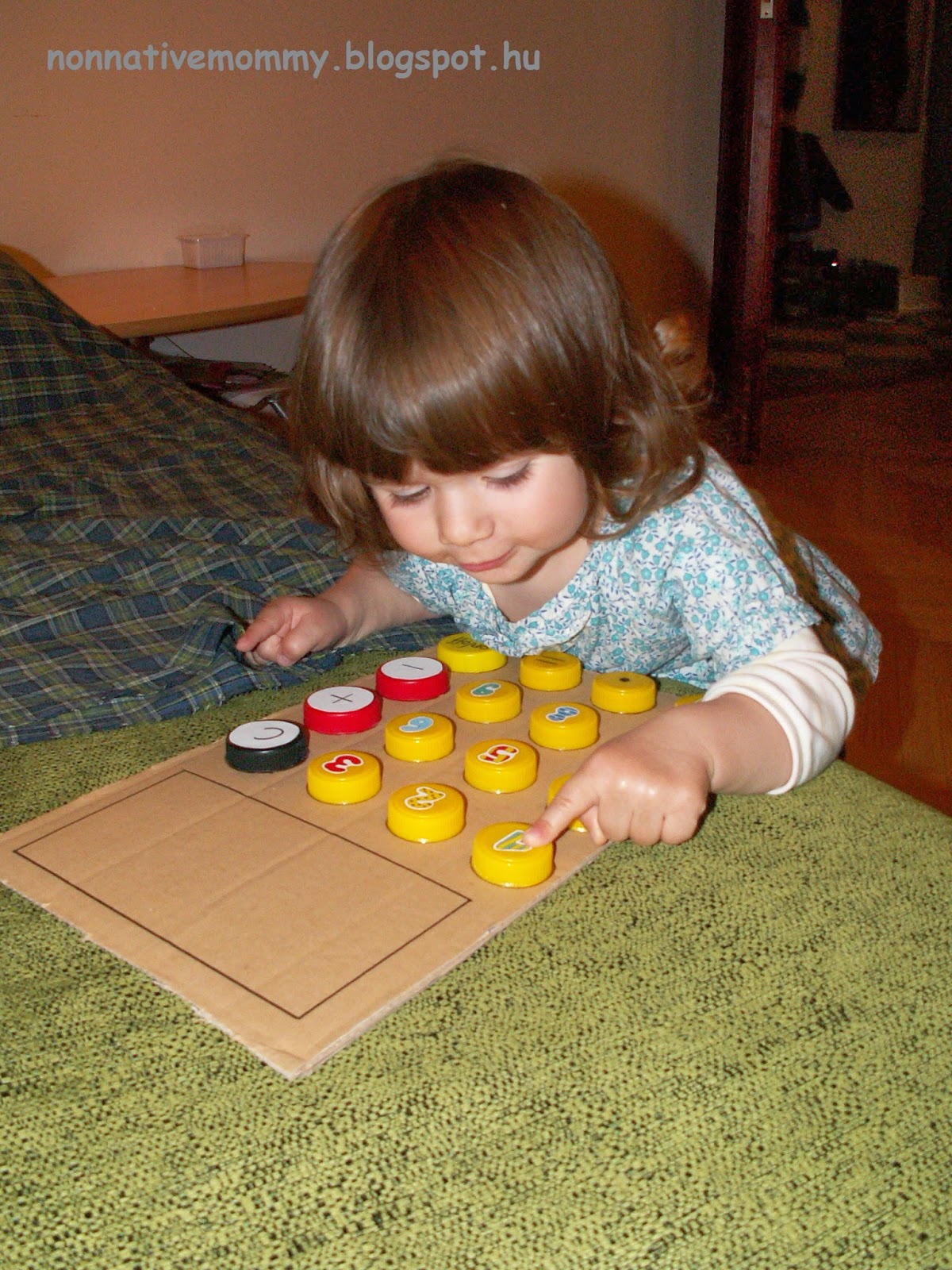
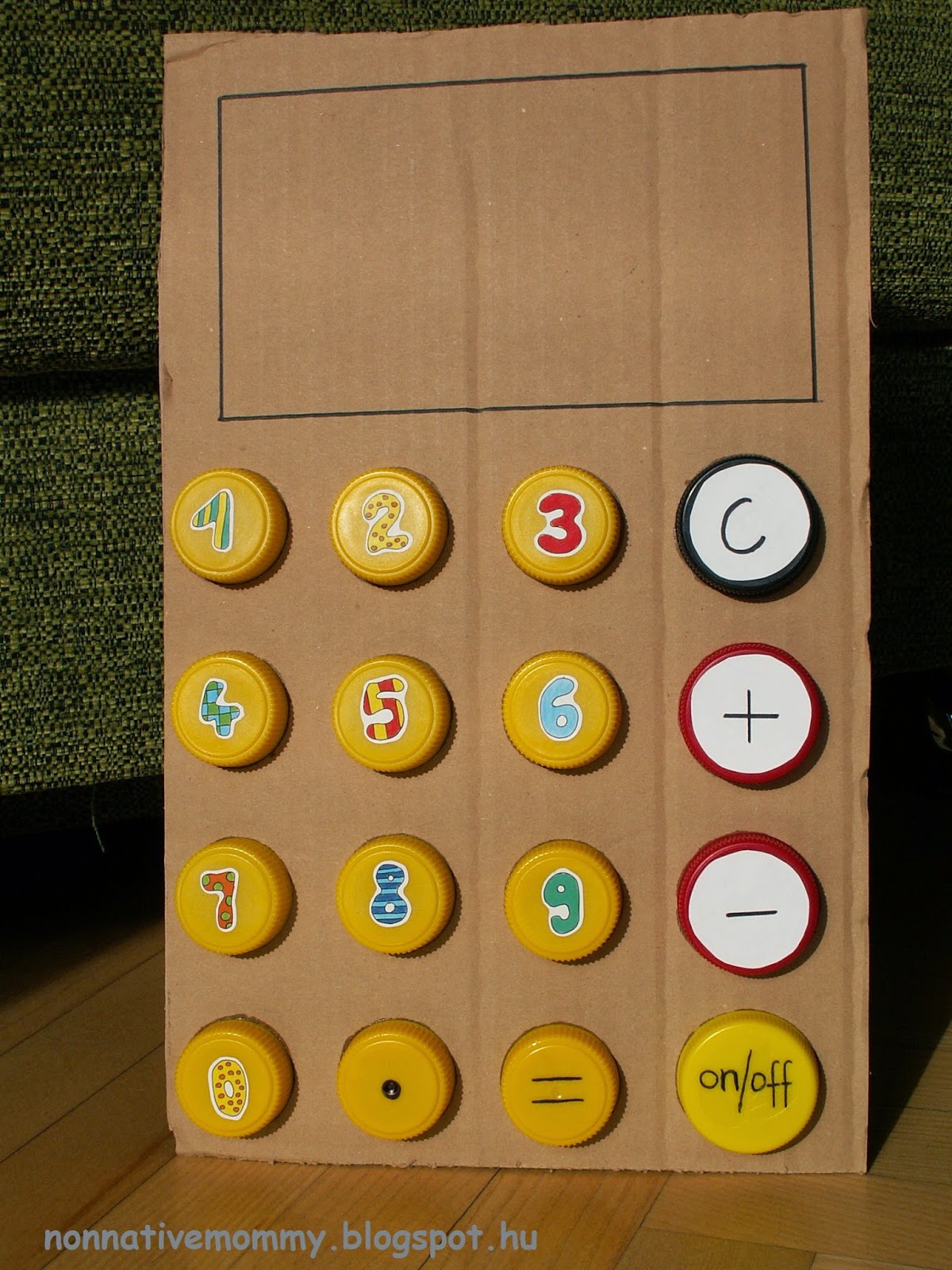
The bottle top calculator is just as much fun as pushing the buttons on a real calculator.
What’s missing?

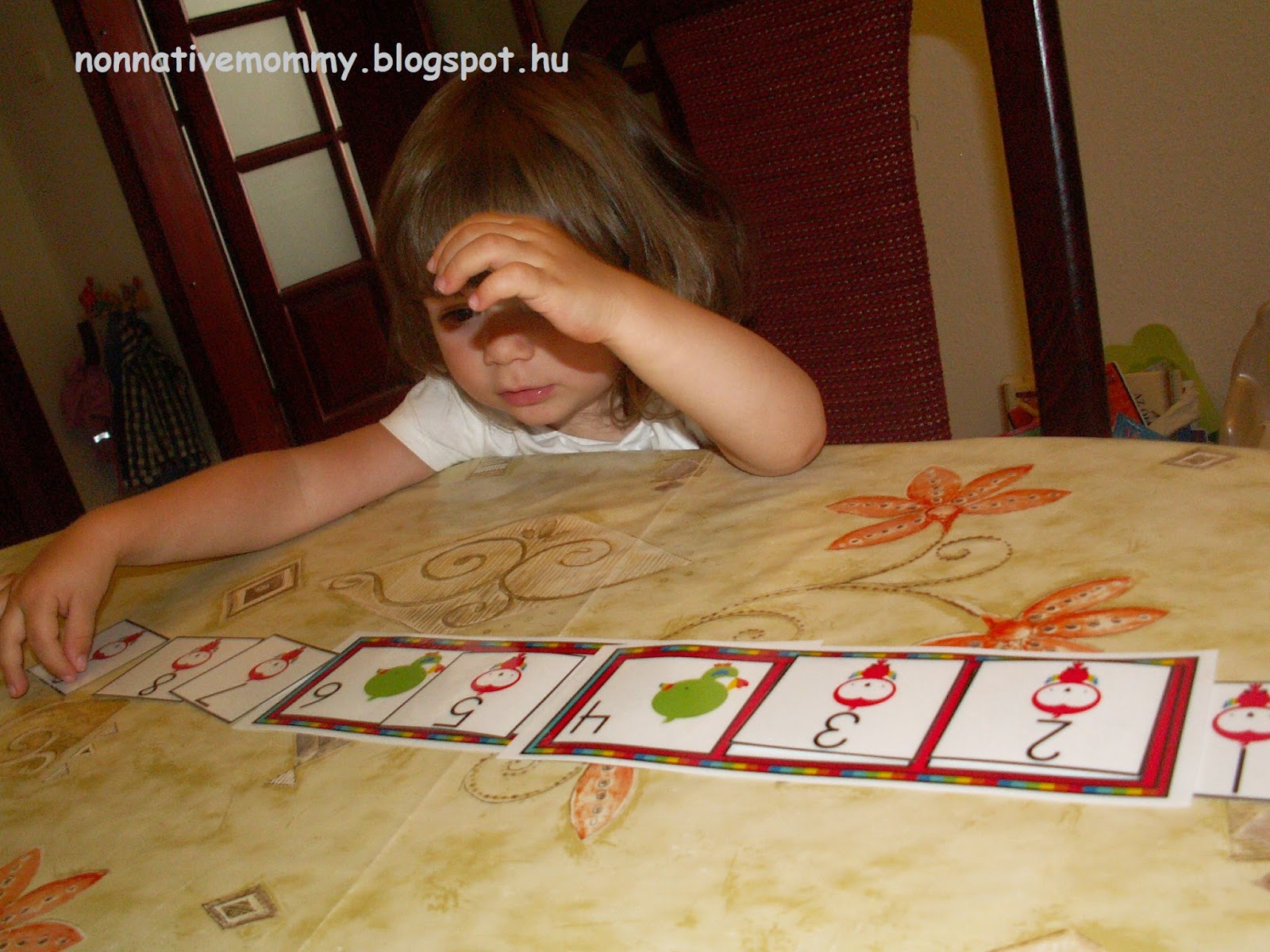
I found a quite difficult number task on www.firstgradebrain.com. (I just checked the link recently and it’s not there anymore. Sorry. I’ve put it on my to-do-list to make an activity like this) What comes between? This task is more for 4-5 year old kids, but we gave it a try. I printed the sheets laminated them and at first I just put one task in front of her with 3 possible options that can come between the two numbers.
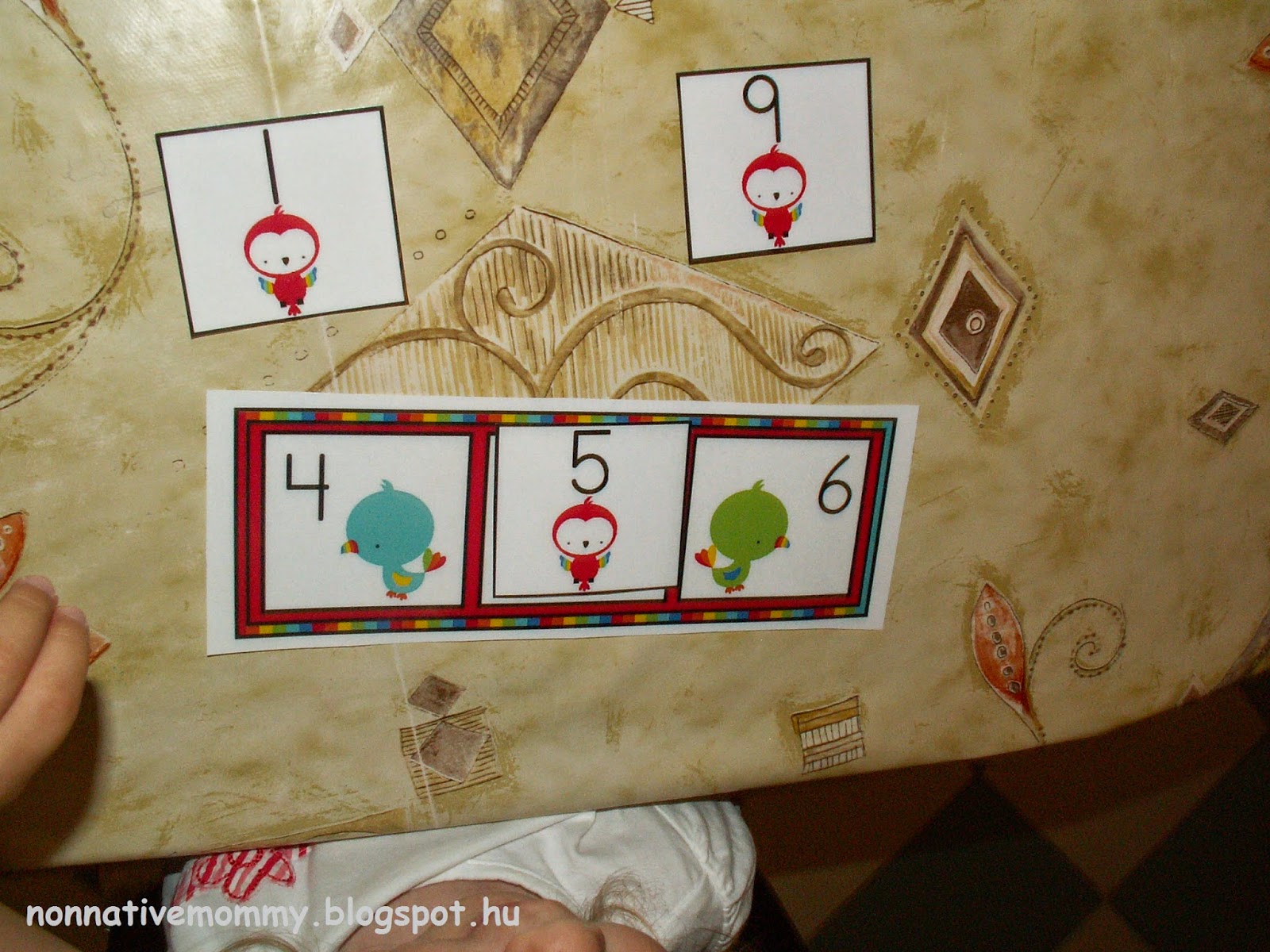
Easy-peasy lemon squeezy

Much to my surprise it wasn’t very difficult for her. We did two more of this task then she started to order the numbers. All by herself.

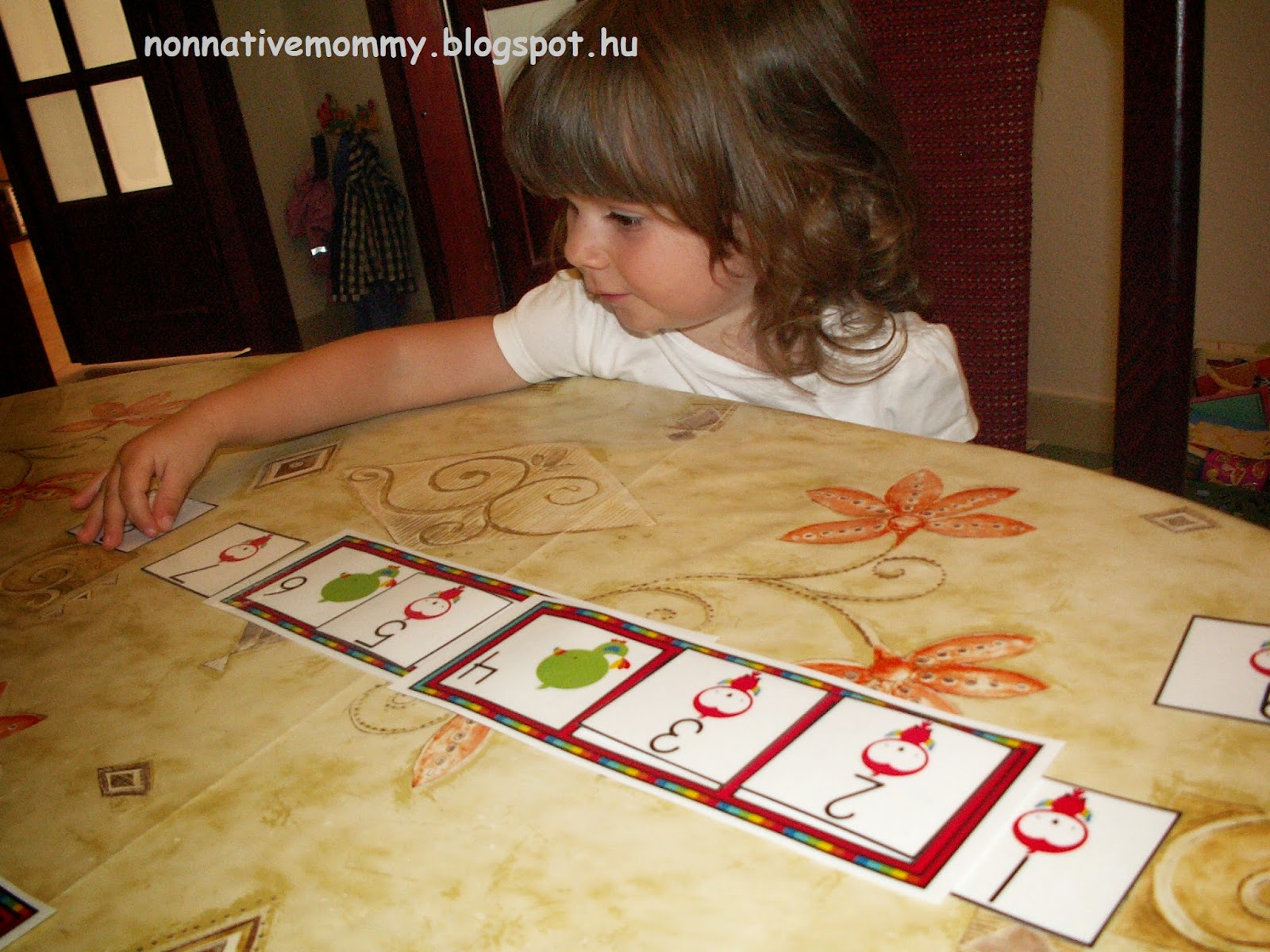
There is nothing more to add 🙂

Ordering the numbers – Making big numbers

I printed the numbers from 1 to 10 in two copies. I coloured and laminated them and the fun could begin.

First, I put them in order, then she matched the other set.
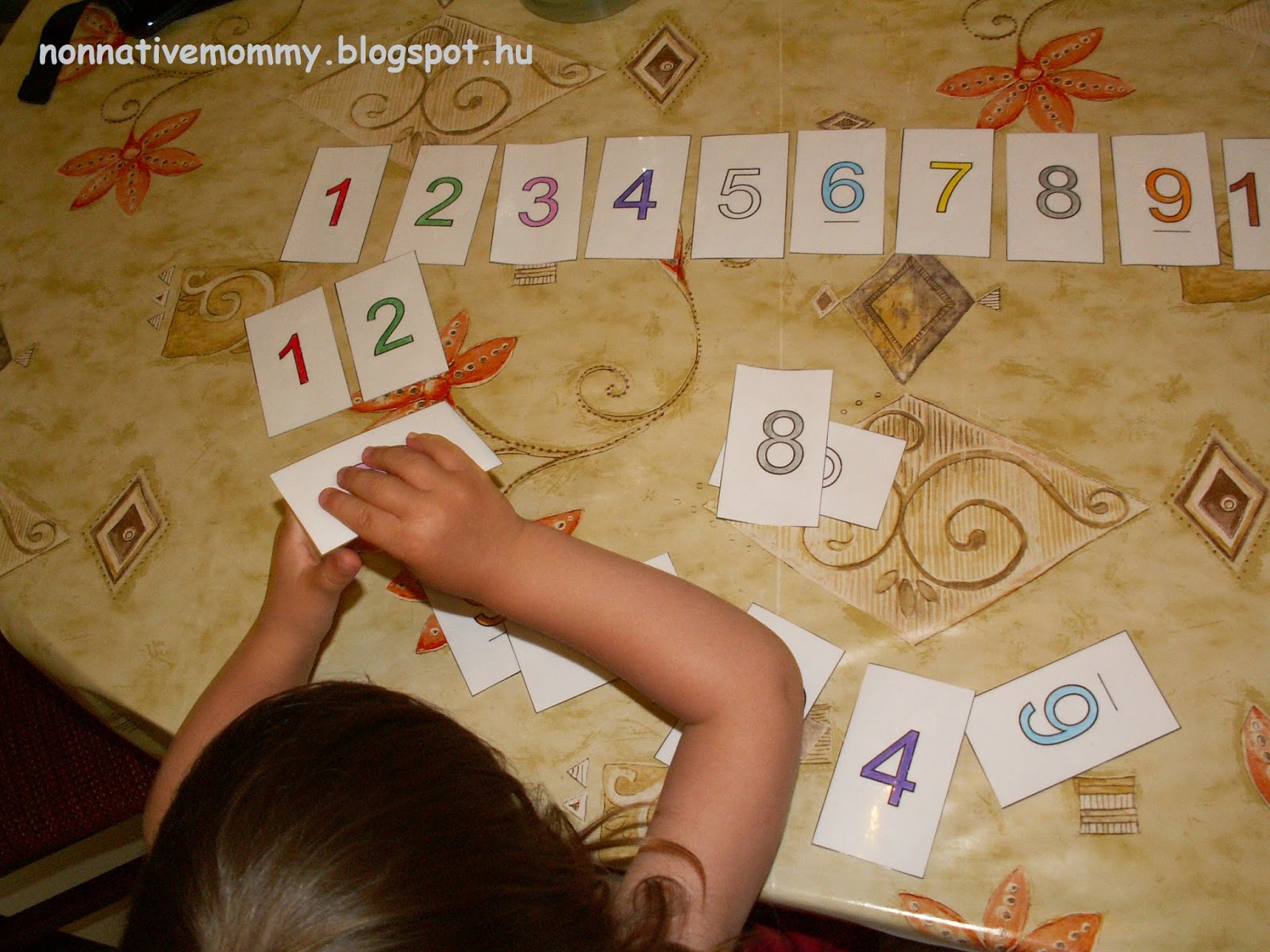
We played a memory game with them. (There are ladybird stickers on one side of the cards so that you can’t see what is on the back)

I’ve found a match

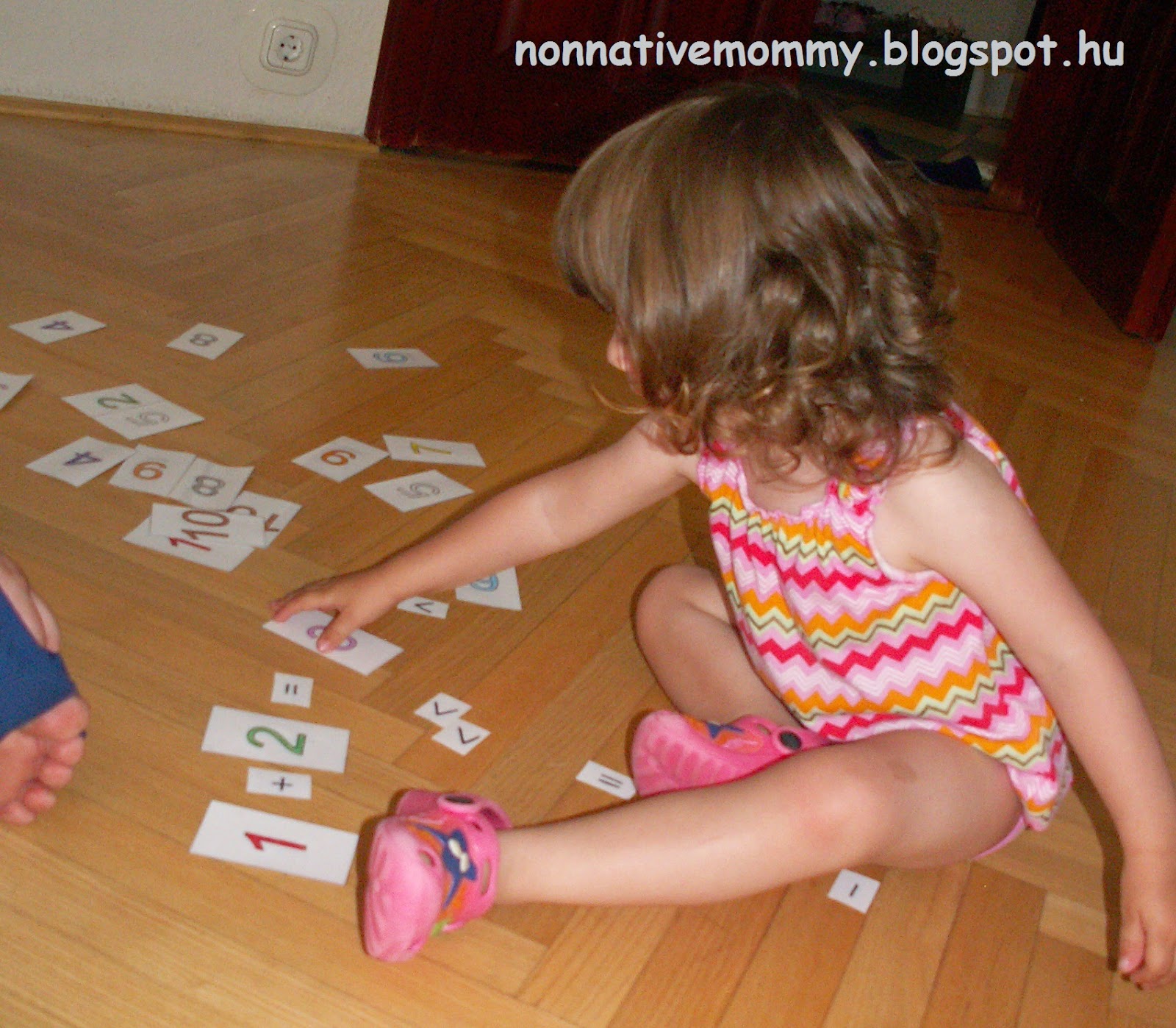
With these numbers, A., our British nanny, played another game. She and E. made big numbers putting the numbers next to each other.

110

And some basic additions.

Watermelon seeds counting game

I used the watermelon seeds counting idea on Toddler Approved! which I really like following as they have great and easy-to-make ideas.

So I just made the watermelon slices out of a green foam sheet, a white and a red sheet. I glued the different coloured paper on top of each other.
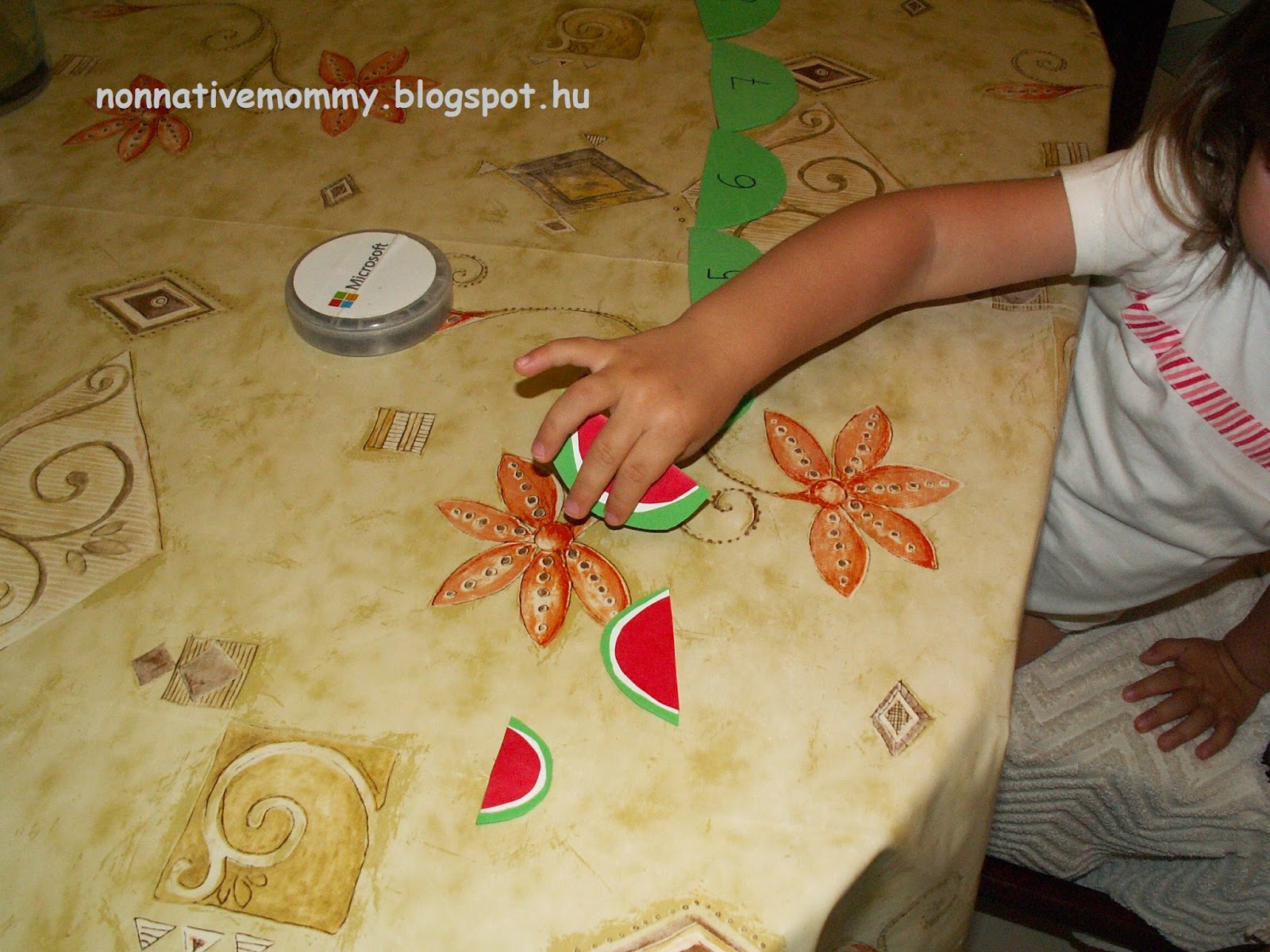
Turning the slices right side up

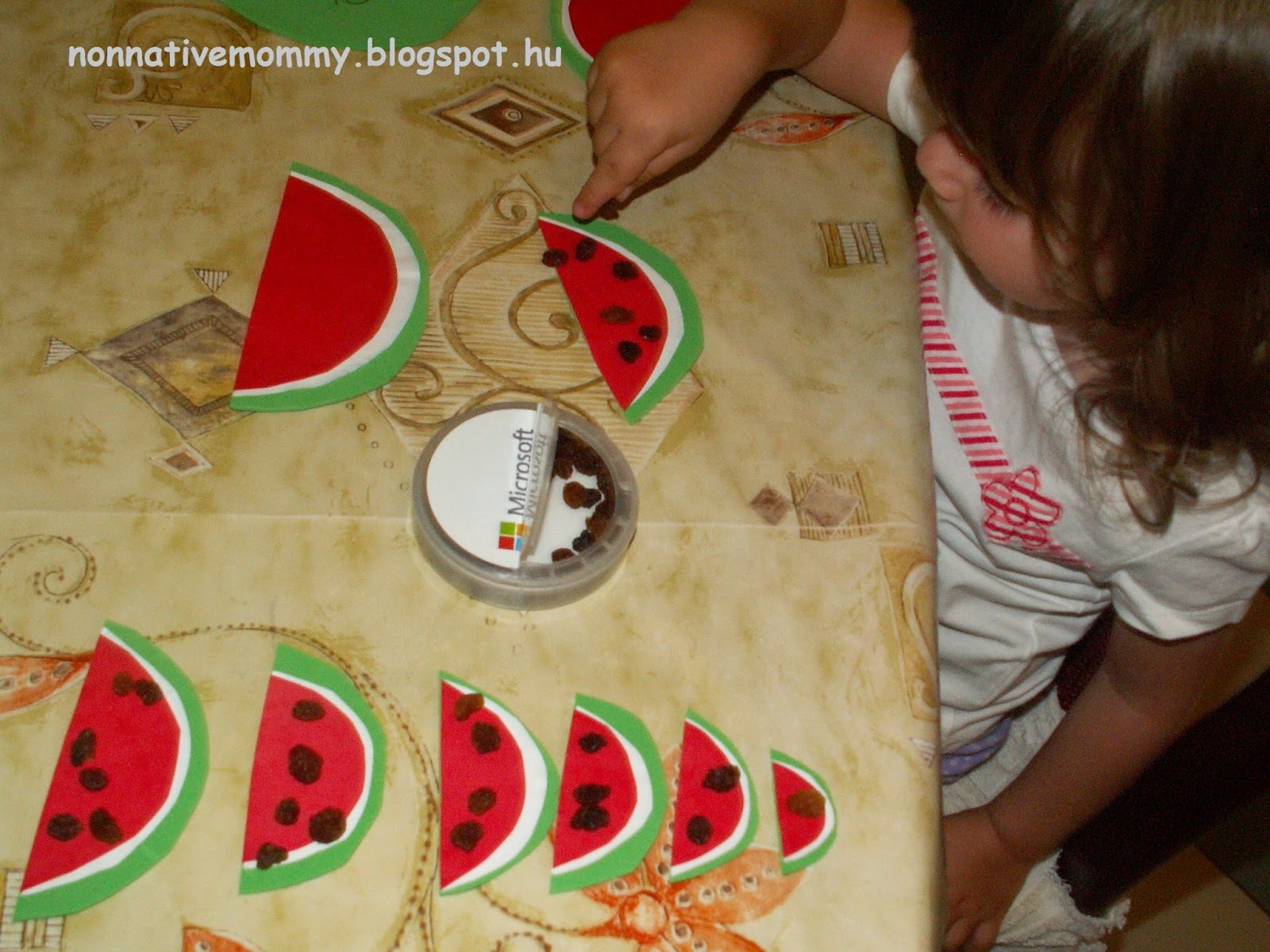
On the back of the slices there are the numbers written. (the slices deliberately grow in size from 1 to 10 so there is more room for the seeds and in this way we can put the slices in growing order.)
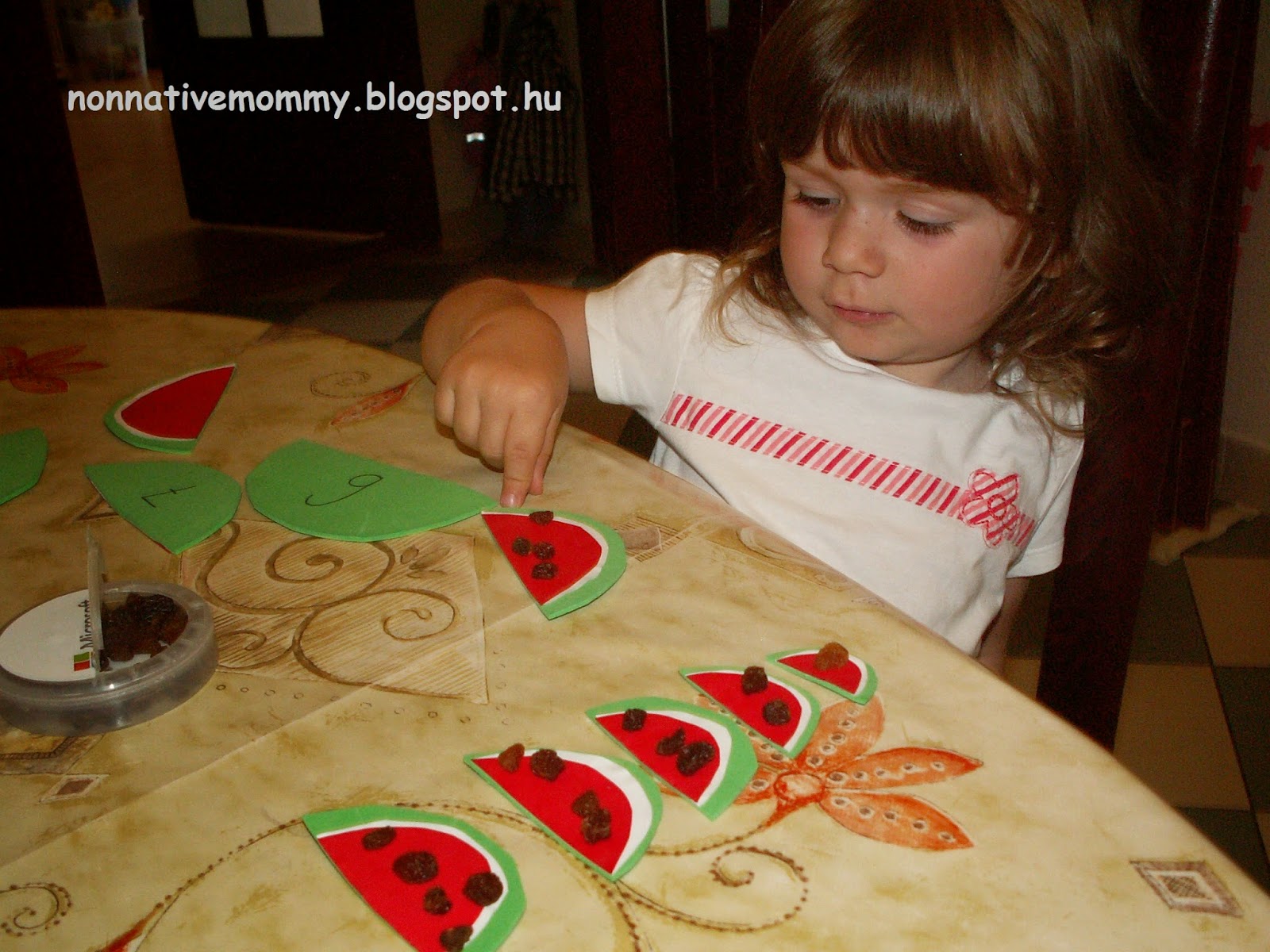
counting

I picked raisins instead of the chocolate chips recommended in the Toddler Approved blog post. Healthier and they do not leave a mark. I put them in a box and the counting started.

One raisin rolled down

We can do many other things with the watermelon slices:

  • put them in order according to the numbers (or backwards)
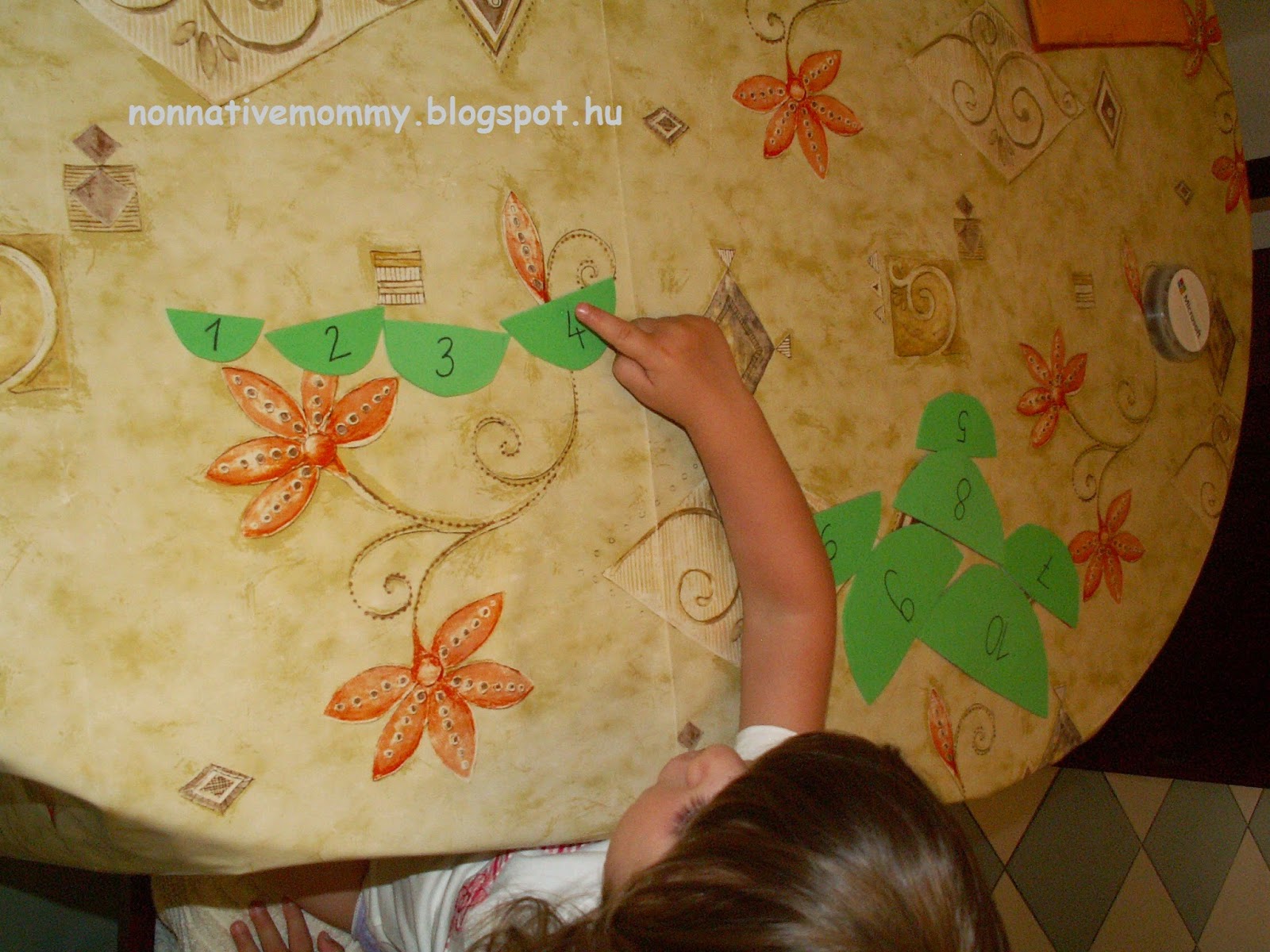
This is four, Mommy
  • order them according to their sizes
    1, 2, 3, 4, 5, 6 …
  • throw a lot of raisins on a slice and eat up all the “seeds” that are not necessary in order to have the number of seeds on the slice as written on the back
    yummie
  • explain how to eat up all the raisins to someone who does not know this game
Number stickers – Helping Little Mole build a house
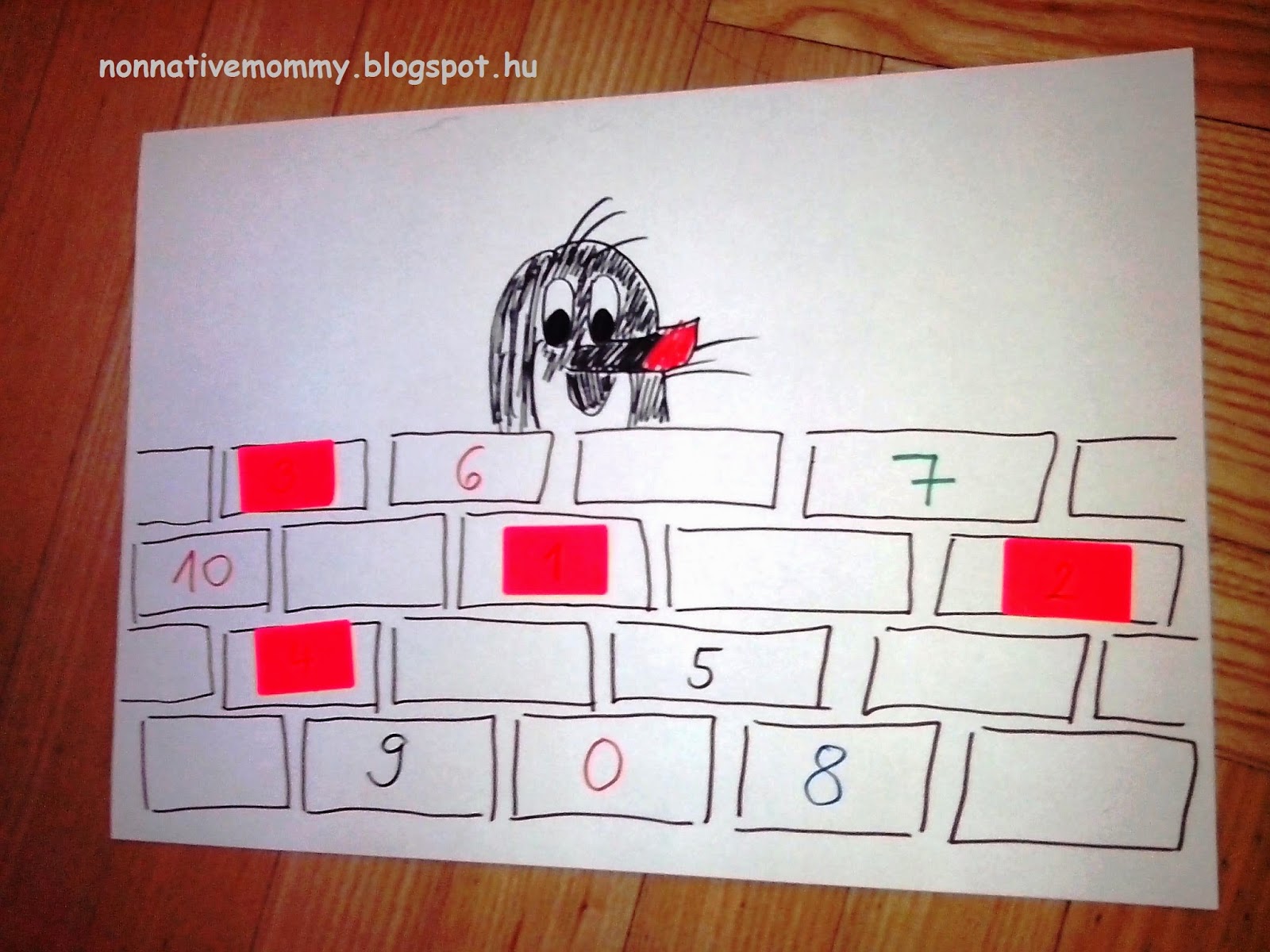
I drew a brick wall and Little Mole’s head on a sheet of paper. Some bricks had the numbers on them from 0-10. On rectangle shaped empty stickers I wrote the numbers from 0-10. E. had to build the wall putting the stickers in the right places, on the matching number. She filled the empty bricks with empty stickers. (Sorry about these photos, they were taken by my mobile.)
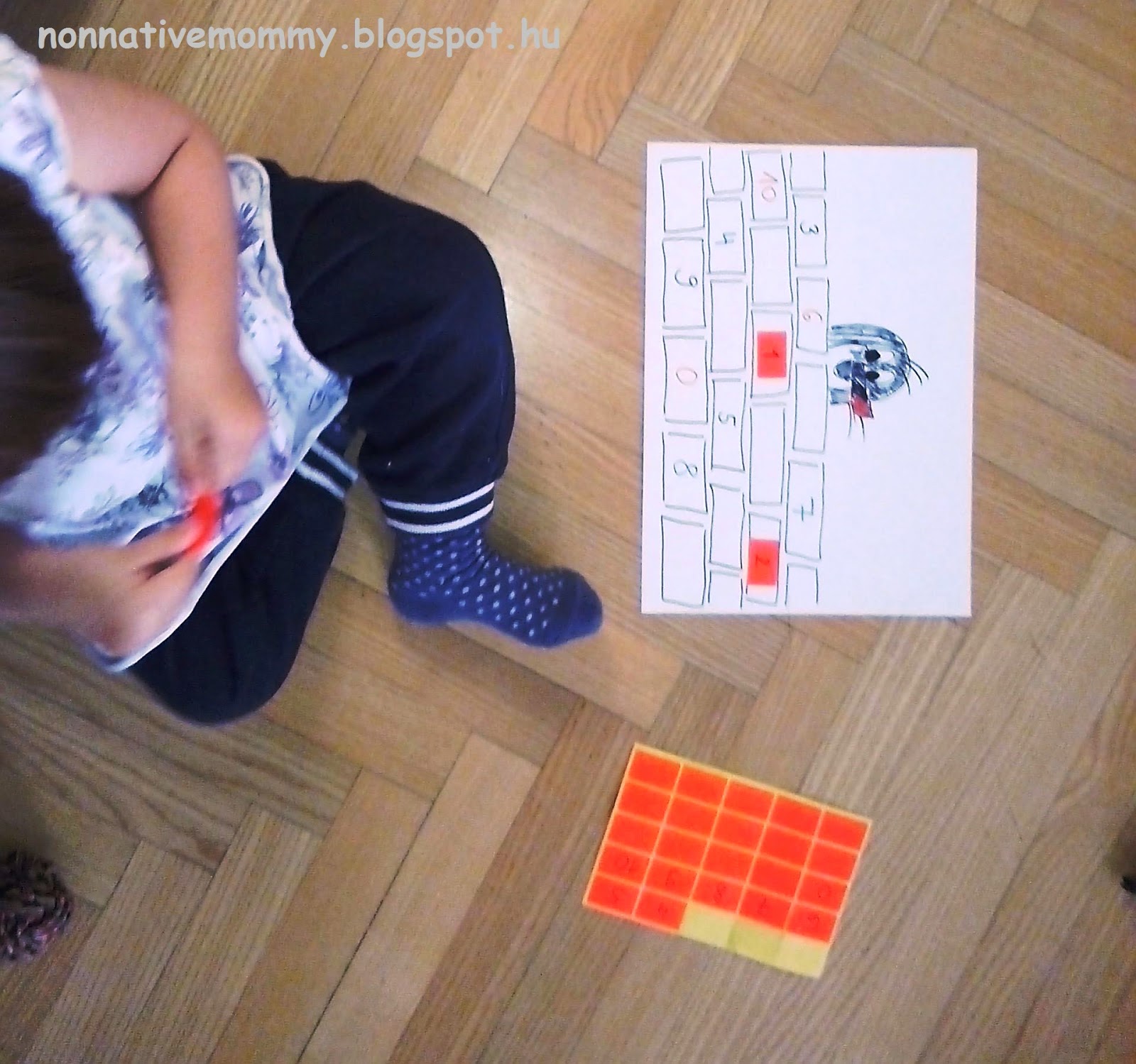
(You can buy these stickers at a “one euro shop” – well, in Hungary at the Chinese markets or shops)
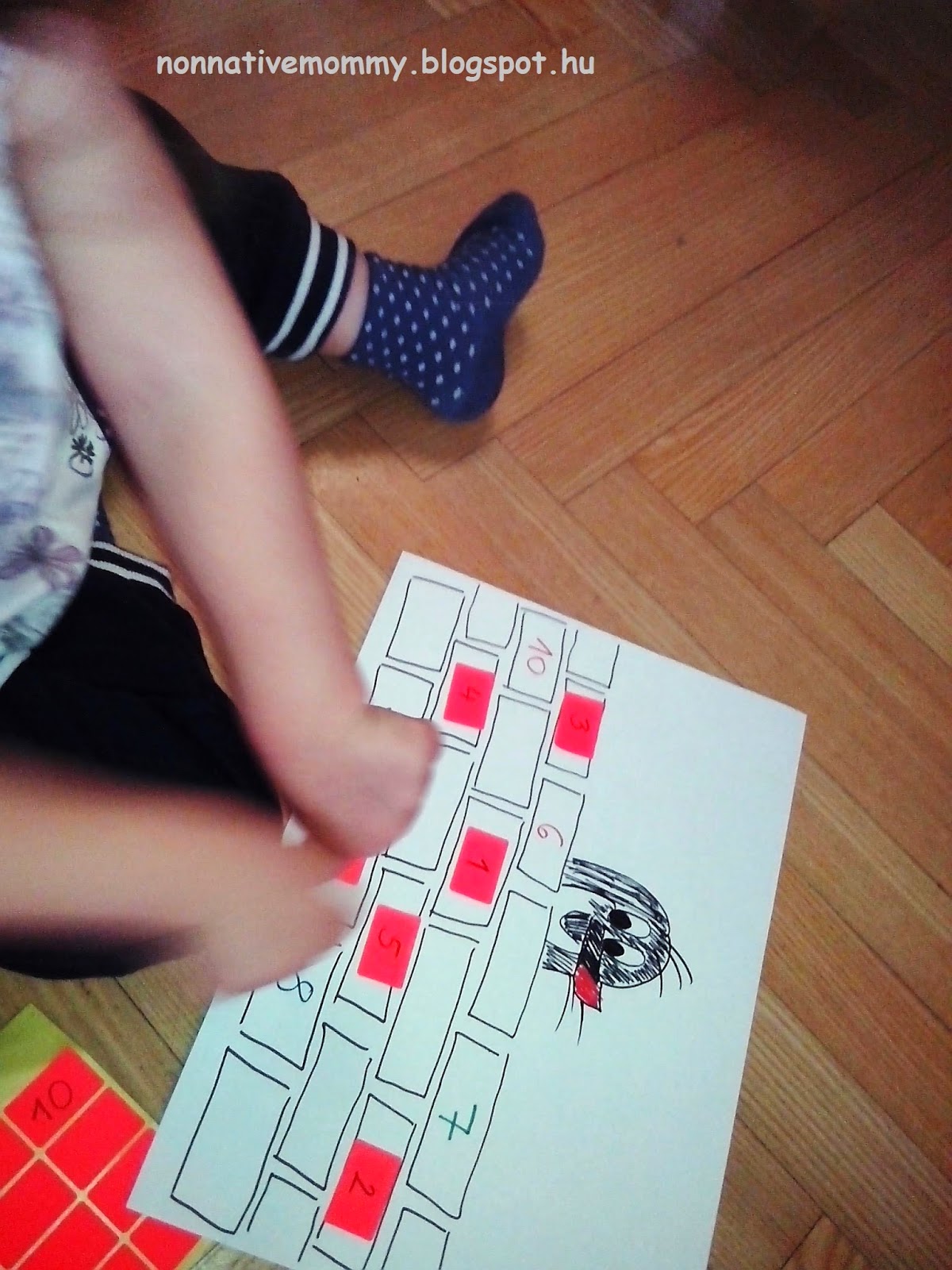
This idea has endless varieties: with the ABC, with big numbers, matching animals, clothes, everyday objects, playing with the colours, copying patterns etc. If you have any idea how to expand this game share it with me in the comments.

Books – some fun books to finish with

Dora the Explorer – A Birthday for Boots (By Scholastic)

In this Dora book, she and her friends buy some goody bags for Boots’ birthday party, but Swiper always takes away one every page.

I bought this book when E was just 1 year old and she loved looking at the pictures. You can talk about a lot of things in the pictures. There can be a lot of counting (goody bags, candle sticks, balloons etc.) but also naming objects connected to a birthday party.

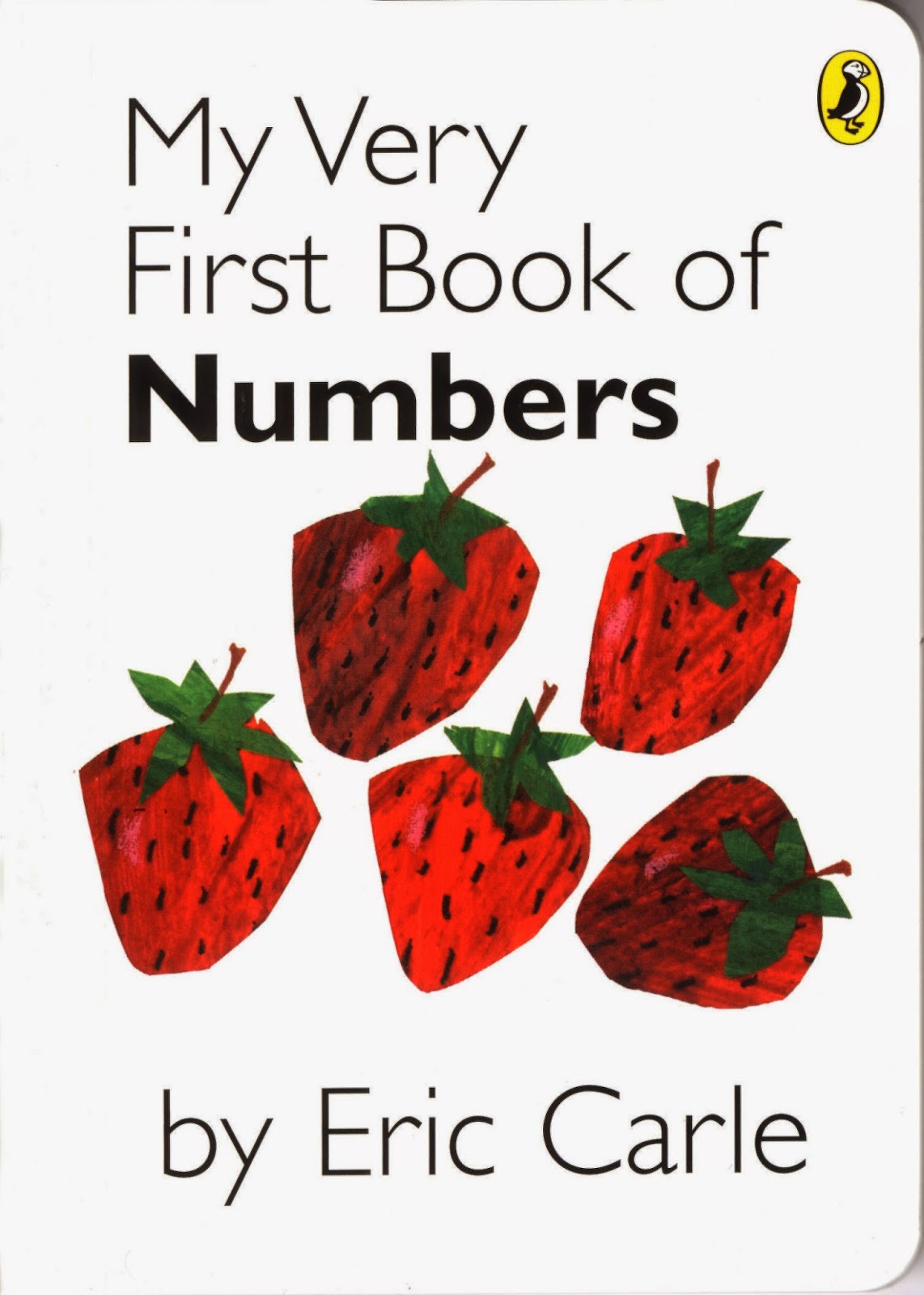
My very first book of numbers by Eric Carl

This book is divided in two parts horizontally and your child needs to find and match the fruits in the bottom part with the numbers (written in numerals and also represented with black squares). As E. has passed two years old, she doesn’t need help, but around last Christmas when she got this book she needed help with the page turning and matching.
Flip me! Counting 1-10 (By Buster Books) You can read the full review of it here. I’m quoting just the essential part of it:

“Counting 1-10 has pages divided into two panels, which kids can rearrange to match. One side has photographs of objects to count <dolls, dinosaurs, sand toys, cars etc.>, along with words identifying the number and name of the object; the other side shows the numerals from 1-10.”

Once we took this flip book on a longer car journey. While she was looking at it, E. threw up. Use it some other places. It’s quite nice.

As numbers and counting are in E’s focus, I’ll come back with some more number games in the near future.
Shapes, shapes, shapes – there are all sorts of shapes

E. is into shapes to a great extent. About 2 months ago (when she was 16-17 months old) she already knew all the basic (and some not so basic) shape names. So it made me think what we can do to practise and play with the shapes in more varied ways.

When E. was quite small, around 6-8 months old, we watched and we’ve still been watching the following videos concerning shapes.

The Shape Song

Shape Song 2

We have some new favourites. While we are watching some of them she bursts out with laughter, like in case of the following:

Miser Maker: I am a shape

The next video might seem very monotonous and boring but my daughter loves it and sometimes wants to watch it 4 or 5 times.

What shape is it?

There are a lot more videos on shapes but I do not want to bore you. You can search for them on youtube.

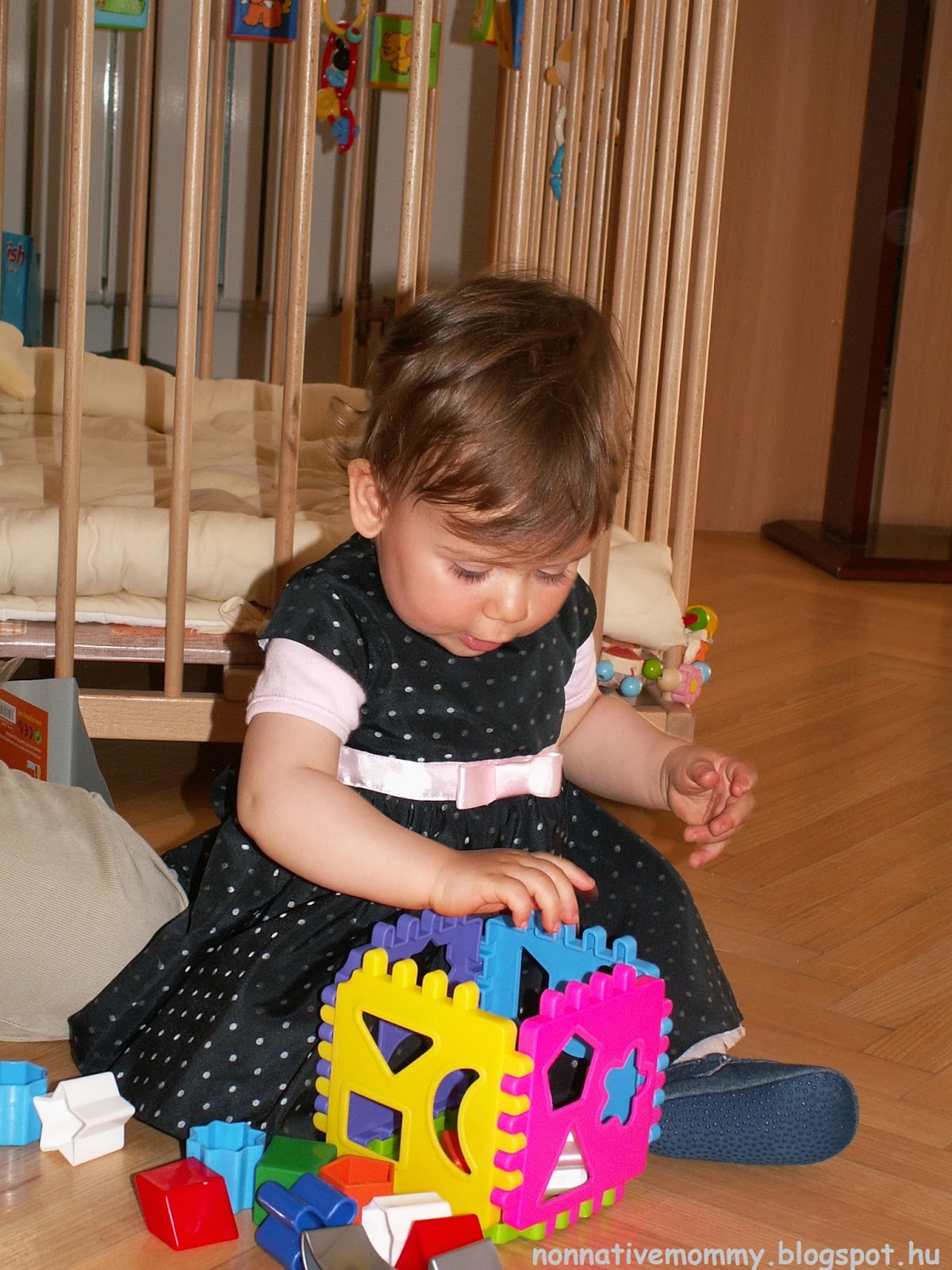
E. got a shape cube for her first birthday, but she was totally untouched by it after taking a first look.

Birthday present with potentials

Mostly, I was playing with it and she was watching, or was just playing away next to me. When she was about 14-15 months old, she started to name the shapes out of the blue, much to my surprise.We also use the shapes of the cube to match shapes in a little bit more different way. I took out a piece of paper and 9 shapes from the cube (I don’t know why 9… it could have been 5, 7 or 10. It was a sudden idea.). With the help of a brown crayon I drew them around (E. was watching closely and tried to help a bit too 🙂 )

Then I gave her the shapes and I didn’t even have to tell her what to do. She started to put the shapes on the paper.


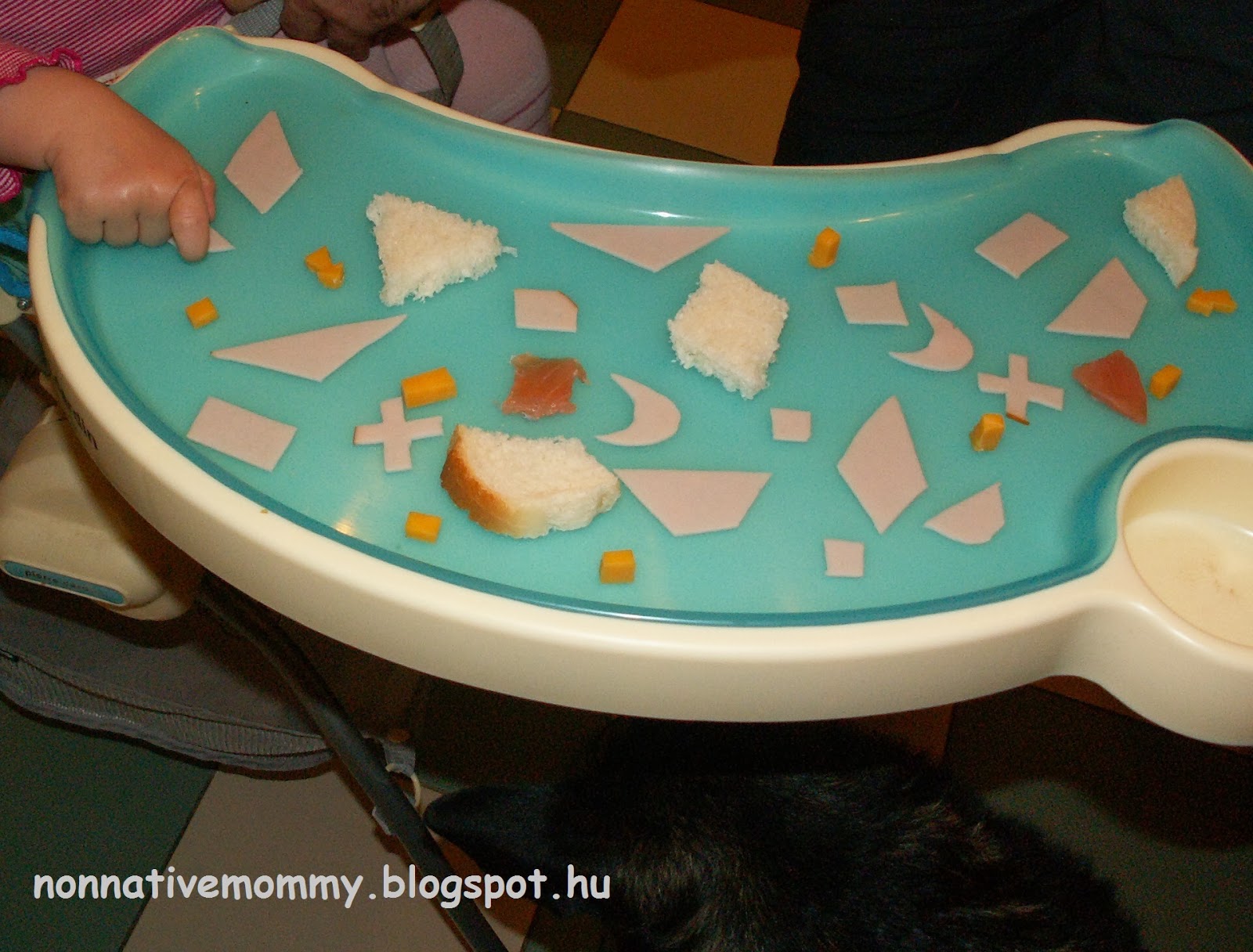
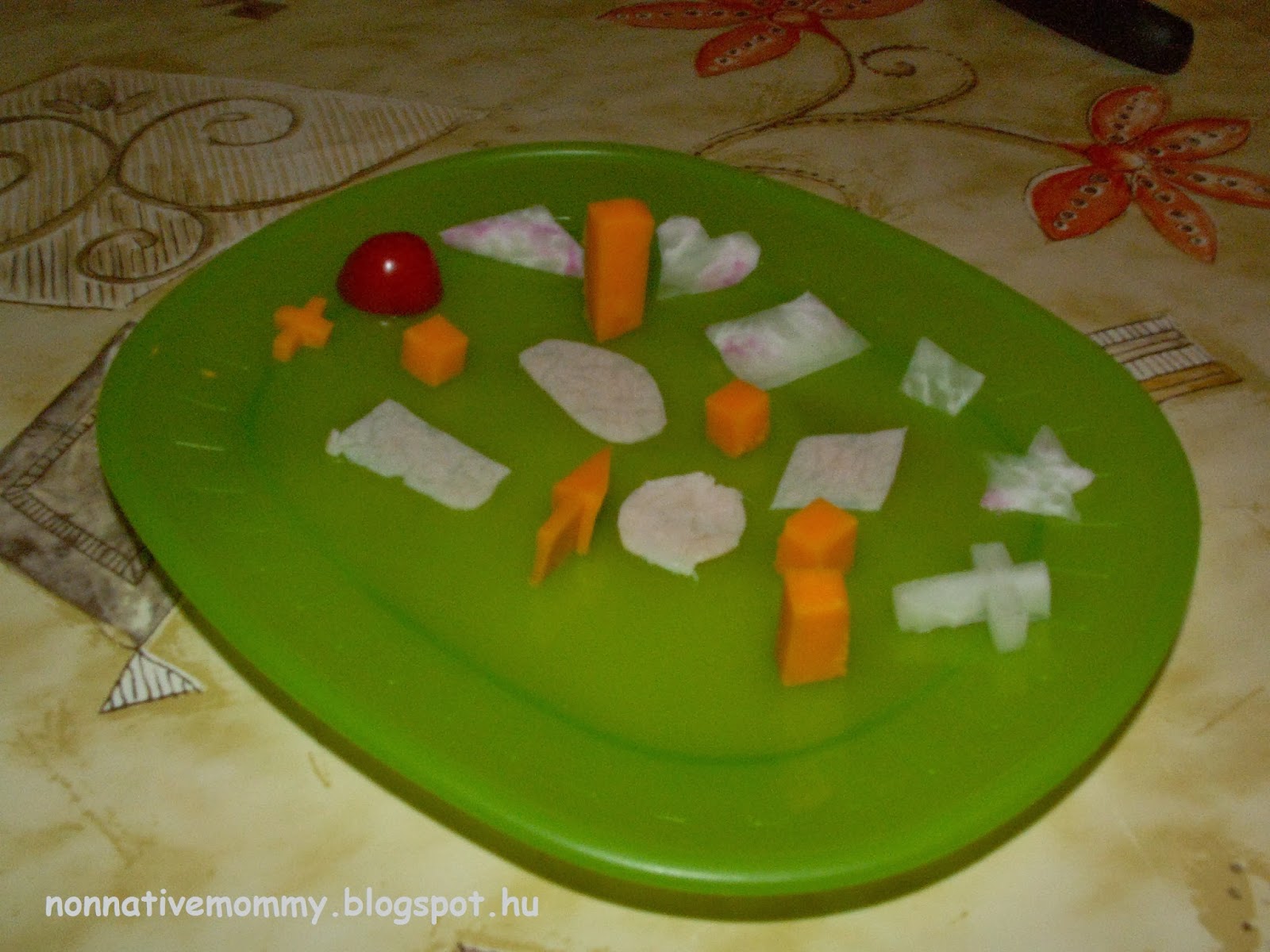
To initiate more talking I always asked what she was doing, what shape it was she was holding etc. Plus, she sometimes said the colour of the shape, too, all by herself.Sometimes E. needs motivation to eat. At dinnertime I prepare some ‘soldiers’ and different shapes carved out of bread, ham, salmon or veggies. It is much more fun for her to eat a pentagon or a triangle than a slice of simple cucumber.


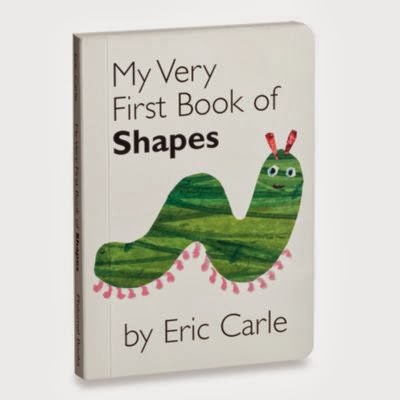
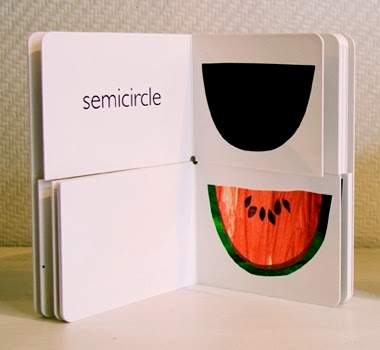
When she turned 16 months we found some books in the library on shapes. This picture dictionary contains two pages of colourful shapes (solids too).


Before taking the book back to the library I had these (and some more pages) photocopied and used the shapes to make flashcards as well.

And a famous favourite (alas, we’ve got it in Hungarian in the library but this unfortunate fact does not keep me back to use it for other language purposes):


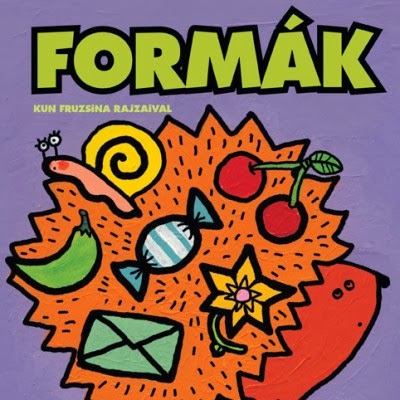
Another Hungarian one: Kun Fruzsina: Formák

Stars

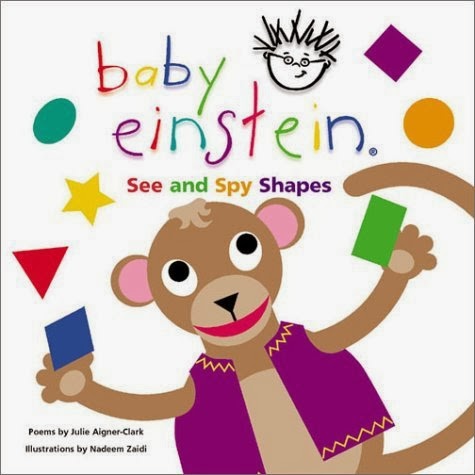
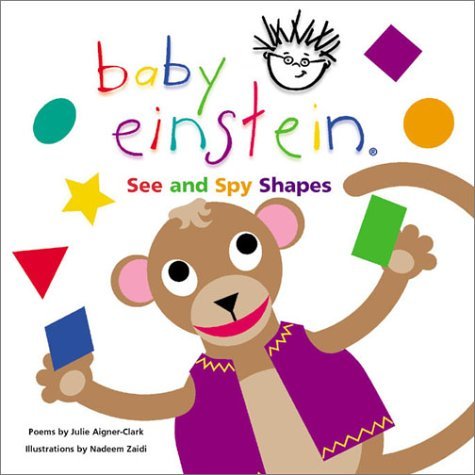
 Last but not least a Baby Einstein book on shapes:

There are tons of books on amazon.com all about shapes. No matter which book you use, but it is another fun way to talk about shapes and see them in different contexts.

Baby’s Best Start (Helen Doron beginner baby course 3rd CD)  has a song about shapes. We listen to it twice a day and E. knows it by heart. Also, the book contains pages of shapes and objects of a similar kind (circle-sun, triangle-sail, square-book).

Often E. identifies shapes by herself. On the table-cloth of our dining table there are some diamond shapes and whenever she walks past she points at them and says: – Little diamond. Here. Big diamond. There.

On the basis of this experience, sometimes we just walk around the house and identify shapes. (The mirror is a rectangle, the washing machine is a cube, the socket is a square and the hair bobble forms a circle etc.) It is also a good idea to collect smaller objects of different shapes in a light box that your child can walk around with. When you have like 10-15 things you can throw them all onto the floor and group them according to their shapes.

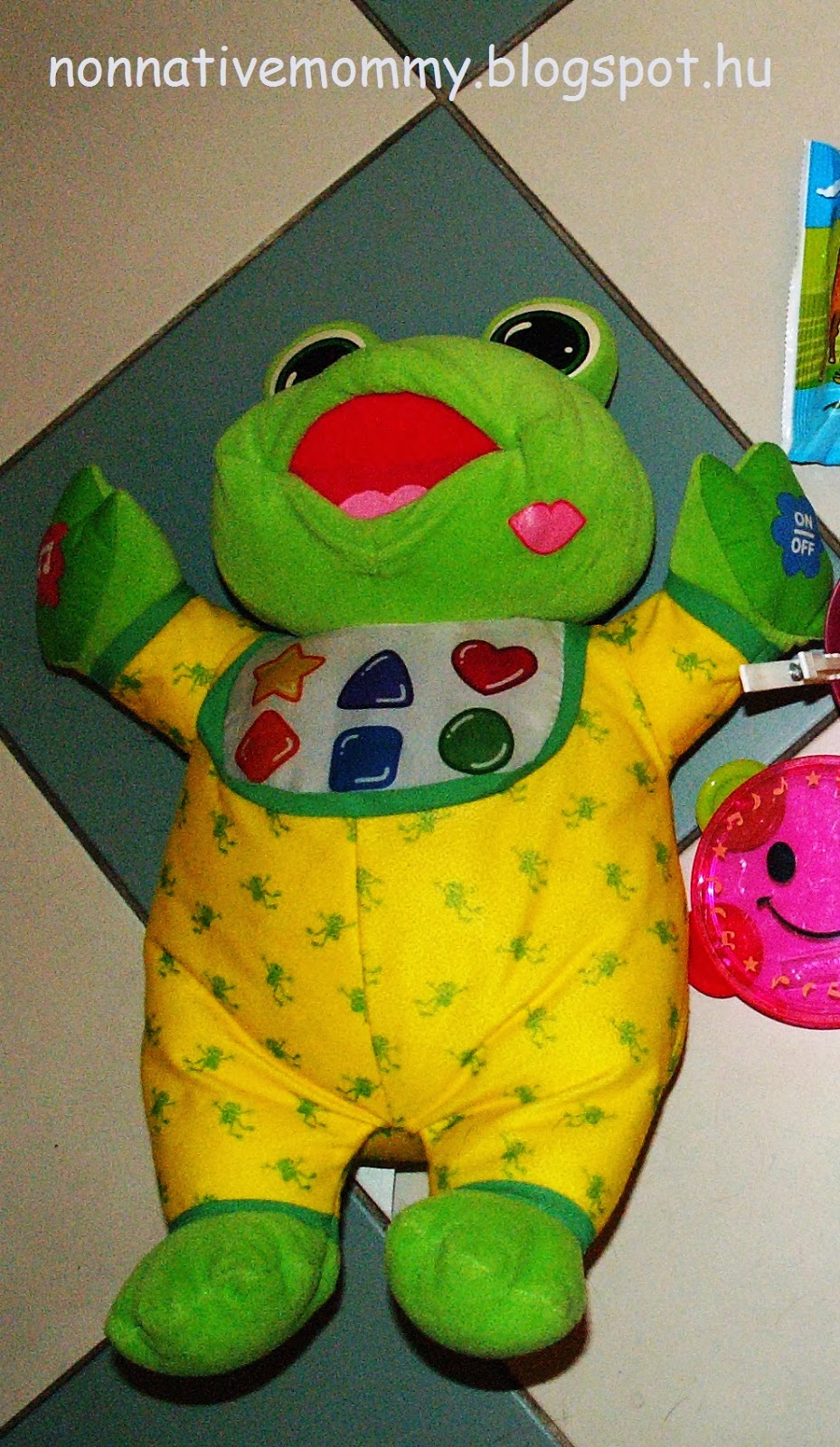
For E.’s first birthday I also bought a second-hand  Froggy with shapes on his tummy. When you turn it on one of the shapes starts flashing. You need to push the flashing button and the Froggy starts singing a famous nursery rhyme/song (Star – Twinkle, Twinkle, Triangle – Mary had a little lamb, Circle – Pat a cake and so on). Unfortunately, the square does not work any more, so whenever E. tries to make the square work I sing the Helen Doron Shapes song.

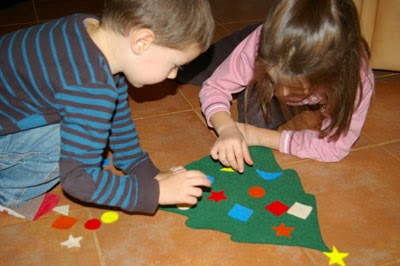
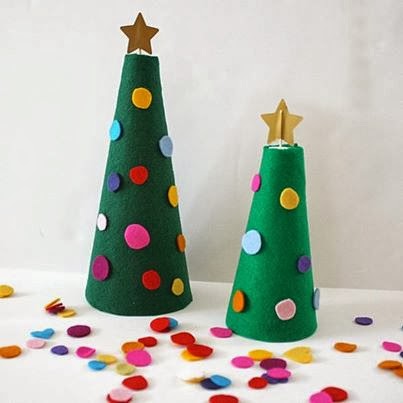
As Christmas was here I was planning to do a little christmasy shape fun, but I did not have time to make it. You can find a lovely Christmas tree decoration game with shapes here (ketnyelvugyerek.hu). The description is in Hungarian, but the picture speaks for itself.

Or a similar activity from Super Simple Learning with a template.

Another simple 3D Christmas tree decoration fun:

http://buggyandbuddy.com/christmas-activities-kids-decorate-felt-christmas-tree/
We are going to do all these next year I am sure, as a little revision. 😉

Finally, let me show you a picture of shape chaos after an hour of playing:


More and more words

Just a short post on how our language development is going. E. is 15,5 months old and about a few weeks ago I stopped counting how many English and Hungarian words she knows.
Now here are some random interesting features of her language knowledge:

English:

  • she knows all the main colours (in both languages)
  • loves saying 3 (or more) -syllable words (aubergine, apricot, butterfly)
  • started to say combination of words (green peas, red rose, purple plum, yellow balloon)
  • she says what she really wants in both languages (more-még, drink-inni, bread-kenyér etc.)
  • her functional language is outstanding – she says thank you, Mommy – when she gives something back to me or when I give her something, here you are (not clearly though – it sounds like: heeyaa), please – when she asks for something, don’t like it – if she doesn’t want to eat something
  • sometimes she sounds like saying a sentence that she doesn’t do in Hungarian (it’s incomprehensible, though)
  • when she points at a spider she says: incywincy
  • potty time is mostly in English so she rather says poopy and peepee
  • prefers songs in English

    Favourite songs now:

  • loves to watch/sing/chant the English alphabet
  • E. likes certain books in English, though I “read” most books in both languages
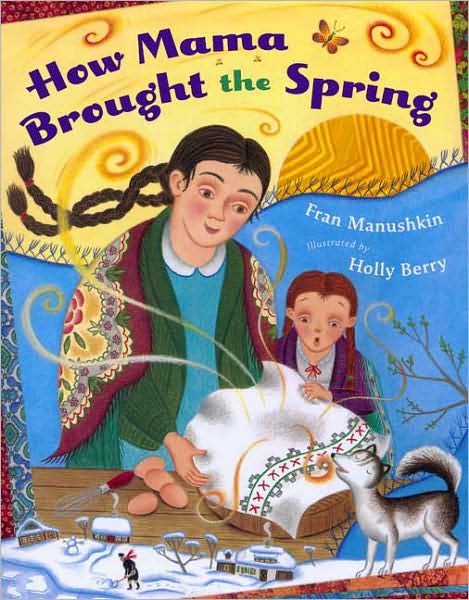
  • Still, her favourite is Fran Manushkin: How Mamma Brought the Spring

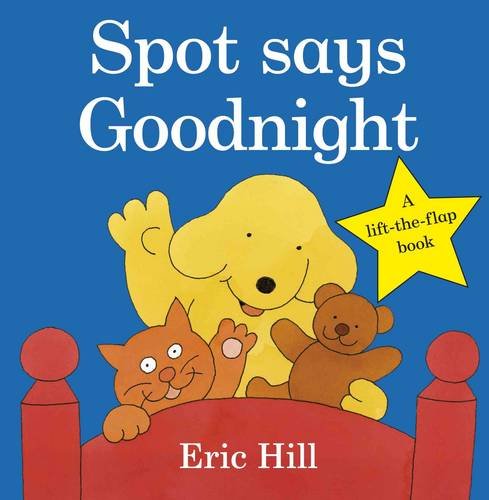
    But she also takes pleasure in Great Day for Up! by Dr. Seuss and Goodnight, Spot by Eric Hill nowadays.

    Hungarian:

    • she is trying to say long words (more than 4 syllables) – palacsinta
    • prefers the countries in this language (her favoutite one to say is Svájc, and her favourite flag is the Belgian – because of the black in it -, though she cannot pronounce it clearly)
    • when she sees the Turkish flag she starts to chant: pont, pont vesszőcske, készen van a fejecske, kicsi nyaka, nagy a hasa, készen van a TÖRÖK basa – her utterence is 50% right, but the intonation is perfect
    • prefers rhymes in Hungarian (Boci, boci tarka, A török és a tehenek)
    • she says tetszik  if she likes something or someone (doesn’t say it in English)


    Some cute details:

    • her favourite animal is the penguin at the moment
    • out of nowhere she calls out her native nanny’s name
    • her favourite colour is black, though she says pink or purple
    • her favourite body part is her belly button (when she has a look at her own, she makes us show ours)
    • her favourite flower is carnation
    • she claps after pooping
    • she loves drawing (onto the parquet, at the playground, on sheets of paper, on the door – but not on the wall yet)
    • she pronounces Peppa Pig as if she were a little native British girl  🙂

    Sleep tight, don’t let the bed bugs bite

    Our days are finished with E.’s evening routine:

    1. watching a little bit of videos
    2. taking a bath
    3. putting on the jammies
    4. drinking milk + reading out a fairy tale (or two)
    5. talking to the angels
    6. falling asleep


    Most of the evening routine is done in Hungarian. This is Daddy’s favourite time spent with E. that I would not like to take away from them. On the other hand I don’t want E. to miss the English vocabulary of the evening routine. Not to mention the fact that reading bedtime stories only in Hungarian is a heartbreak for me. So every now and then (like 2-3 times a week) I try to convince my husband to turn into English. And it works brilliantly.

    Let’s see the programme step by step (the ideal version):

    18:45 – watching videos: D. sits down in front of the computer to watch some English videos with E: (the usual collection of E.’s youtube videos, or this idiotic Meow, Meow song in the Tamil language:

    Don’t ask me why they watch it. One guess is E. LOVES it, the other is this is the way my husband rebels against the English evening routine – just kidding 😉

    In the meantime I do some things around the house, preparation for the feeding, E.’s room, jammies etc.

    If I happen to sit down in front of the computer with E., I prefer to watch a Peppa pig episode or The Going To Bed Book by Sandra Boynton or one of E.’s favourite song Twinkle Twinkle Little Star with the owl:


    19:00 – taking the bath:
    E. sits in the bath and the sea creatures are jumping in one by one – the crocodile, the starfish, the octopus, the whale, the turtle, and then an extra duck, some measuring spoons of different colours, sometimes a filter and more bottle caps. So she can hardly move in the water.

    We usually name the animals, sometimes we attack her with the animals, and spay her with water, of course, while we comment the happenings in English. But mostly we follow what she wants to do.

    Sometime she asks for her plastic book – one is a biblical story of the lost lamb, the other is Vizipók and his friends. I tell her the Lost Lamb story in English, we talk about the pictures, and at the end I ask her to show me the shepherd, the lamb or other things in the pictures. But I’m in trouble with Vizipók as I don’t know the names in English or they sound really silly (Ormányosbogár = Snout Beetle, Keresztespók= Garden Spider) so I rather hide this booklet when we have a bath in English.

    Another favourite is Mommy Duck and her ducklings. Mommy Duck can carry 3 little ducklings on her back. When we play with the ducks Mommy Duck is swimming around E. and when the ducks are behind her one of the ducklings is taken off Mommy Duck’s back (by D.). In the meantime we sing 5 Little Ducks (well, three in this version). E. is so cute as she is trying to turn back to see how the ducklings disappear, but usually she is not quick enough.

    Another activity is toothbrushing. E. asks for her toothbrush, then she brushes the crocodiles teeth while we are singing This is the way we brush our teeth. She also wishes to brush Daddy’s teeth or mine. Every now and then she brushes her own teeth as well. If she is not in the mood, I do it for her, which she doesn’t really like.

    When we are finished in the bath we say good bye to the toys. E. hands me the toys one by one and we say good night to them. If I tell her to look behind because there is one more toy, she understands it perfectly and turns around the grab the object. While we are putting the toys away she is waving good-bye.

    19:30 – getting dressed into pyjamas:

    We usually play the changing table games I have already posted about. D. puts on E.’s jammies and sleeping bag. He usually sings some songs. I prepare her milk. E. turns off her light, only a bedside lamp is on. Then E. and I sit down in the rocking chair to drink her milk, and D. reads a story or two. If we read in English at the moment we are reading the book: How Mama Brought the Spring by Fran Manushkin. It’s for kids around the age of 5, but E. adores the pictures in the book. Before E. finishes her milk, D. says good night to her and leaves the room. Then we turn off the light and talks to the angels. I say thank you for the nice day and recall the lovely happenings of our day. E. often repeats the words she can also say like, baby, happy, her name or grandparents’ name, Daddy, Mommy etc. SO actually she thanks for everything that happens to her. Then I put her down into her bed (she says ‘bed’) and I give her dummy (she says ‘dummy’) and I give her a textile nappy and her doggy she always sleeps with. I kiss her goodnight and leave the room. Most of the time she falls asleep within 5-10 minutes. Sometimes she chats to herself a little. If it’s an English evening she talks to herself in English.

    So here are some expressions how to say good night:

    • Sleep well
    • Sweet dreams
    • Nighty-night
    • Good night, sleep tight, don’t let the bedbugs bite (you can find the origin of this phrase here – quite interesting, worth reading the theories. The one I like the most is the rope idea.)

    Have a good night!

    Books we are using

    E. is extremely interested in books and  we, as a family, find it important to have a good and varied library at home. If you raise your child bilingual, having great books is essential from the very beginning. Quality counts more than quantity. We also use some Hungarian books in English and vica versa. I would spend my husband’s monthly salary on books if I could. So far I’ve managed to collect a few books both in English and Hungarian:

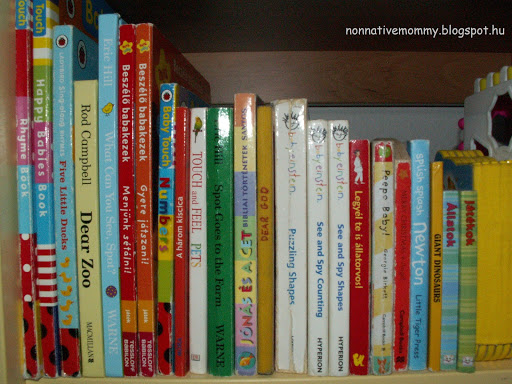
    Our small baby library

    The books you can see in the photo above are the ones that are available for E. at any time she wants them. I also have some more rhyme books, fairy tale collections and other stories in paperback format. I rather keep them away from her at present as she is living her life through experimenting (chewing, tearing, hitting, folding etc.) with everything.

    Reading out loud to your child, no matter in which language, is a must. Even at a very young age. In our case both in English and in Hungarian.

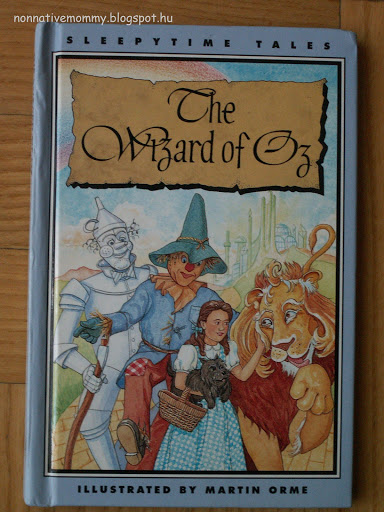
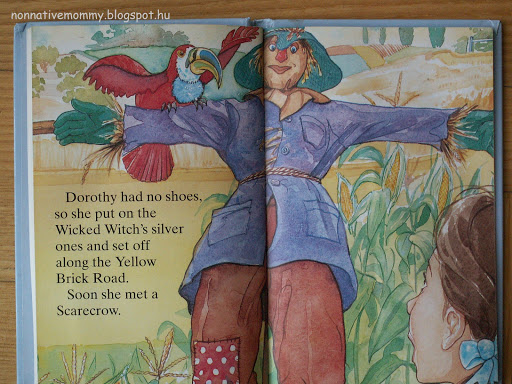
    E.’s biggest favourite is The Wizard of Oz at the moment. She is now a year old. And of course, we did not start it with this story. What we have is not a board book so she can’t have it; I take it only when we read it, so it is not available to her 7/11. Probably this is also part of the magic. I bought this book in a second hand Hungarian (!) book shop for 100 HUF:


    I try to read it out with sound effects. The characters have different tones of voice, when the storm is coming I say whoooosh or sssssshhhhh, when the lion appears I roar, when the wizard prepares the balloon I imitate the blowing of a balloon etc. E. really loves all the sound effects. After I have read the book, she can get it for a short while. E. tries to turn the pages (it’s not easy for her as she is used to board books) and while we are looking at the pictures I tell her what we see in a few words. Then we put the book back to its place. This is when she starts whining, sometimes crying but it’s quite easy to direct her attention to something else, luckily.

    But I should start with the beginning. Let’s go in chronological order:
    At the very beginning, from birth to 6 months I used three CLOTH BOOKS.

    
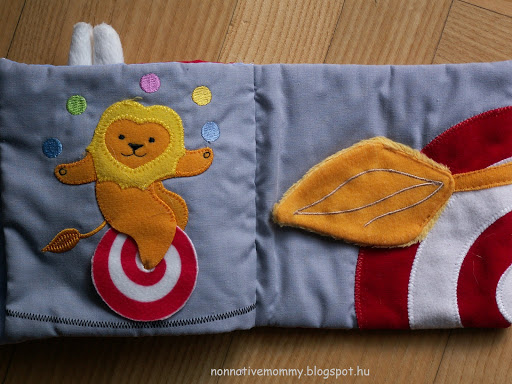
    IKEA cloth book – The Giant Elephant’s Circus
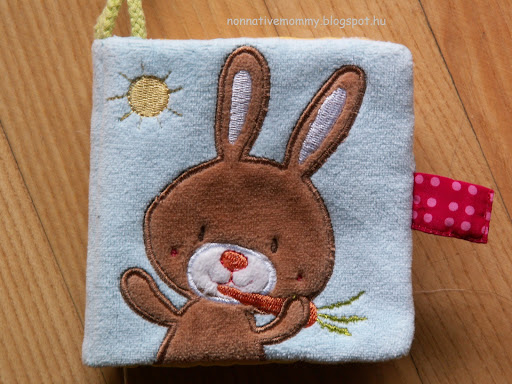
    One from IKEA, and two from DM (we got them all as presents). When she couldn’t move around too much and too fast, I just put down the book so she could see it and told a story (The Giant Elephant’s Circus, The Rabbit’s Carrot Garden, The Secret Treasure – the latter is an underwater story with sea animals, alas, I have no pics of it as it landed at one of the Grandmas). She paid really close attention. Then by the time she could touch the book, I described the sounds they made (crackle and rustle), the different surfaces they had (rough, smooth, soft). Later on I stared to name the colours, the very simple sentences got more complex, though the main story line remained the same.


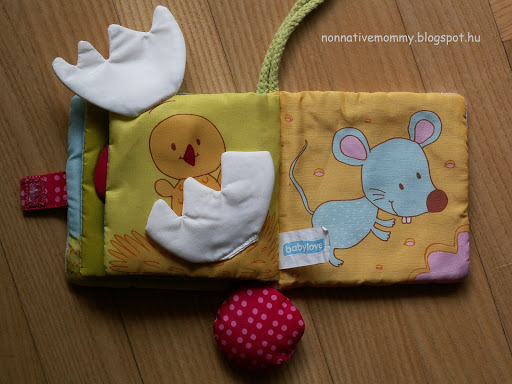
    Babylove cloth book -The Rabbit’s Carrot Garden


    The first thing E. could do with her hands after grabbing an object is turning the page of these books, and after a while BOARD BOOKS. It was after the age of 6 months, but this time she was just interested in turning the pages. When she was around 8-9 months old she was closly examining certain pages and skipped others.

    I, myself, LOVE the Ladybird series. They have so many great books for all ages. The Baby Touch series is what suits a child under 3 the most. We have 2 of these colourful, vivid fun books which can be touched, scratched, pushed and licked:


    In case of the Rhyme Book, I say the rhyme or sing the song which is on the given page while E. is touching and licking the different surfaces. I often ask her questions about the pictures (Where’s the Teddy? or Are these flowers the same? What colour is the pussycat?) and then I answer them (There he is, No, they’re different, She’s orange), but nowadays she’s started to answer me babbling or pointing or even saying some wordlike utterances.

    In case of the Happy Babies Book, we mostly touch and scratch, or wave hello or bye-bye to different creatures. Also, I say a lot of colours here. If I’m a little bored with it then I sing along a song which could be connected to the pictures. E.’s favourite page is the last one, so we just sit over it and push and lick the squishy, circle and the shiny, silver triangle.

    Another number 1. book with small kids is the Spot series by Eric Hill. Here is a video where Eric Hill himself is reading out one of his books, Where’s Spot?. The little hands love turning the flaps (but be careful, they can tear them off in the twinkling of an eye). Spot is very well supported online as well. Have a look at Spot’s homepage.

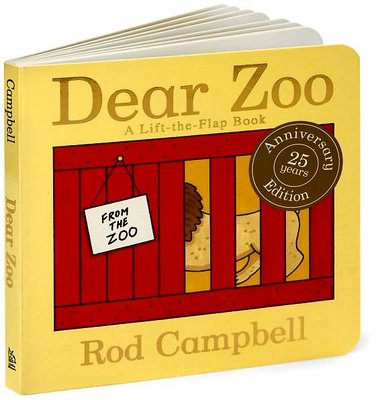
    E. enjoys flap books a lot. Another one in our library, which is “read” on a daily bases, is Dear Zoo. You can have a look at the inside in this funny video.

    There are some educational books for early learning purposes. The market is vast for these books and there are a great number of them. What we have are some Baby Einstein books about shapes and numbers (I managed to get 3 of them at a mom-to-mom sale in the local youth centre for a few hundred HUF). 
     

    I could go on and on listing the books we love using or would love to buy but there would be no point. As far as I’ve experienced it, it doesn’t really matter what books you have, and how many you have as long as you open them regularly, on a daily bases, or as frequently as your child is interested in them. Even if you don’t have a well lined purse (well, well it’s not a surprise that these baby books cost a fortune) you can find discounts and second hand books too.

    Check out the following sites:


    Angolkönyvek.com

    There’s a site (bookdepository.com) where delivery is free. What’s more, you can read to your child online for free (though it’s not really for babies, or at least my little one doesn’t really enjoy it that much yet): wegivebooks.org . Another possibility is to make your own book, but it’ll be another post.

     
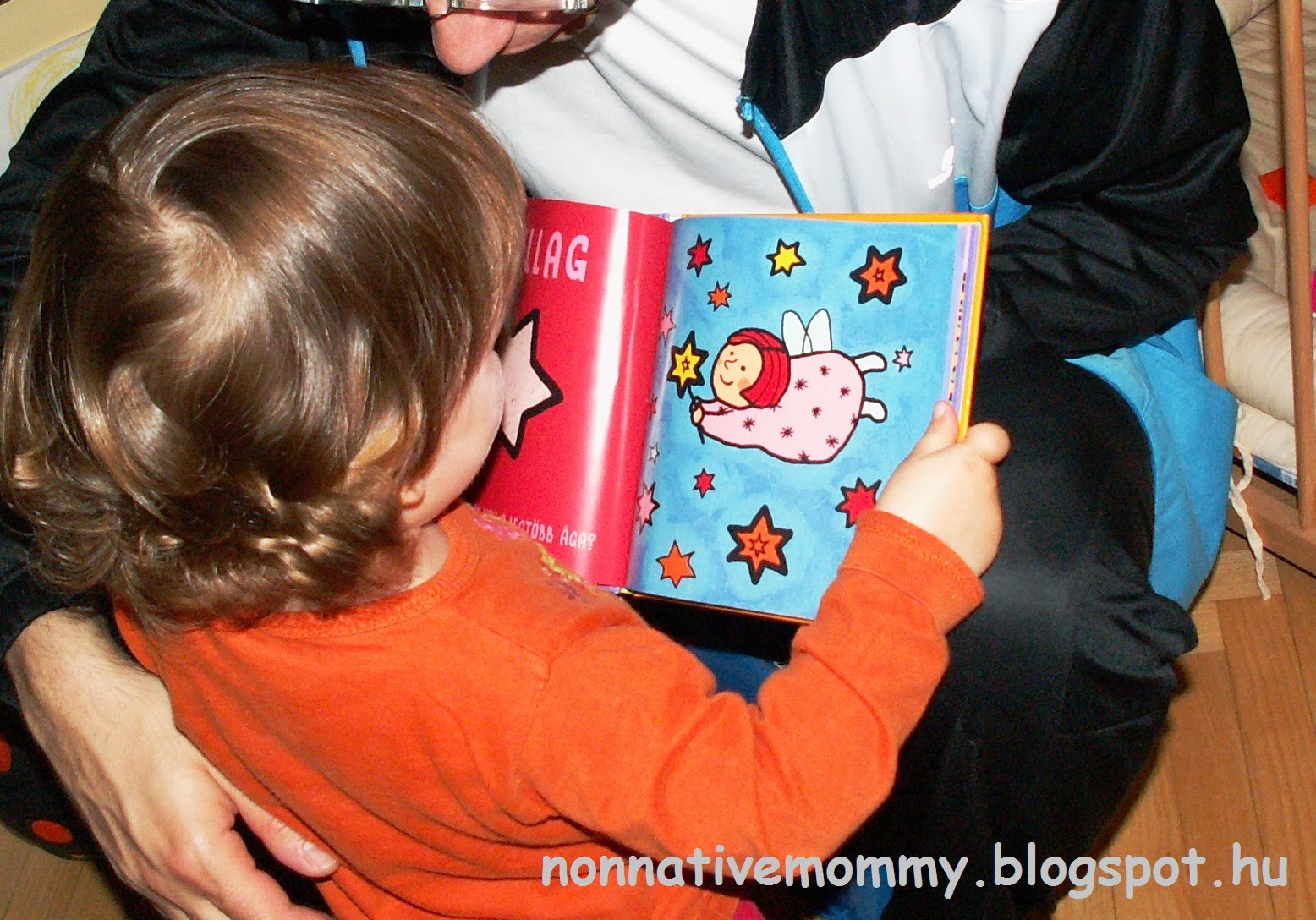
    And to finish this post, here is a photo of E. reading her favourite book: