New flashcards – flags

I have created another pack of flashcards: the European flags. The pack is not full yet, but quite a lot is done. First, I just wanted to check if E. is interested in them or not. As they are very colourful, she loved them at first sight.


I tried to concentrate on countries which are neighbouring countries of Hungary, or I have some information about, or we have already been to etc. I, myself, coloured them AGAIN. (I hope baby Jesus will bring me a colour printer for Christmas). To make the flashcards more durable I laminated them (that was the easier part).

Activities  you can do with flags:

  1. just have a look and say the name of the country
  2. name the colours on the flag
  3. say if the stripes are vertical or horizontal (E. loves long words)
  4. tell your child the capital
  5. talk about the country if you know it (in our case for instance: Ireland, Mommy lived there for a year a long time ago, the U.K. – this is where A. (our native nanny) comes from, Turkey – this is where Mommy and Daddy were on their honeymoon, Hungary –  we live in Hungary etc.
  6. show two flags and ask: which one is … ? and your child can pick the right one (E. likes this activity not only with cards, but also with soft toys, building blocks, flowers or coloured pencils…. whatever)
  7. turn down three cards and let your child turn them up one by one, then say the name of the country (and the capital or the colours – combination of 1.-2.-4.)
  8. spread all the cards on the floor and tell your child to choose his or her favourite one (maximum three – E. would give me all the cards 🙂 )
  9. pick the flags with the same colours and group them (redwhite: Switzerland, Poland and Austria, bluewhitered: the Czech Republic, France, the Netherlands, Russia, Croatia, Slovakia, Slovenia, redwhitegreen: Italy, Hungary, Bulgaria, blackyellowred: Germany, Belgium)
  10. if you make 2 sets you can play a memory game (I had neither time, nor energy to make two sets)

More flags are on the way:

  • I want to make England, Scotland, Wales and Northern Ireland
  • I cannot leave out the USA and Australia as they are among the most important English speaking countries
  • Countries of Asia, Africa and South America  are coming too

I wish a day would be about 36-38 hours long…

Home-made tools for language practice – matching colours

E. LOVES colours and all the games in connection with colours. One of her first words was a colour (red in English, kék -blue- in Hungarian). So I though I should make some fun activities with the colours. Here is one of them:

I drew circles and coloured them on two white sheets. Just to be on the safe side, I laminated them to make them more durable. On one sheet there are the basic colours: red, blue, green black and white. On the other one: brown, pink, orange, yellow and purple.

From the kitchen I picked some bottle caps, lids of different colours, but I didn’t have black and orange so I took off an orange and a black magnet from the fridge.

I put all the caps, magnet and lids into a box and put it in the living room. E. went there and took it off immediately. Without me showing her what to do, she started to match the colours. She can concentrate on it for few minutes only, but she always says out loud the name of the colours. Most of the time she uses one language, either English or Hungarian. Only very rarely does she mix them.
Sometimes I pick the caps from the box and she shows me where to put them.

We never get to the end of the matching, though. Either she gets tired of it, or runs away with the two favourites: yellow and purple. 🙂

Home-made tools for language practice – Peek-a-boo house

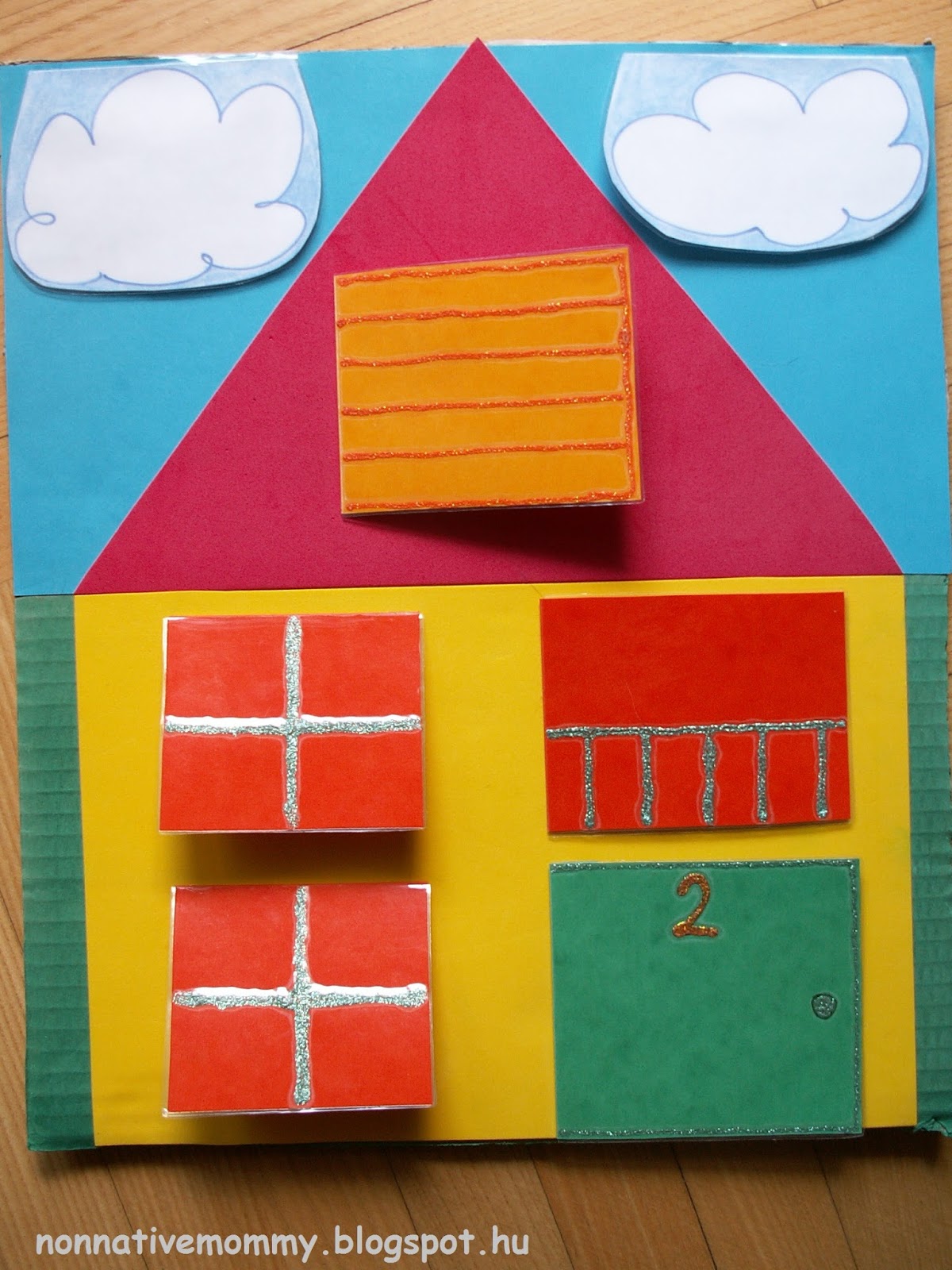
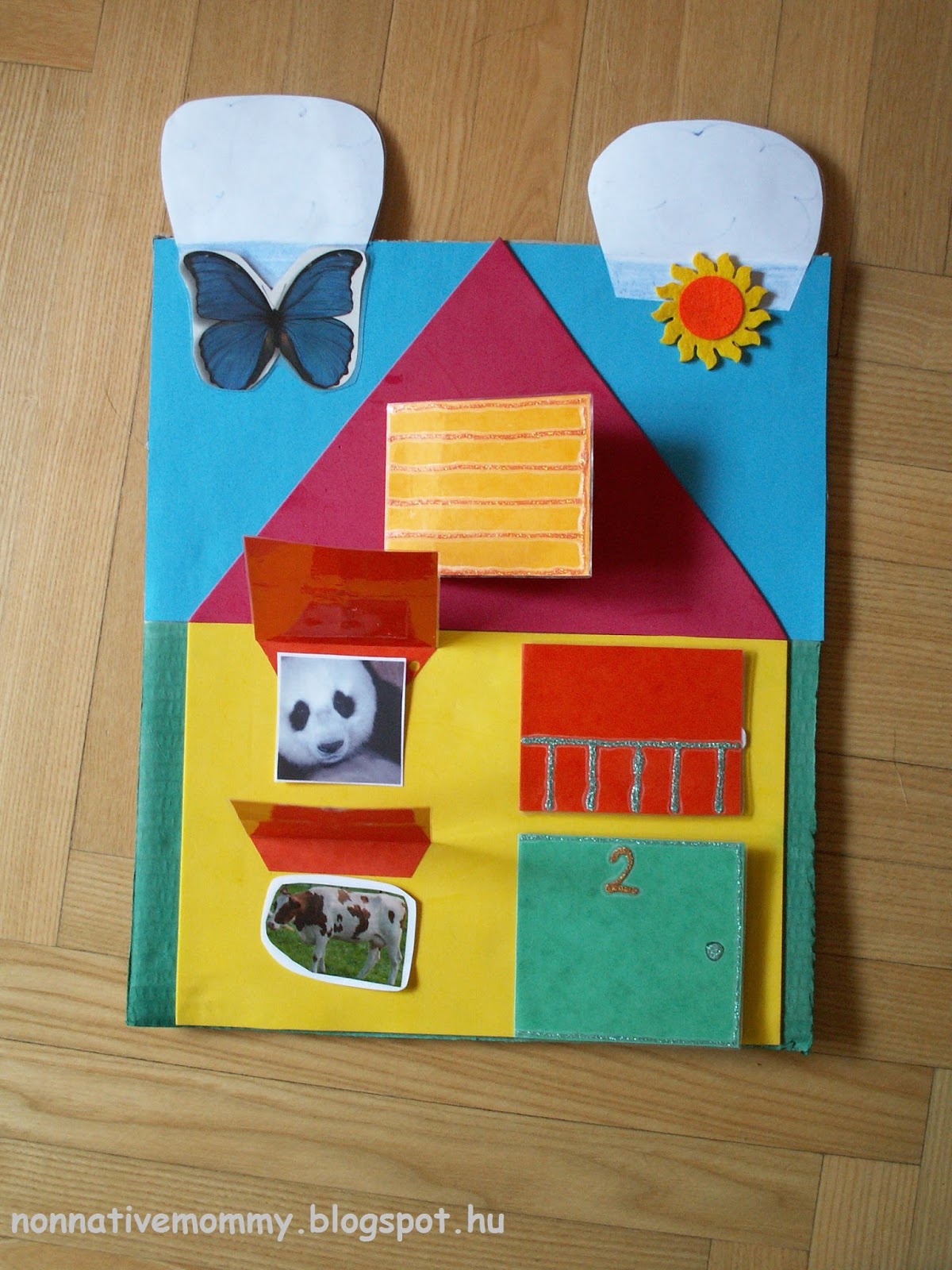
This idea came from the “lift-the-flap” books, like Spot goes to the farm by Eric Hill. E. likes peeping to see what’s behind a door, a bush or a gate. Also, I saw this technique to be used at the Helen Doron lesson to practice new/old vocabulary. So why not make my own?

The basis is cardboard and I decorated it with orange and green paper, as well as red and yellow craft foam sheets (“dekorgumi”). The door and windows are laminated and glued on the surface. The sky is made from coloured paper and the green grass is painted.

(E. has already torn the clouds partly, so I strengthen them with Cellotape). I hide animals, people, babies, pieces of furniture etc. behind the flaps. Whatever works.

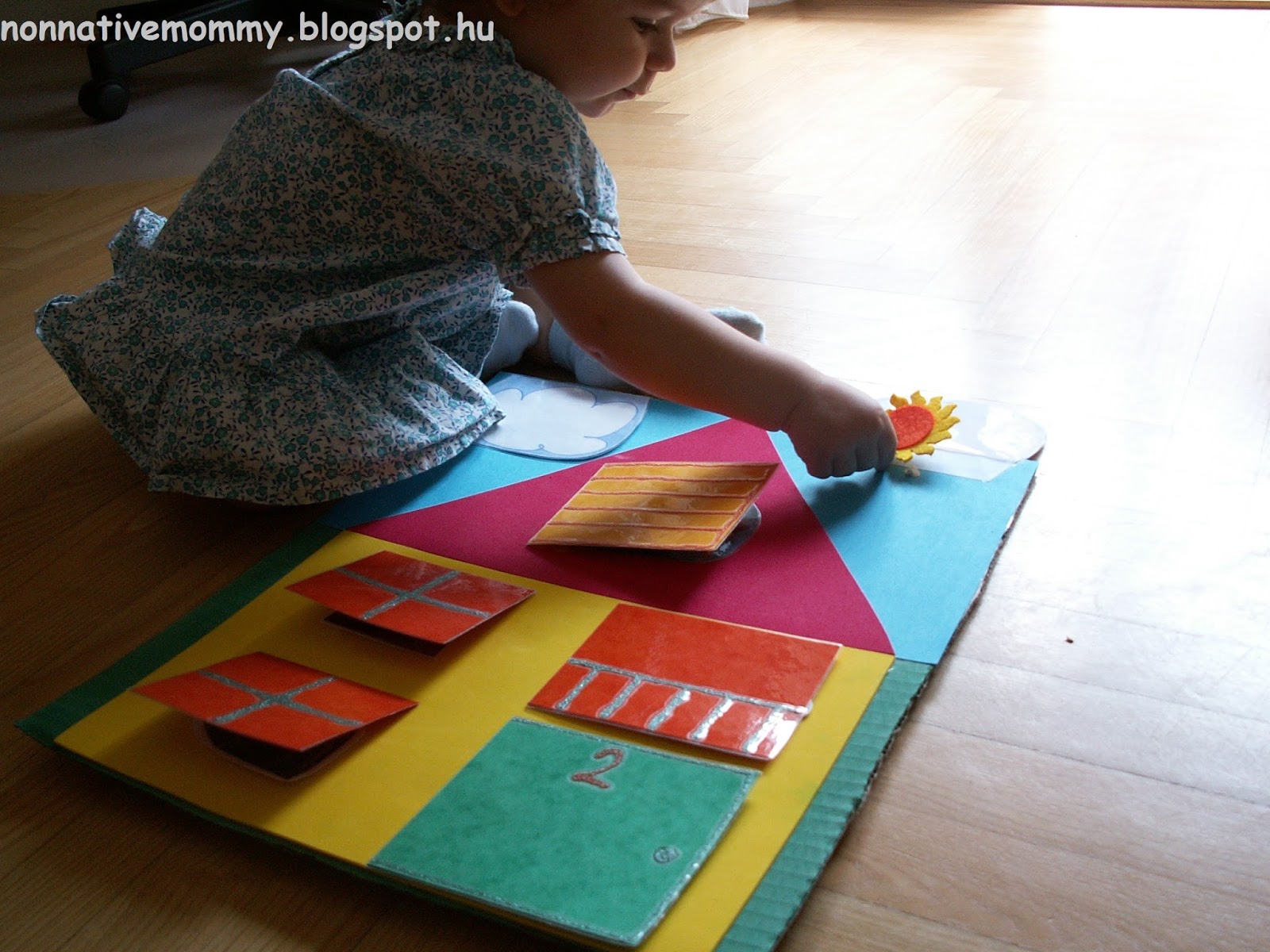
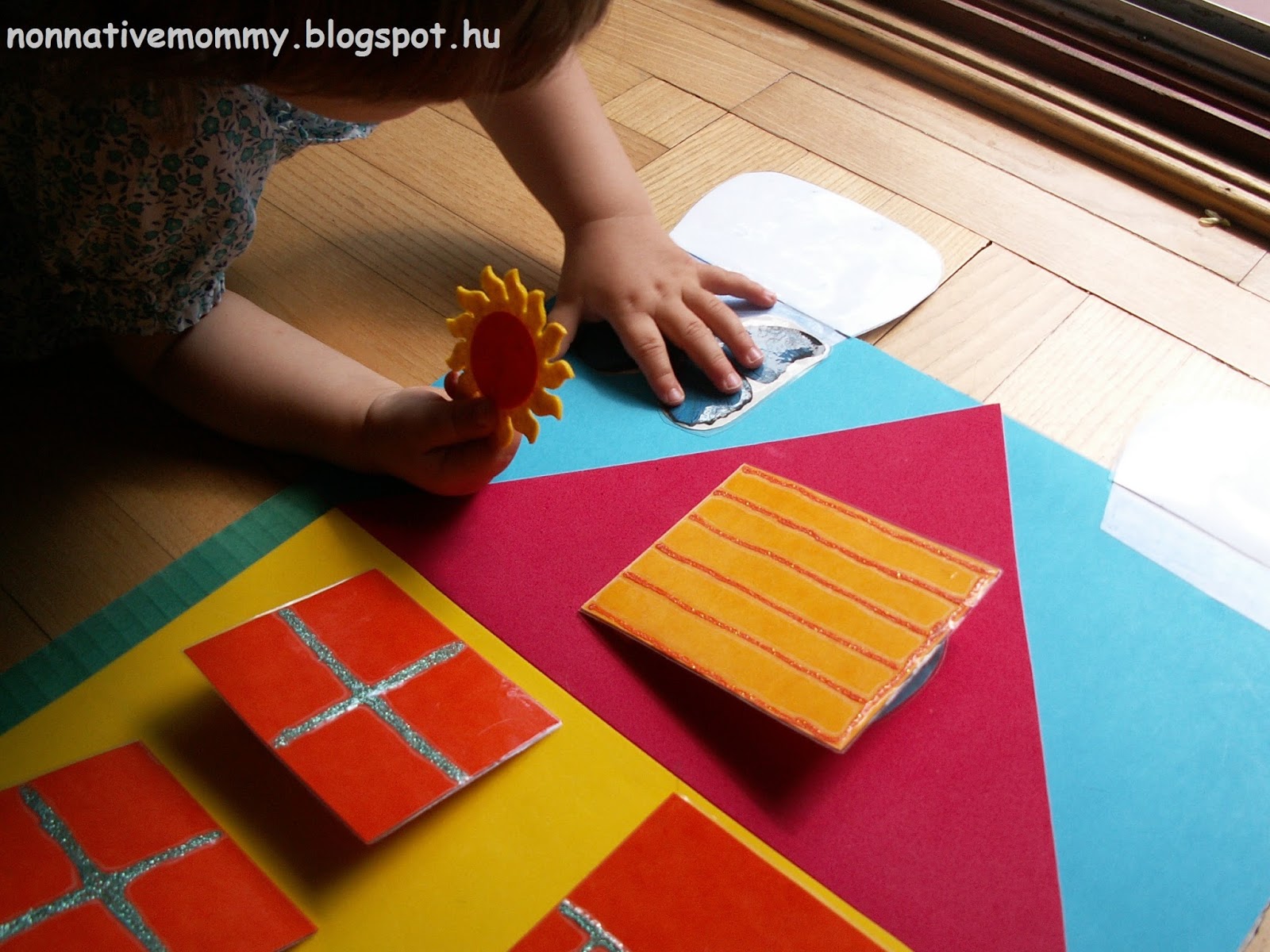
It’s a good idea to stick the house on the floor or on the wall as while the kids are fidgeting with it, it moves a lot and makes it more difficult to open the flaps and easier to tear off a window.

E.’s favourites are the sun and the butterfly. She picks them and walks around with them in her hands. When I changed the pictures she was surprised at the change. Now she’s found the box of pictures and not surpised any more. She tries to change the pictures herself.