Home-made tools for language practice – matching colours

E. LOVES colours and all the games in connection with colours. One of her first words was a colour (red in English, kék -blue- in Hungarian). So I though I should make some fun activities with the colours. Here is one of them:

I drew circles and coloured them on two white sheets. Just to be on the safe side, I laminated them to make them more durable. On one sheet there are the basic colours: red, blue, green black and white. On the other one: brown, pink, orange, yellow and purple.

From the kitchen I picked some bottle caps, lids of different colours, but I didn’t have black and orange so I took off an orange and a black magnet from the fridge.

I put all the caps, magnet and lids into a box and put it in the living room. E. went there and took it off immediately. Without me showing her what to do, she started to match the colours. She can concentrate on it for few minutes only, but she always says out loud the name of the colours. Most of the time she uses one language, either English or Hungarian. Only very rarely does she mix them.
Sometimes I pick the caps from the box and she shows me where to put them.

We never get to the end of the matching, though. Either she gets tired of it, or runs away with the two favourites: yellow and purple. 🙂

Home-made tools for language practice – Peek-a-boo house

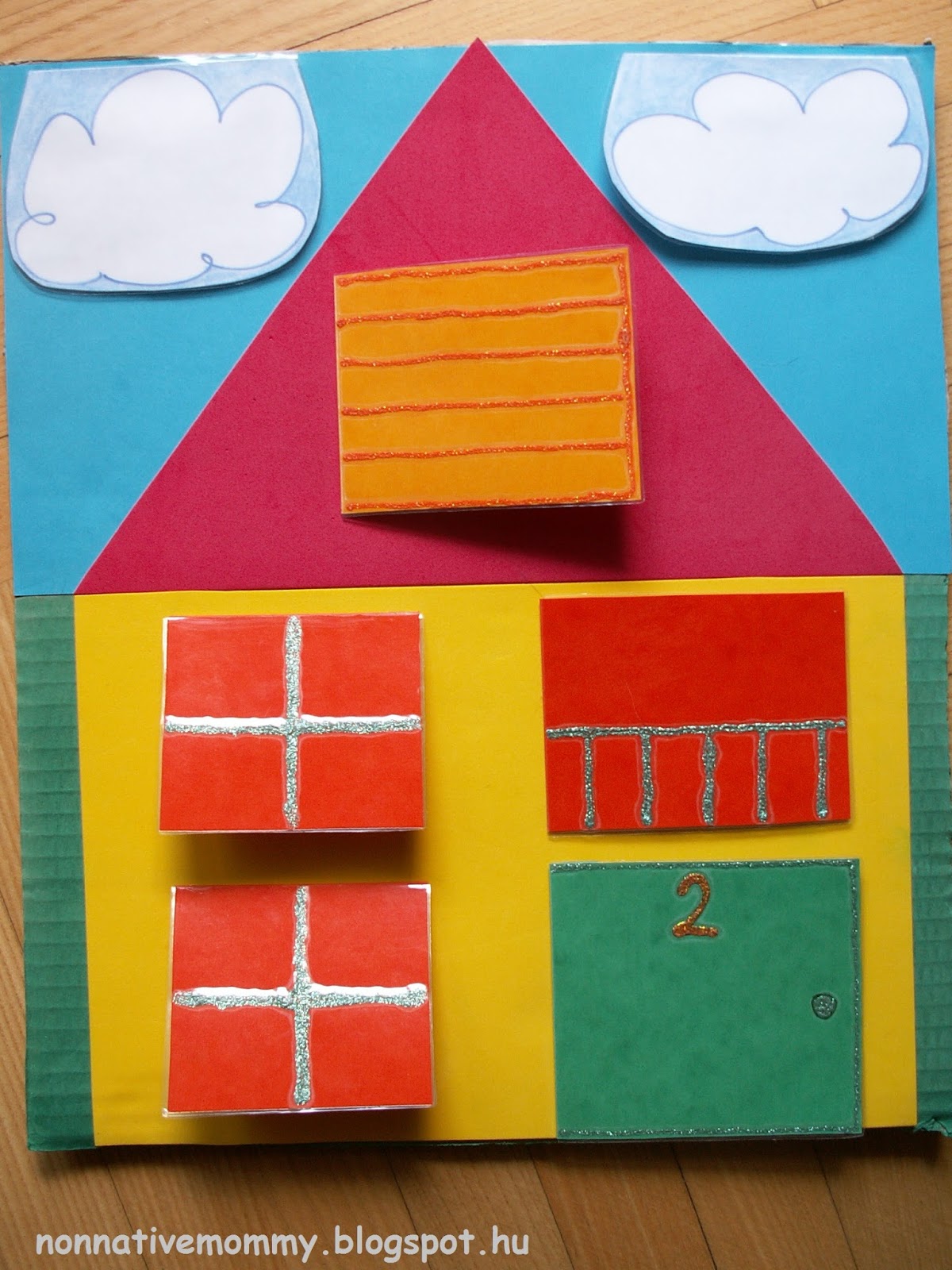
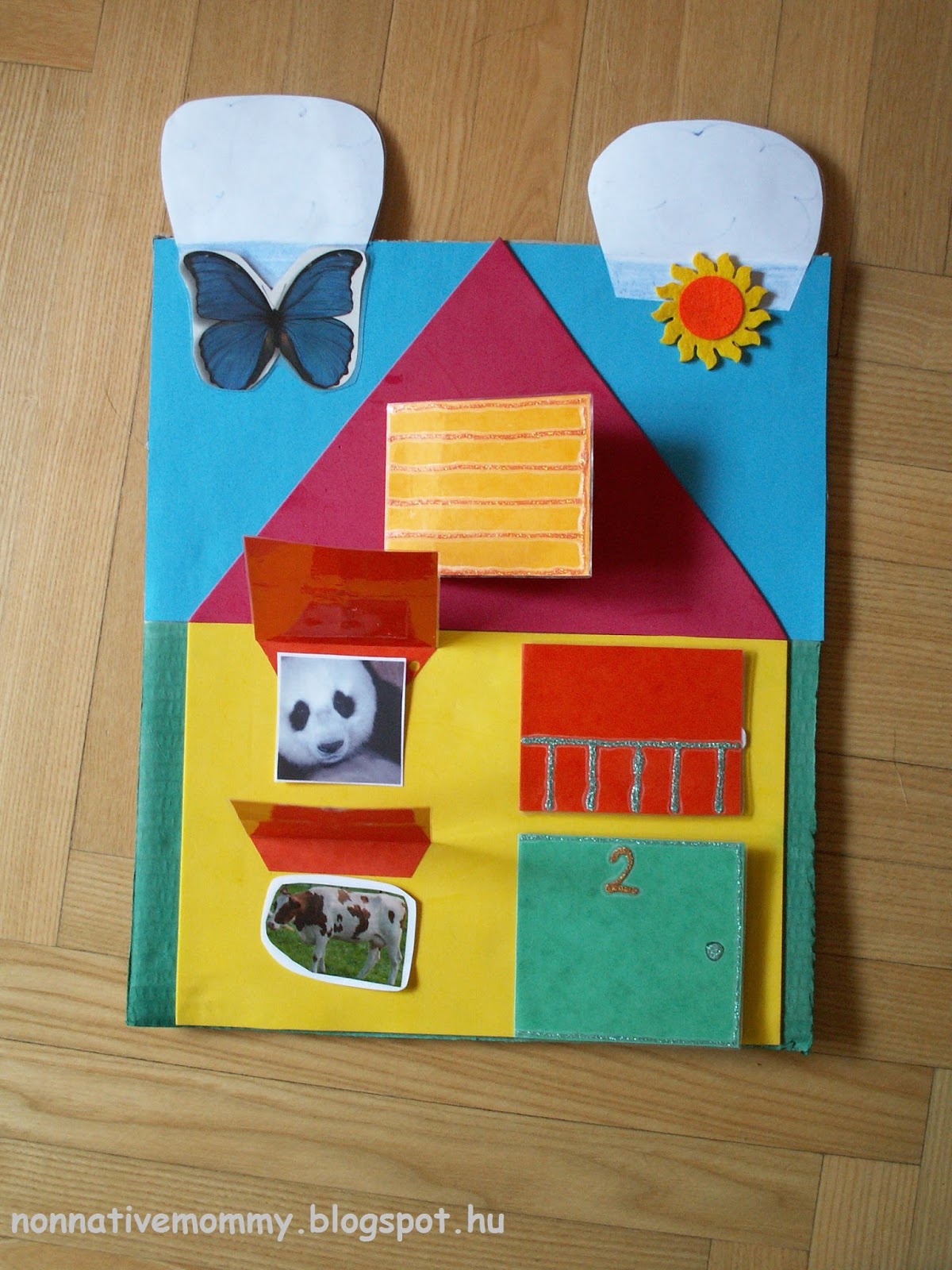
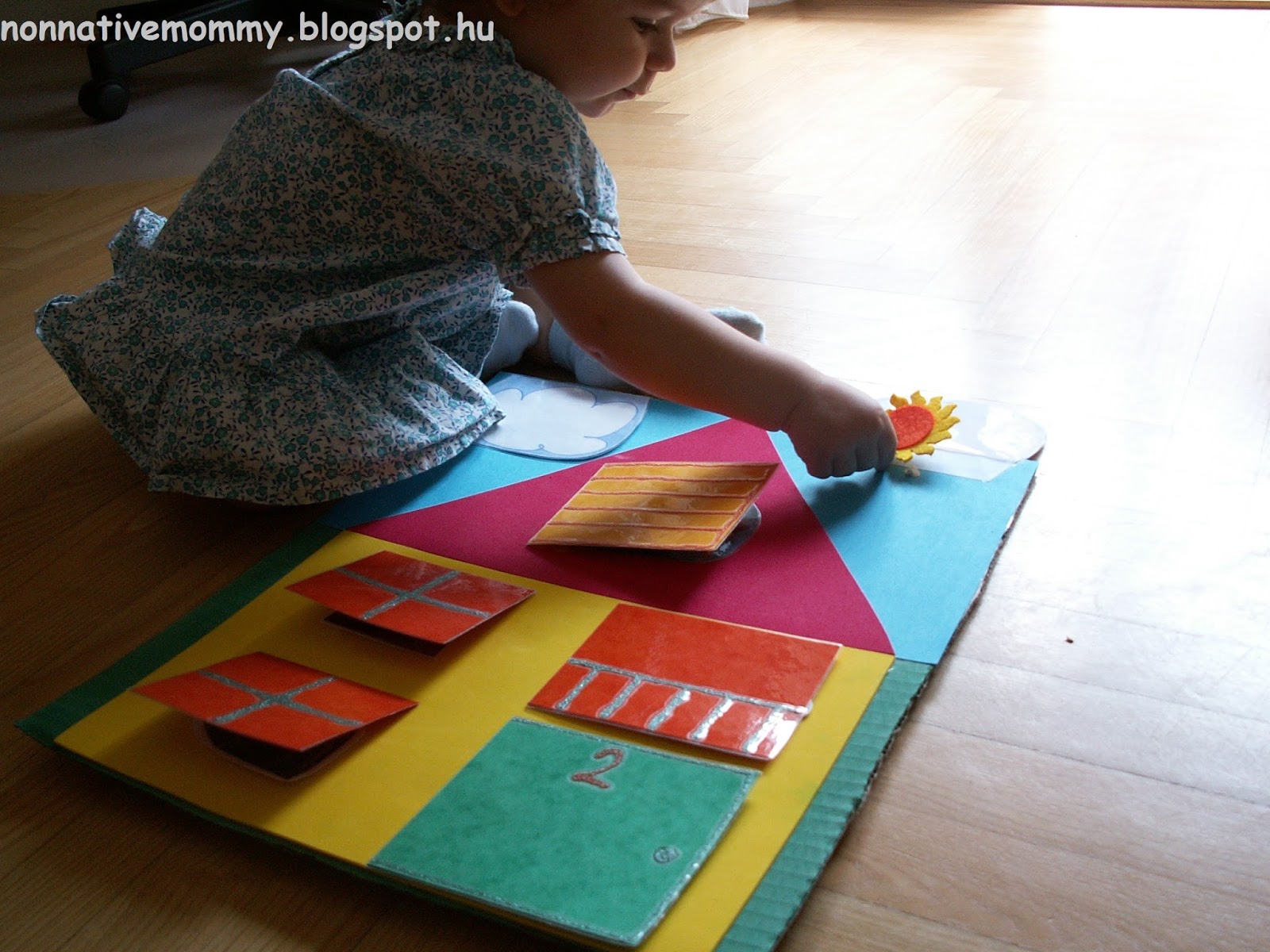
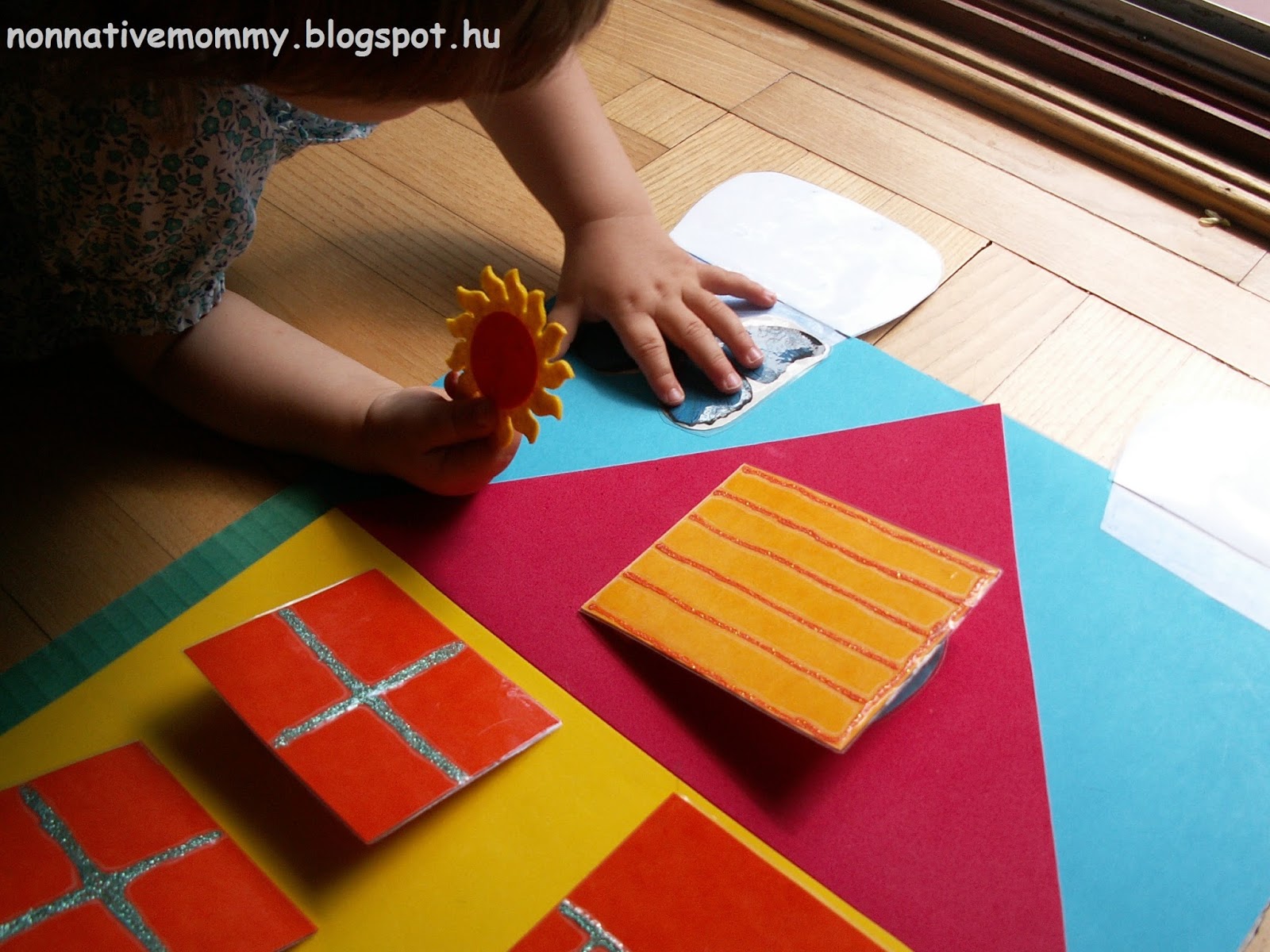
This idea came from the “lift-the-flap” books, like Spot goes to the farm by Eric Hill. E. likes peeping to see what’s behind a door, a bush or a gate. Also, I saw this technique to be used at the Helen Doron lesson to practice new/old vocabulary. So why not make my own?

The basis is cardboard and I decorated it with orange and green paper, as well as red and yellow craft foam sheets (“dekorgumi”). The door and windows are laminated and glued on the surface. The sky is made from coloured paper and the green grass is painted.

(E. has already torn the clouds partly, so I strengthen them with Cellotape). I hide animals, people, babies, pieces of furniture etc. behind the flaps. Whatever works.

It’s a good idea to stick the house on the floor or on the wall as while the kids are fidgeting with it, it moves a lot and makes it more difficult to open the flaps and easier to tear off a window.

E.’s favourites are the sun and the butterfly. She picks them and walks around with them in her hands. When I changed the pictures she was surprised at the change. Now she’s found the box of pictures and not surpised any more. She tries to change the pictures herself.

Helen Doron Baby Days II.

August has arrived so we have taken part in another few days at our Helen Doron Language School. Here is the summary of our 3 sessions:
Day1: Fruits
I was really happy as this is one of E.’s favourite topics. Her eyes sparkled when she saw a picture of an apple and a straberry in the teacher’s hand. She looked at me and glowed with delight. I felt she knew the whole session will be about fruits. So I wasn’t surprised at all when in the middle of the lesson she was brave enough to say apple, pear and nana (for banana). She says strawberry in Hungarian (she always chooses the easier word of the two languages – very smart). The activities we had:

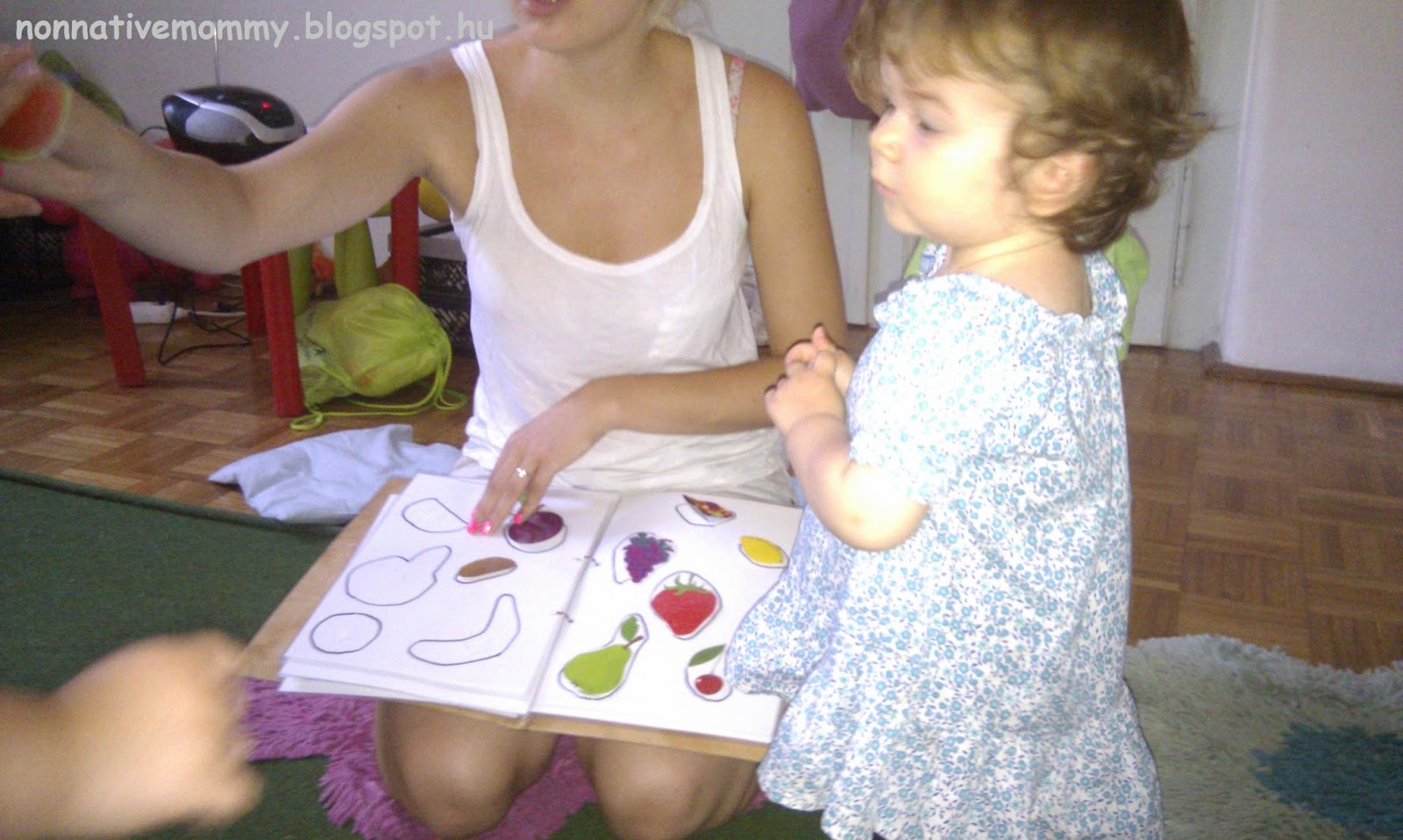
  • matching half fruit
  •  matching fruit with their shapes
  •  sticking fruit on a big tree
  •  taking plastic fruits out of a pelican’s beak then put them back
  •  turning flashcards facing down
  •  fruit song ( I like bananas…)
And of course the usual revisions, like the Uppety song or the Waving song.
E. is waving to Rosie, the doll (on the 3rd day)

The teacher in me would have included the colours a little bit.

I was taken aback when the picture of an avocado came up. Well, we live in a different eating culture here in Hungary.

However, the main point is E. enjoyed herself a lot. I haven’t seen her this active yet. And the number of mums and kids was better than at the beginning of July (6 mums with 6 kids – too many).

Day2: Animals

 E. wasn’t in a good mood today. We had a rough night and she was clinging to me all day. It was the same at the lesson. She was much less active, which was a pitty. As I could see the other kids were a little bit less patient than they usually are. But again E. said quite a few animal names and the sounds they make, too. (hippo, doggy, miaow, hee-haw)


I liked the ‘Abracadabra’ game. It was about showing 3 animal pictures and the same animals in soft toys. Then the teacher covered the toys with a blanket and made one of the animals disappear as she lifted the blanket up. Then she asked which animal was missing and made the kids match the soft toys and the animal pictures. It could draw and keep children’s attention.

We also listened to some real animal sounds and had to find the picture of the animal we could hear. It was also good fun, though there was some technical glitch, which also happened when we were listening to the animal sound song.

Another great activity was a bowl of water with plastic animals in it. I was scared to see the bowl full of water but nobody got wet, luckily, and the kids took great pleasure in splashing a bit in water. (Not to mention how refreshing it was in this heat). It is also a nice activity from sensory point of view. One of the reasons why I like the Helen Doron Early English is the wonderful combination of several kind of development involved at the lessons.

We also revised a little bit of the fruits (matching Velcro-ed fruit with their shape and matching one type of fruit with two of its kind with a marker on a white board – E. was interested in the latter as we started to do a little bit of drawing together).

Fruit activity – sorry, taken with a mobile

After that the kids chose a toy animal from a big bag (E. said: ‘choseone’ as if it were one word) they had to lift it up and put it down, then turn it round while we were listening to the Uppety song.

All in all, it was a good day with plenty of varied activities, nice hand puppets, real-life animal sounds, some sensory game and great deal of moving around. I just wish E.’d had a better mood.
We finished on time and we could get home to our weekly Mums’ English Club.

Day 3: Actions

This day was all about moving around. It was lovely, though towards the end the kids got a little carried away. But let’s start with the beginning.

The group shrank a little, there were only 4 mums with their kids. We were banging drums, the door, the chair (E. sometimes hit her head a bit) with the drumsticks.

E. is picking drumsticks for banging

The children were swinging in a blanket one by one, walking around slowly and quickly, turning around, clapping hands, touching face, stacking building blocks, pouring water, and most important of all, blowing bubbles among others. What else would a little explorer wish to do? All the activities were engaging and great fun for the kids. This time I managed to take some nicer photos. Have a look. The pics speak for themselves.

Pouring water from a cup to a bowl


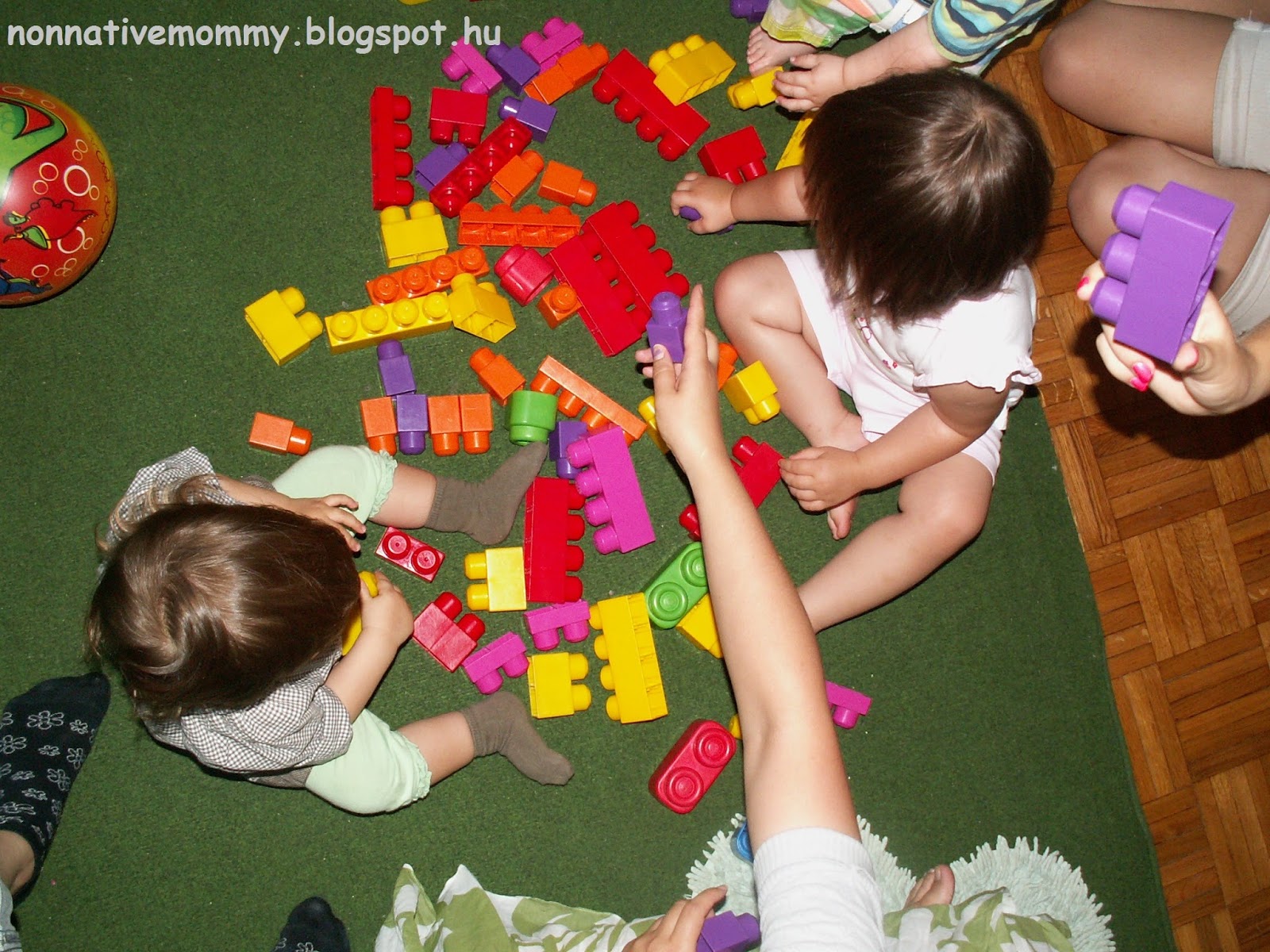
“Stacking, stacking, stacking it up”


I’ll try it

The lesson fell apart a bit by the lesson. One child was eating, the other one was whining (wanted more bubbles), the third one was taking the pictures off the wall, instead of indulging themselves in the Waving song – Whatever! It was a great day. They all got really excited because there were a lot impulses.

Every time I am amazed how brave E. is to say English words, more and more every day. She likes taking part in these sessions. She said purple, bubble, water, more, try it and shouted in the middle of the lesson: ORANGE ORANGE ORANGE. This must be the sign of her being entertained and feeling relaxed 🙂 Well, I’ve already reached my main aim, then.

Sleep tight, don’t let the bed bugs bite

Our days are finished with E.’s evening routine:

  1. watching a little bit of videos
  2. taking a bath
  3. putting on the jammies
  4. drinking milk + reading out a fairy tale (or two)
  5. talking to the angels
  6. falling asleep


Most of the evening routine is done in Hungarian. This is Daddy’s favourite time spent with E. that I would not like to take away from them. On the other hand I don’t want E. to miss the English vocabulary of the evening routine. Not to mention the fact that reading bedtime stories only in Hungarian is a heartbreak for me. So every now and then (like 2-3 times a week) I try to convince my husband to turn into English. And it works brilliantly.

Let’s see the programme step by step (the ideal version):

18:45 – watching videos: D. sits down in front of the computer to watch some English videos with E: (the usual collection of E.’s youtube videos, or this idiotic Meow, Meow song in the Tamil language:

Don’t ask me why they watch it. One guess is E. LOVES it, the other is this is the way my husband rebels against the English evening routine – just kidding 😉

In the meantime I do some things around the house, preparation for the feeding, E.’s room, jammies etc.

If I happen to sit down in front of the computer with E., I prefer to watch a Peppa pig episode or The Going To Bed Book by Sandra Boynton or one of E.’s favourite song Twinkle Twinkle Little Star with the owl:


19:00 – taking the bath:
E. sits in the bath and the sea creatures are jumping in one by one – the crocodile, the starfish, the octopus, the whale, the turtle, and then an extra duck, some measuring spoons of different colours, sometimes a filter and more bottle caps. So she can hardly move in the water.

We usually name the animals, sometimes we attack her with the animals, and spay her with water, of course, while we comment the happenings in English. But mostly we follow what she wants to do.

Sometime she asks for her plastic book – one is a biblical story of the lost lamb, the other is Vizipók and his friends. I tell her the Lost Lamb story in English, we talk about the pictures, and at the end I ask her to show me the shepherd, the lamb or other things in the pictures. But I’m in trouble with Vizipók as I don’t know the names in English or they sound really silly (Ormányosbogár = Snout Beetle, Keresztespók= Garden Spider) so I rather hide this booklet when we have a bath in English.

Another favourite is Mommy Duck and her ducklings. Mommy Duck can carry 3 little ducklings on her back. When we play with the ducks Mommy Duck is swimming around E. and when the ducks are behind her one of the ducklings is taken off Mommy Duck’s back (by D.). In the meantime we sing 5 Little Ducks (well, three in this version). E. is so cute as she is trying to turn back to see how the ducklings disappear, but usually she is not quick enough.

Another activity is toothbrushing. E. asks for her toothbrush, then she brushes the crocodiles teeth while we are singing This is the way we brush our teeth. She also wishes to brush Daddy’s teeth or mine. Every now and then she brushes her own teeth as well. If she is not in the mood, I do it for her, which she doesn’t really like.

When we are finished in the bath we say good bye to the toys. E. hands me the toys one by one and we say good night to them. If I tell her to look behind because there is one more toy, she understands it perfectly and turns around the grab the object. While we are putting the toys away she is waving good-bye.

19:30 – getting dressed into pyjamas:

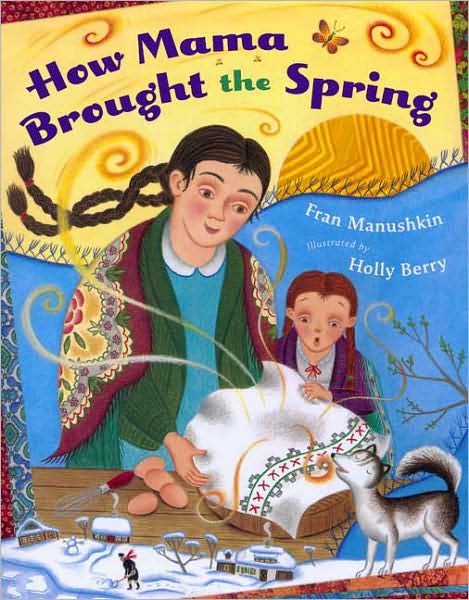
We usually play the changing table games I have already posted about. D. puts on E.’s jammies and sleeping bag. He usually sings some songs. I prepare her milk. E. turns off her light, only a bedside lamp is on. Then E. and I sit down in the rocking chair to drink her milk, and D. reads a story or two. If we read in English at the moment we are reading the book: How Mama Brought the Spring by Fran Manushkin. It’s for kids around the age of 5, but E. adores the pictures in the book. Before E. finishes her milk, D. says good night to her and leaves the room. Then we turn off the light and talks to the angels. I say thank you for the nice day and recall the lovely happenings of our day. E. often repeats the words she can also say like, baby, happy, her name or grandparents’ name, Daddy, Mommy etc. SO actually she thanks for everything that happens to her. Then I put her down into her bed (she says ‘bed’) and I give her dummy (she says ‘dummy’) and I give her a textile nappy and her doggy she always sleeps with. I kiss her goodnight and leave the room. Most of the time she falls asleep within 5-10 minutes. Sometimes she chats to herself a little. If it’s an English evening she talks to herself in English.

So here are some expressions how to say good night:

  • Sleep well
  • Sweet dreams
  • Nighty-night
  • Good night, sleep tight, don’t let the bedbugs bite (you can find the origin of this phrase here – quite interesting, worth reading the theories. The one I like the most is the rope idea.)

Have a good night!

Home-made tools for language practice I.- Flashcards

As a language teacher I used a lot of card activities with my students to explain, identify, show or play things with them. It worked even with adults, but it’s a hit with kids. They are colourful, fun to look at, nice to chew them or fold them (well, at least from E.’s point of view).

You can find a lot of ready-made flashcards on the net, for example, here. You just print them and can start using them. You can also find videos showing flashcards. I found them rather disappointing. A lot of them have strange visuals, or they use the American variation of the word I wouldn’t use. But the most horrible experience is when the words are pronounce by a machine. It’s scary. Plus, I don’t want to make E. sit in front of the computer a lot.
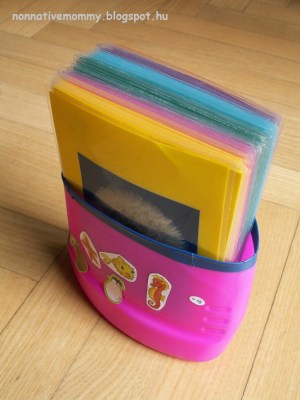
I decided to make my own cards; it’s more personal in this way, and sometimes E. could see when I prepared them, and became even more interested. And we can take with us if we want.

Of course I’ve read a lot about the method which was developed by Glen Doman and his flashcards, but I found it too much pressure on me. So I took it easy 🙂

What I do is similar to the Doman technique, but maybe not so thorough. I make flashcards about the topics E. is interested in. And the way I show them to her is not so systematic and not so fast. I’m not changing the cards so often as we play a lot with them and it’s not only about showing her the cards.

So here is an example. When she was 8 months old, I was just showing her the cards and say what she could see in the picture. Later, on I mooed when the cow turned up and also showed the MAKATON sign for the cow. Then when she was around 10-11 months old I started to add extra information as well (“The cow gives us milk” – and showed the picture, showed the signs for cow and milk). When E. became 1 year old we started to name the colours as well (“Look – the cow is white and brown. It gives us milk” – I showed the signs – What colour is the milk? – and I answered: – “White”. Now, at the age of 14 months, E. answers “white” and she moos as soon as she hears the word “cow”.)

Sometimes I tell her a story or connect the cards to something that happened to us, or anything connected to real life. She loves those cards the most which she experienced in her own life (E.g.: body parts are great as she can identify them on me or on herself, what’s more, the cards make her interactive; she asks D. to show his belly button. Among the flowers she adores the dandelion clock as we blew a lot of them when they bloomed in the park, but there are the fruits she can touch and taste like a banana or an apple).

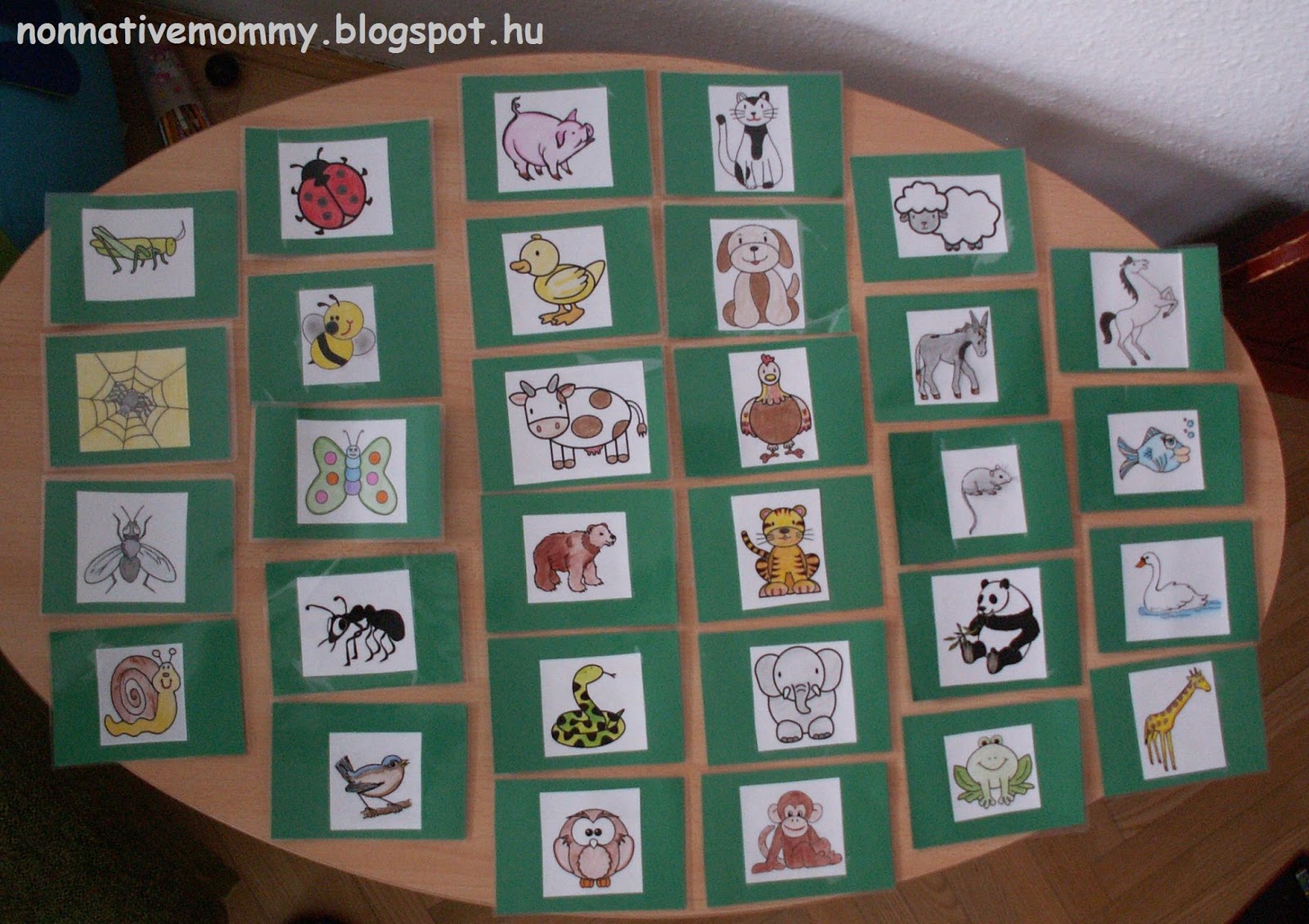
I started with animals. As we don’t have a colour printer I found some colouring pages on the net and selected some basic (later some more) animals, printed them and coloured them myself. (Quite time-consuming). Luckily I got a laminator from D. for Christmas, so I glued the coloured animals on colour paper and laminated each. It was a great idea as at the beginning E. chewed, folded and threw them away, so they really needed to be tough. Different topics have different background colours.

Animals
I thought at that time I won’t make other cards but animals since she wanted nothing else but animals. We made noises that the animals made, named their colours, stated what they like eating, where they live, or sang a song about them etc.
Then she got a basket of soft vegetables (from IKEA) and I was “forced” to make some vegetable cards. (We play matching games with the soft vegetables and the cards). The same thing happened when we bought the wooden fruit box.
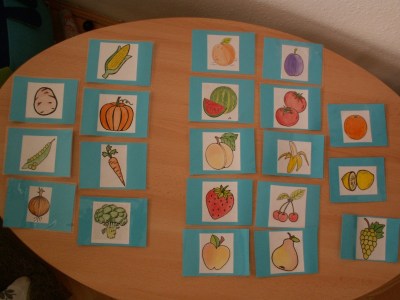
Fruit and vegetables

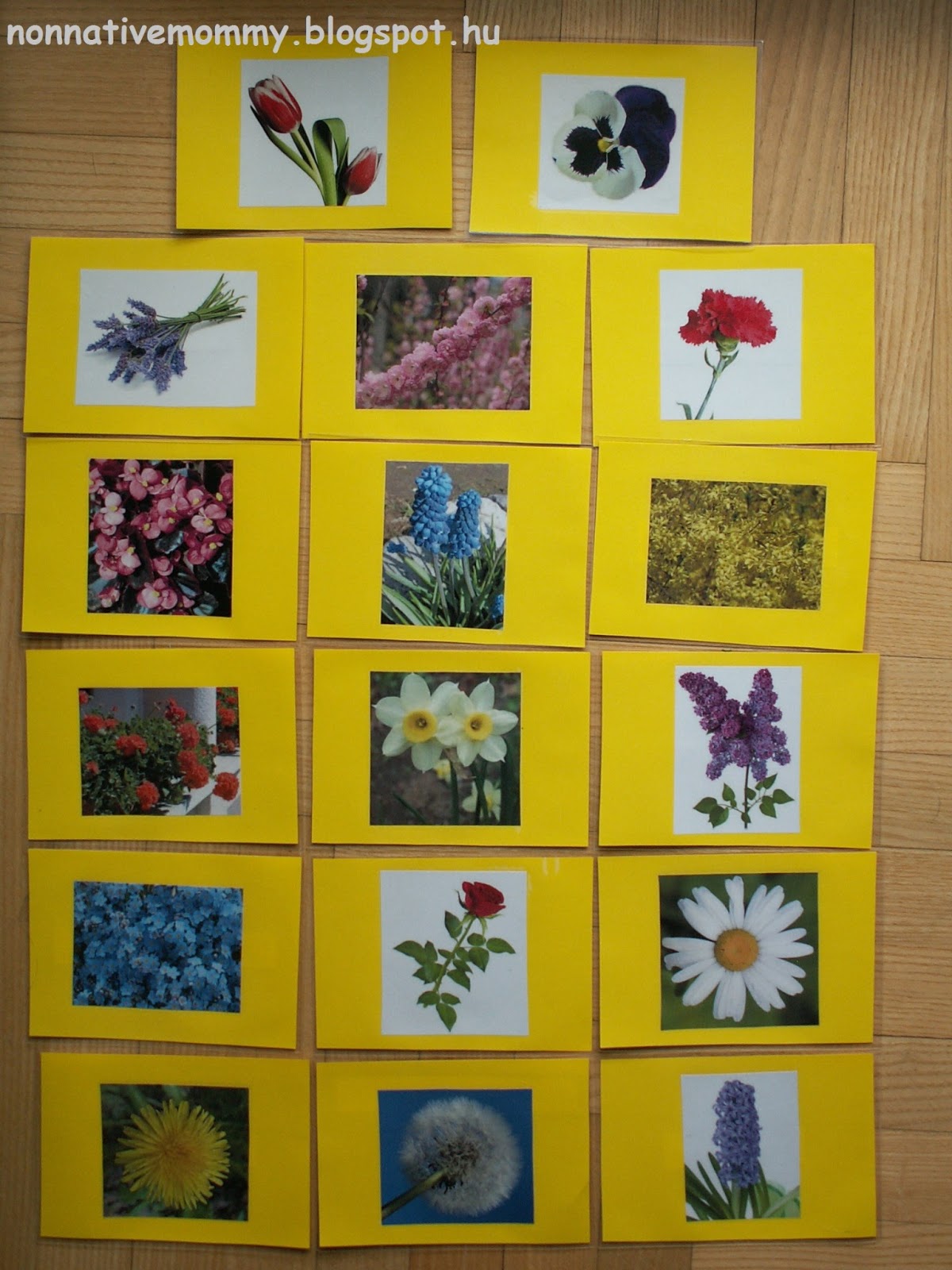
While we were walking in the park I realised we needed some flower cards, too. I just haven’t had the energy and willpower to make tree cards, but I will one day. The flower cards are more ‘professional’ as they are photos printed in colour.
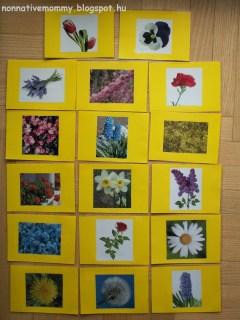
Flowers

I don’t want E. to learn reading yet, so I didn’t bother making word cards connected to the pictures. Except for the flower cards. And the reason for it is that I have difficulty remembering the names of the flowers so it is also a learning process for me. The names are on the back. Sometimes she wants to look at the words, so I show her. But I’m NOT teaching her to read.

Then the body parts came influenced by the Helen Doron songs and rhymes. At the moment we are looking at them when E. is sitting on the potty, as we can point at different body parts when she is half-naked (belly button is her favourite). After making the body part cards, the time came when a box was necessary for keeping the cards in one place (that is next to the potty most of the time). So long time ago I saw a pinterest post about how to make a box for kids out of a Vanish plastic bottle. I made it and the cards can fit in it well.

Body parts

I also made musical instruments, but she has just started to become interested in them. We are going to begin using them later on.
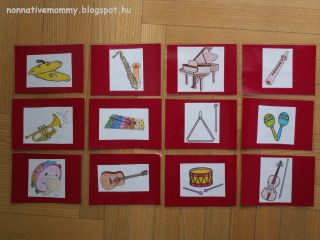
Musical instruments

Below you can see the present collection of our cards. They are far from being ready. I’m continuously making new cards to each group.
Certainly there are more groups to come (everyday objects, furniture, baby stuff, means of transport, rooms, playground toys, tools, kitchen ware etc).

The collection
Let’s sum up what to play with cards?
1. Show them and say the name of the thing in the card
2. Matching cards and toys (toy animals, toy fruit or real ones can work well too)
3. Grouping (body parts on the head or fruit and vegetables in 2 groups, or according to colours in case of flowers)

4. Story telling (E.g.: chose few animals and vegetables and flowers, and build a story around them – the rabbit eats the carrot and hops into the field to smell flowers where he meets his best friend, the mouse, who is running away from the cat, because the mouse tried to drink the cat’s milk)

5. Link the cards with sign language
6. Face down (put out 3-4 cards facing down and the child can turn them one by one, then name/show/point at the thing on the card – sounds boring but E. loves this too)
7. Sing a song (I put out some cards, e.g.: the lamb, the ladybird and the spider – I sing a song about one of the animals – Incy Wincy Spider and either E. picks up the card I’m singing about or we act out the song; the same with The Ladybird song or Ba-Ba Black Sheep song)
8. Odd one out (I show 3 or 4 cards of the same kind, but one is different – 3 farm animals and a wild one, or 3 yellow flowers and one red etc. –  then I ask, for instance, “Is the pig a wild animal?” – “No, it’s not a wild animal.” “Is the horse a wild animal?” -“No, it’s not a wild animal.” “Is the cow a wild animal?” – “No, it’s not a wild animal.”-“Is the lion a wild animal?” – “Yes, it is!” So the pig, the horse and the cow are farm animals.)
There must be much more games to play, just let your (and your child’s) imagination fly.