Over 100 words

E. turned 16 months on Monday and I am not exaggerating if I say she can use much more than 100 words in each language (Hungarian and English).

The calculation was done by D. He added up all the functional language (thanking, asking, giving, objecting, greetings etc.) and words of different topics we’ve been dealing with (see the collection bellow) and the sum must be over 100 words, getting closer to 200.

Now I’m collecting the ones that E. uses confidently in the right context (and not just parroting them or not the ones she understands because in this case there are a thousand words, I guess). Of course, these words and expressions are not 100 % clear. (She tends to pronounce the “k”  sound  “p”, the “g” sound “b” or the vowels sometimes melt into one another). Still, it’s her great achievement.

Now I’m trying to focus on her English only:

Peek-a-boo

Functional language:

  • Thank you
  • Please
  • Pick it up
  • Here you are
  • There (if she wants to go somewhere)
  • Let’s go
  • Come on
  • Bye-bye
  • Hi/Hello
  • Don’t like it
  • Like it
  • Cheers (when drinking)
  • Up
  • Out (of the playpen or high chair)
  • not comfy (on the potty)
  • Oops (when something is fallen)
  • Oh, no! (when something goes wrong)
  • Peek-a-boo (when she hides behind the curtain)

Family members:

  • mommy
  • daddy
  • granny
  • papa (for grandpa)
  • baby
  • + names of our family members (7 people), our native nanny (A.) and my best friend (B.)

Animals: (if she doesn’t know the name of the animal she says the sounds they make)

  • doggie
    Our poor mixed-breed
  • froggie
  • cat/kitty
  • cow
  • sheep
  • kangaroo
  • hippo
  • bear
  • mouse
  • rat
  • panda
  • butterfly
  • ladybird
  • bee
  • pig
  • duck
  • ant
  • turtle
  • whale
  • dino

Fruit:

Window pictures
  • apple
  • pear
  • grapes (a bunch of grapes)
  • banana
  • kiwi
  • orange
  • plum
  • lemon
  • cherries
  • strawberries
  • apricot
  • peach
  • tomato
  • berry

Vegetable:

  • aubergine
  • onion
  • potato
  • broccoli
  • mushroom
  • pumpkin

Other foods:

water
  • cheese
  • bread
  • salami
  • sausage
  • honey
  • water
  • milk
  • mayonnaise
  • ketchup
  • butter
  • yogurt
  • coffee
  • ice creme
  • ricecake

Flowers:

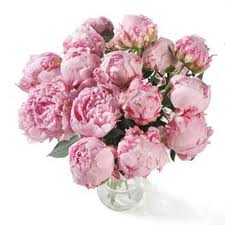
  • peony
  • lilac
  • begonia
  • pansy
  • daisy
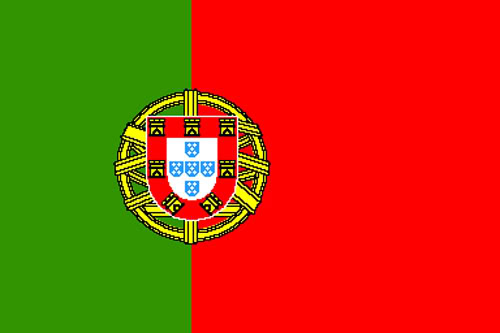
Flag of Portugal – E.’s favourite right now

Countries/Flags/:

  • Norway
  • Belgium
  • Portugal
  • Hungary
  • the European Union
  • Turkey
  • Italy

Colours: (the clearest utterances)

    • red
    • orange
    • yellow
    • green
    • blue
    • purple
    • pink
    • black
    • white
    • grey
Bubbles
  • brown

Shapes:

  • oval
  • triangle
  • heart
  • star
  • pentagon
  • rectangle

Everyday object/Toys:

  • spoon
  • plate
  • knife
  • fork
  • bottle
  • kitchen
  • teddy
  • book
  • playground
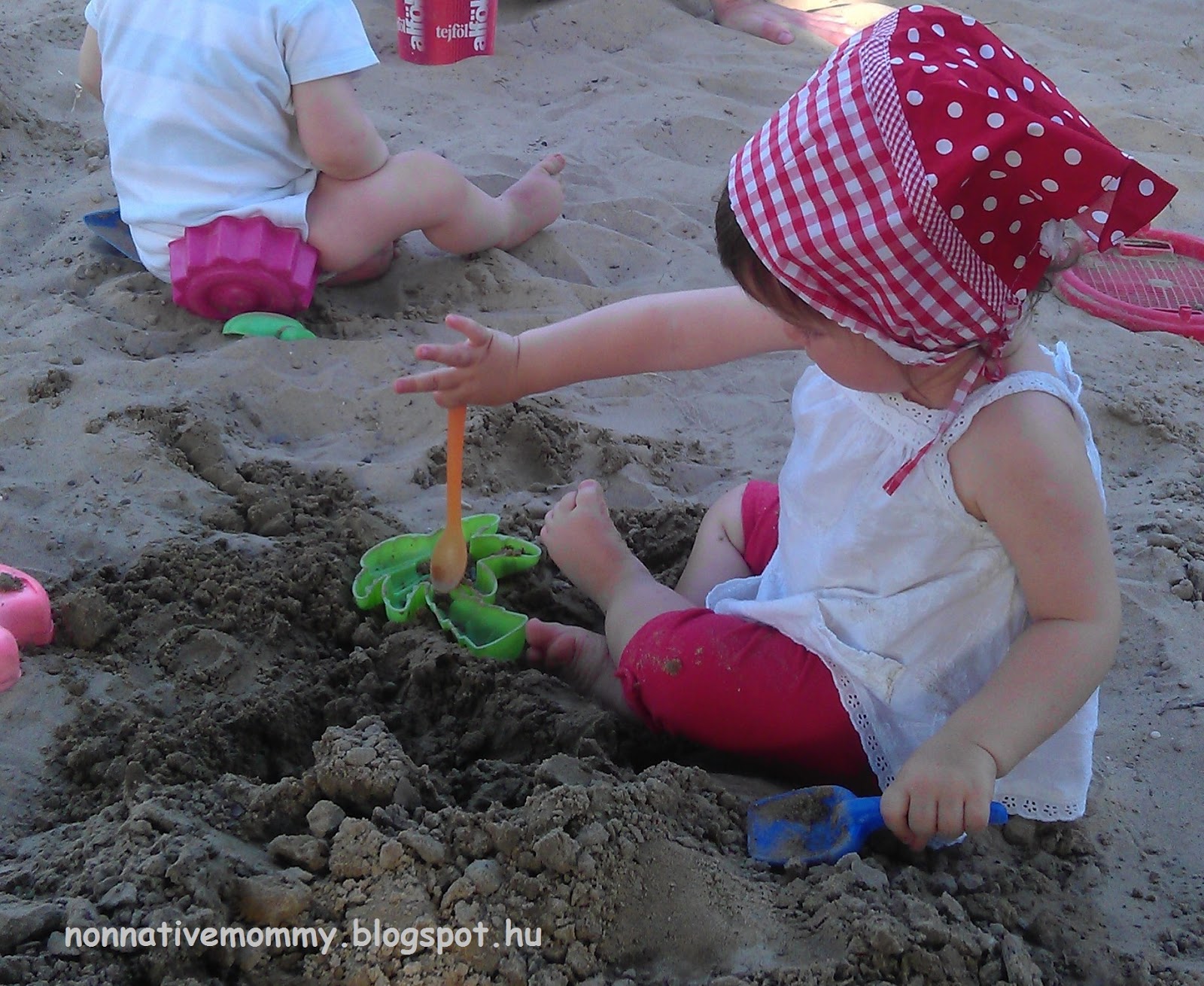
  • sandpit
  • bath
  • colour pencil
    drawing a star
  • crayon
  • paper
  • drawing
  • nappy
  • creme
  • toothbrush
  • man (a plastic figurine)
  • clock
  • high chair
  • door
  • playpen
    Sandpit
  • video
  • dummy
  • potty
  • poopy
  • pee pee
  • peg
  • mill
  • car
  • choo-choo train
  • ball
  • puddle
  • big
  • bubbles
  • bin
  • balloon
  • sun
  • cloud
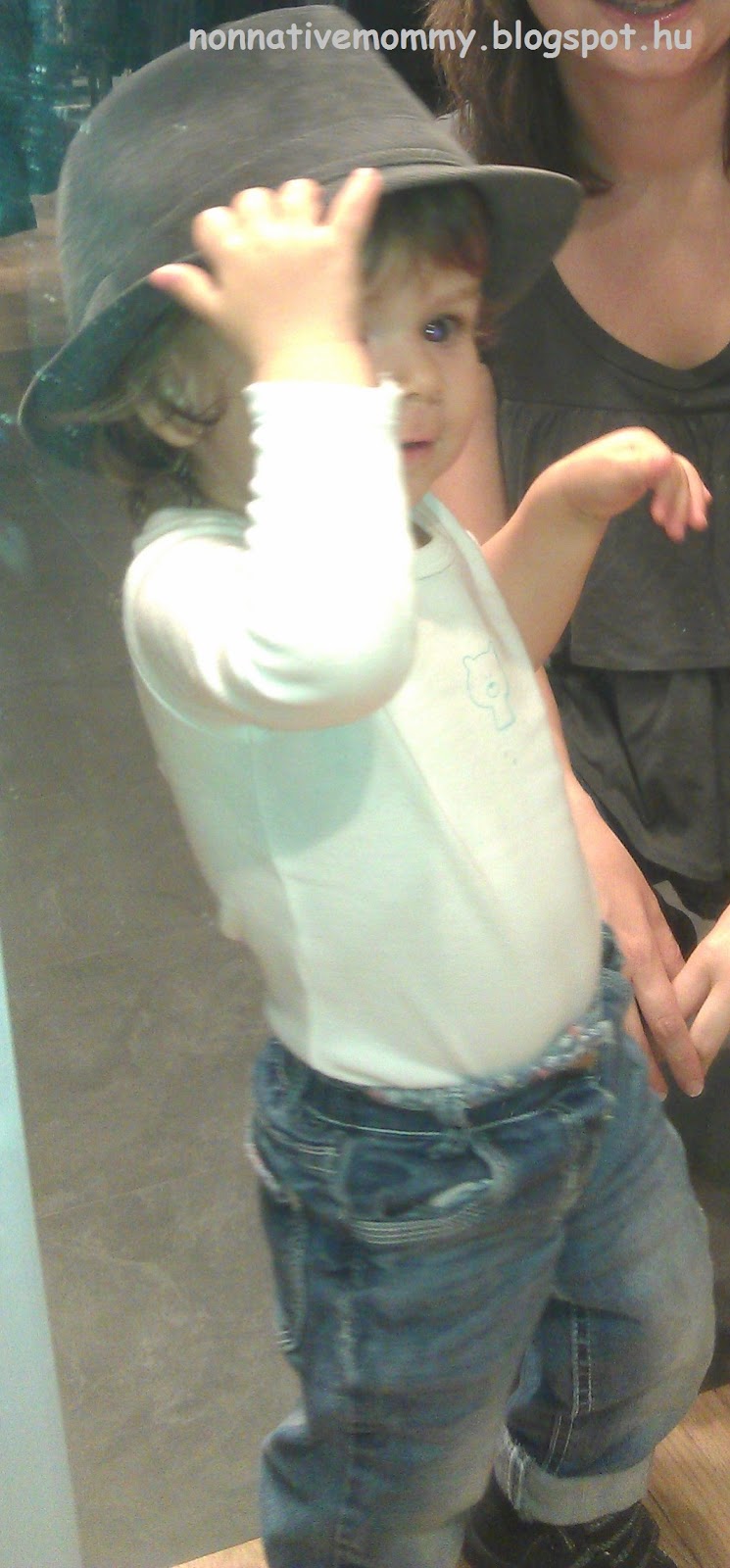
Hat and jeans

Clothes:

  • jacket
  • slippers
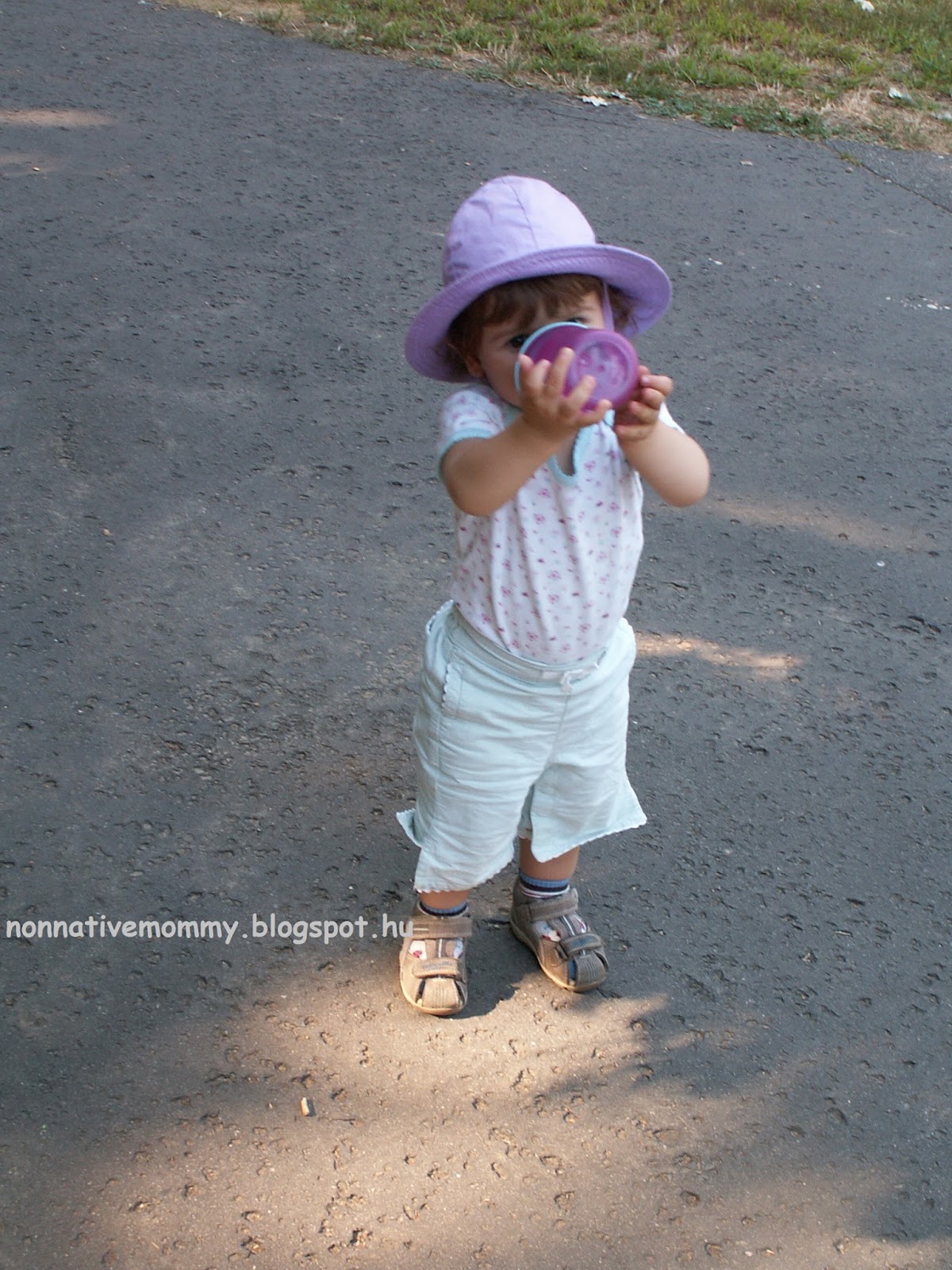
  • hat
  • trousers
  • jeans
  • shoes
  • cardigan
  • boots
  • pyjamas
  • socks

Body parts:

  • head
  • pinkie
  • nose
  • ear
  • knee
  • mouth
  • toe
  • eyes

Musical instruments: (she’s not so intereted in this topic although she is quite musical)

  • drum
  • piano

Breeds of dog: (I introduced some dog flashcards 3 days ago)

  • Westie
  • Shar-pei
  • bulldog
  • puli
  • mixed breed

E. is making up more and more combinations, like big puddle, red pinkie (for polished fingernails), purple plum, pencil drawing, banana yogurt, black doggie etc.

If it goes like this, in two more months she’ll say sentences. She’s amazing, a little genius. Am I proud? Hard to say how much 🙂

More and more words

Just a short post on how our language development is going. E. is 15,5 months old and about a few weeks ago I stopped counting how many English and Hungarian words she knows.
Now here are some random interesting features of her language knowledge:

English:

  • she knows all the main colours (in both languages)
  • loves saying 3 (or more) -syllable words (aubergine, apricot, butterfly)
  • started to say combination of words (green peas, red rose, purple plum, yellow balloon)
  • she says what she really wants in both languages (more-még, drink-inni, bread-kenyér etc.)
  • her functional language is outstanding – she says thank you, Mommy – when she gives something back to me or when I give her something, here you are (not clearly though – it sounds like: heeyaa), please – when she asks for something, don’t like it – if she doesn’t want to eat something
  • sometimes she sounds like saying a sentence that she doesn’t do in Hungarian (it’s incomprehensible, though)
  • when she points at a spider she says: incywincy
  • potty time is mostly in English so she rather says poopy and peepee
  • prefers songs in English

    Favourite songs now:

  • loves to watch/sing/chant the English alphabet
  • E. likes certain books in English, though I “read” most books in both languages
  • Still, her favourite is Fran Manushkin: How Mamma Brought the Spring

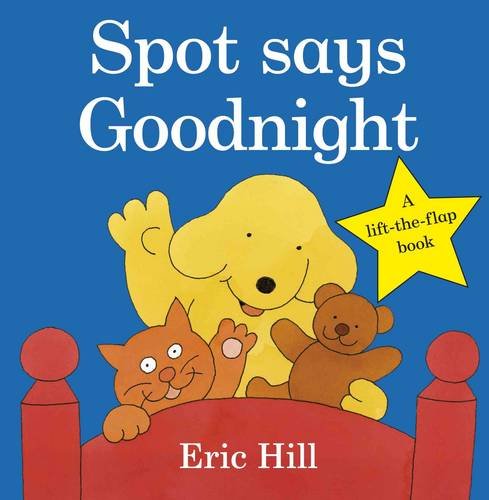
    But she also takes pleasure in Great Day for Up! by Dr. Seuss and Goodnight, Spot by Eric Hill nowadays.

    Hungarian:

    • she is trying to say long words (more than 4 syllables) – palacsinta
    • prefers the countries in this language (her favoutite one to say is Svájc, and her favourite flag is the Belgian – because of the black in it -, though she cannot pronounce it clearly)
    • when she sees the Turkish flag she starts to chant: pont, pont vesszőcske, készen van a fejecske, kicsi nyaka, nagy a hasa, készen van a TÖRÖK basa – her utterence is 50% right, but the intonation is perfect
    • prefers rhymes in Hungarian (Boci, boci tarka, A török és a tehenek)
    • she says tetszik  if she likes something or someone (doesn’t say it in English)


    Some cute details:

    • her favourite animal is the penguin at the moment
    • out of nowhere she calls out her native nanny’s name
    • her favourite colour is black, though she says pink or purple
    • her favourite body part is her belly button (when she has a look at her own, she makes us show ours)
    • her favourite flower is carnation
    • she claps after pooping
    • she loves drawing (onto the parquet, at the playground, on sheets of paper, on the door – but not on the wall yet)
    • she pronounces Peppa Pig as if she were a little native British girl  🙂

    Home-made tools for language practice I.- Flashcards

    As a language teacher I used a lot of card activities with my students to explain, identify, show or play things with them. It worked even with adults, but it’s a hit with kids. They are colourful, fun to look at, nice to chew them or fold them (well, at least from E.’s point of view).

    You can find a lot of ready-made flashcards on the net, for example, here. You just print them and can start using them. You can also find videos showing flashcards. I found them rather disappointing. A lot of them have strange visuals, or they use the American variation of the word I wouldn’t use. But the most horrible experience is when the words are pronounce by a machine. It’s scary. Plus, I don’t want to make E. sit in front of the computer a lot.
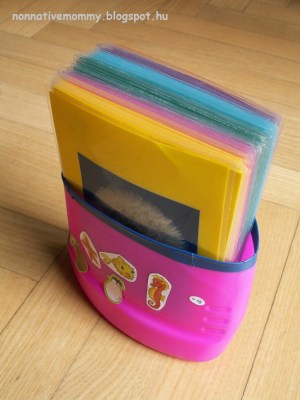
    I decided to make my own cards; it’s more personal in this way, and sometimes E. could see when I prepared them, and became even more interested. And we can take with us if we want.

    Of course I’ve read a lot about the method which was developed by Glen Doman and his flashcards, but I found it too much pressure on me. So I took it easy 🙂

    What I do is similar to the Doman technique, but maybe not so thorough. I make flashcards about the topics E. is interested in. And the way I show them to her is not so systematic and not so fast. I’m not changing the cards so often as we play a lot with them and it’s not only about showing her the cards.

    So here is an example. When she was 8 months old, I was just showing her the cards and say what she could see in the picture. Later, on I mooed when the cow turned up and also showed the MAKATON sign for the cow. Then when she was around 10-11 months old I started to add extra information as well (“The cow gives us milk” – and showed the picture, showed the signs for cow and milk). When E. became 1 year old we started to name the colours as well (“Look – the cow is white and brown. It gives us milk” – I showed the signs – What colour is the milk? – and I answered: – “White”. Now, at the age of 14 months, E. answers “white” and she moos as soon as she hears the word “cow”.)

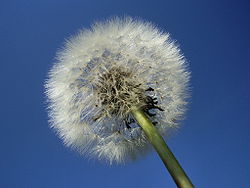
    Sometimes I tell her a story or connect the cards to something that happened to us, or anything connected to real life. She loves those cards the most which she experienced in her own life (E.g.: body parts are great as she can identify them on me or on herself, what’s more, the cards make her interactive; she asks D. to show his belly button. Among the flowers she adores the dandelion clock as we blew a lot of them when they bloomed in the park, but there are the fruits she can touch and taste like a banana or an apple).

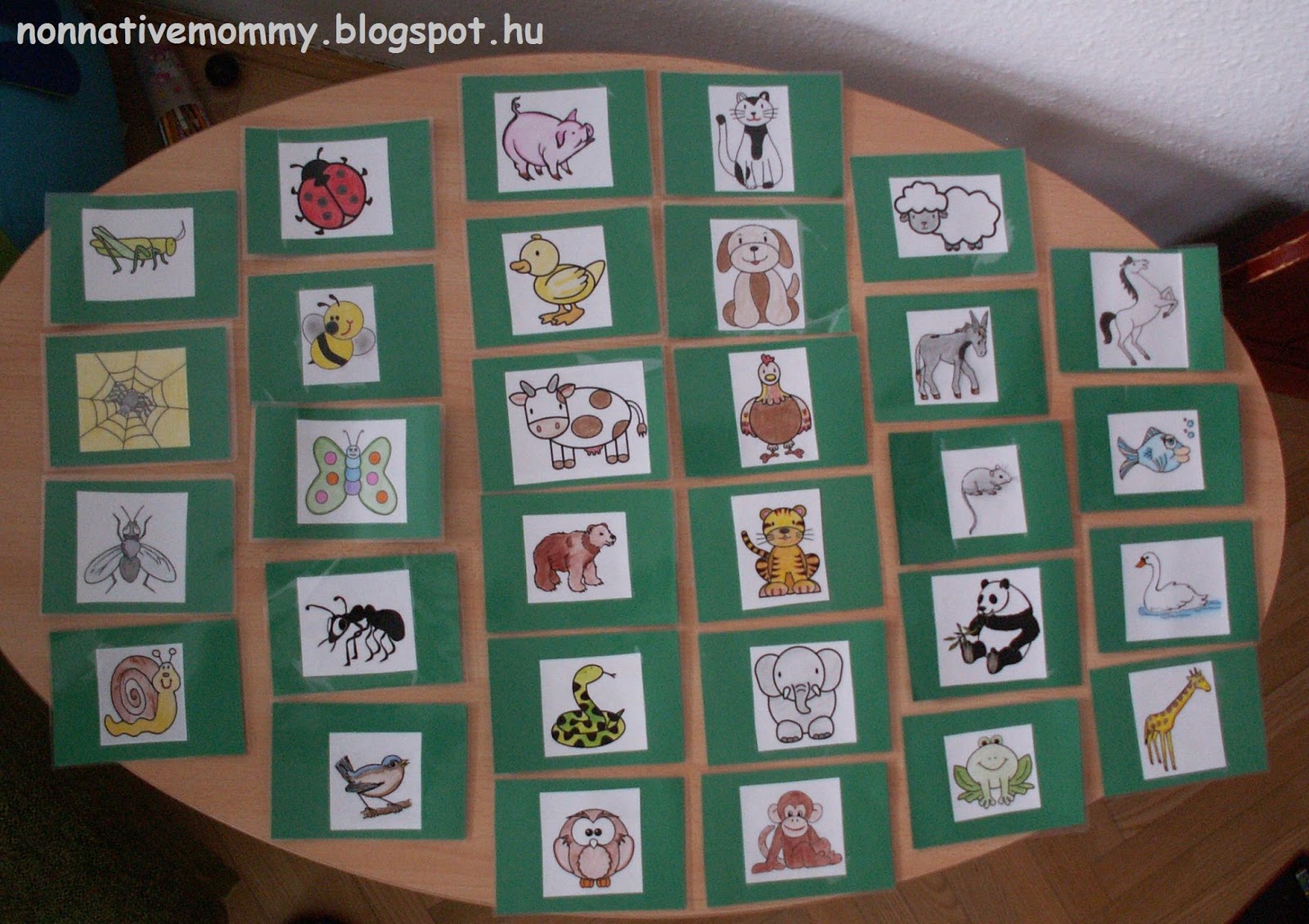
    I started with animals. As we don’t have a colour printer I found some colouring pages on the net and selected some basic (later some more) animals, printed them and coloured them myself. (Quite time-consuming). Luckily I got a laminator from D. for Christmas, so I glued the coloured animals on colour paper and laminated each. It was a great idea as at the beginning E. chewed, folded and threw them away, so they really needed to be tough. Different topics have different background colours.

    Animals
    I thought at that time I won’t make other cards but animals since she wanted nothing else but animals. We made noises that the animals made, named their colours, stated what they like eating, where they live, or sang a song about them etc.
    Then she got a basket of soft vegetables (from IKEA) and I was “forced” to make some vegetable cards. (We play matching games with the soft vegetables and the cards). The same thing happened when we bought the wooden fruit box.
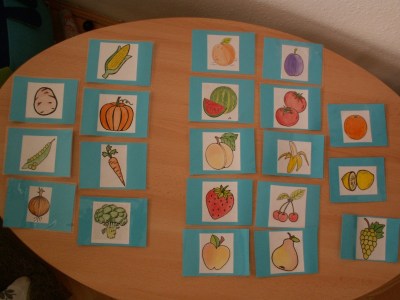
    Fruit and vegetables

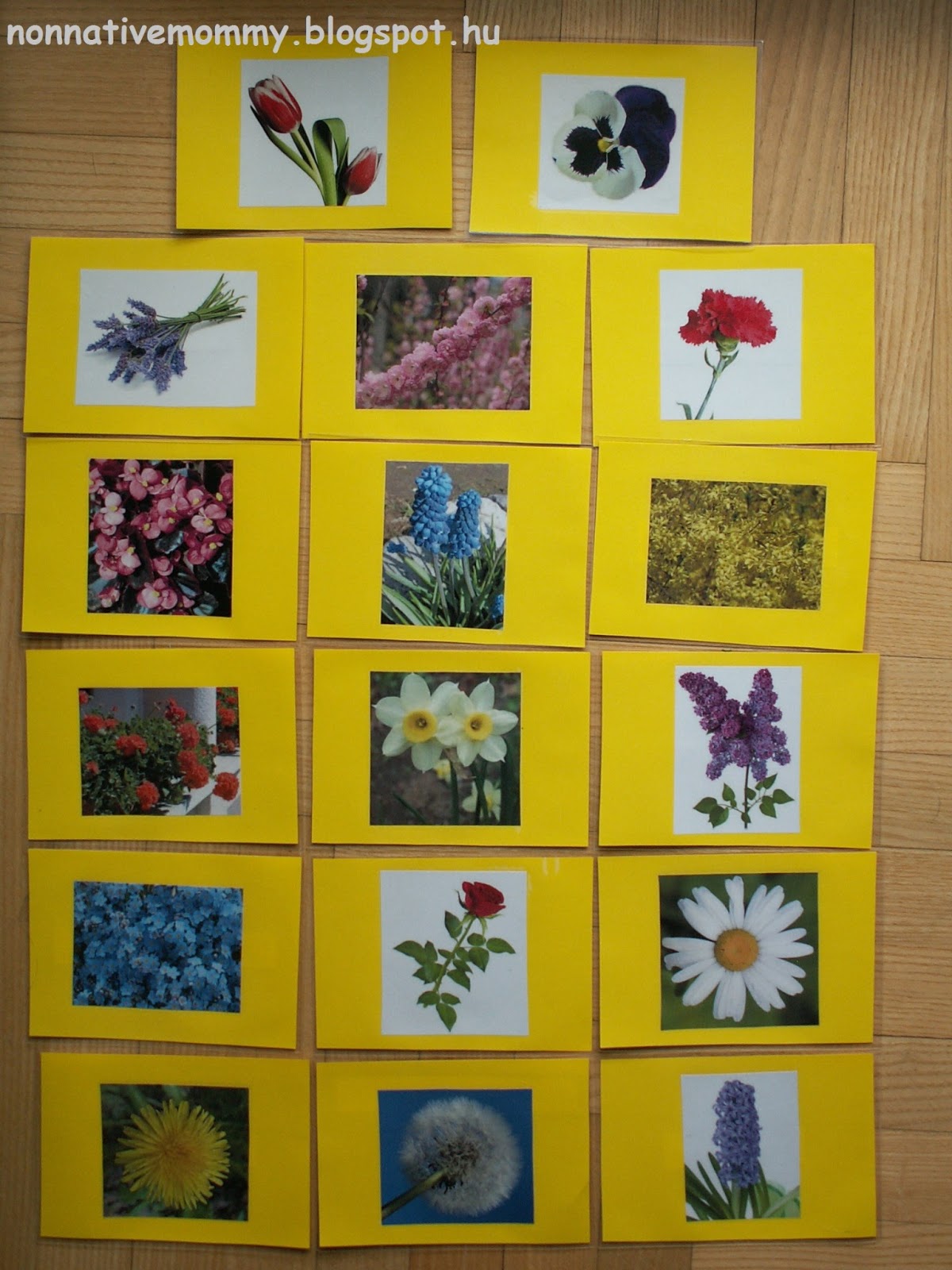
    While we were walking in the park I realised we needed some flower cards, too. I just haven’t had the energy and willpower to make tree cards, but I will one day. The flower cards are more ‘professional’ as they are photos printed in colour.
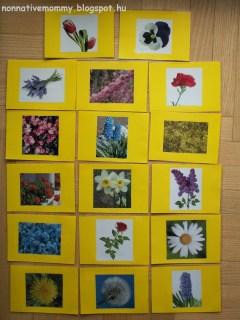
    Flowers

    I don’t want E. to learn reading yet, so I didn’t bother making word cards connected to the pictures. Except for the flower cards. And the reason for it is that I have difficulty remembering the names of the flowers so it is also a learning process for me. The names are on the back. Sometimes she wants to look at the words, so I show her. But I’m NOT teaching her to read.

    Then the body parts came influenced by the Helen Doron songs and rhymes. At the moment we are looking at them when E. is sitting on the potty, as we can point at different body parts when she is half-naked (belly button is her favourite). After making the body part cards, the time came when a box was necessary for keeping the cards in one place (that is next to the potty most of the time). So long time ago I saw a pinterest post about how to make a box for kids out of a Vanish plastic bottle. I made it and the cards can fit in it well.

    Body parts

    I also made musical instruments, but she has just started to become interested in them. We are going to begin using them later on.
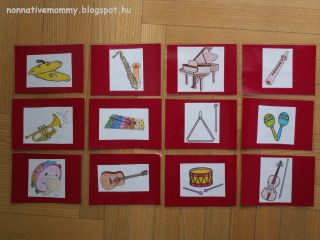
    Musical instruments

    Below you can see the present collection of our cards. They are far from being ready. I’m continuously making new cards to each group.
    Certainly there are more groups to come (everyday objects, furniture, baby stuff, means of transport, rooms, playground toys, tools, kitchen ware etc).

    The collection
    Let’s sum up what to play with cards?
    1. Show them and say the name of the thing in the card
    2. Matching cards and toys (toy animals, toy fruit or real ones can work well too)
    3. Grouping (body parts on the head or fruit and vegetables in 2 groups, or according to colours in case of flowers)

    4. Story telling (E.g.: chose few animals and vegetables and flowers, and build a story around them – the rabbit eats the carrot and hops into the field to smell flowers where he meets his best friend, the mouse, who is running away from the cat, because the mouse tried to drink the cat’s milk)

    5. Link the cards with sign language
    6. Face down (put out 3-4 cards facing down and the child can turn them one by one, then name/show/point at the thing on the card – sounds boring but E. loves this too)
    7. Sing a song (I put out some cards, e.g.: the lamb, the ladybird and the spider – I sing a song about one of the animals – Incy Wincy Spider and either E. picks up the card I’m singing about or we act out the song; the same with The Ladybird song or Ba-Ba Black Sheep song)
    8. Odd one out (I show 3 or 4 cards of the same kind, but one is different – 3 farm animals and a wild one, or 3 yellow flowers and one red etc. –  then I ask, for instance, “Is the pig a wild animal?” – “No, it’s not a wild animal.” “Is the horse a wild animal?” -“No, it’s not a wild animal.” “Is the cow a wild animal?” – “No, it’s not a wild animal.”-“Is the lion a wild animal?” – “Yes, it is!” So the pig, the horse and the cow are farm animals.)
    There must be much more games to play, just let your (and your child’s) imagination fly.

    Walking in the park in Enlgish – birds, trees and flowers

    Every morning we go out for a walk. E. is the most attentive at this time of the day. At the beginning I was rather tense talking in English while we were walking and meeting other people, but by now I’ve got used to it.

    On our way I name whatever we see. I try to pay attention to which direction she looks and what she sees. As I’m behind her, it’s not easy. So what I say is:

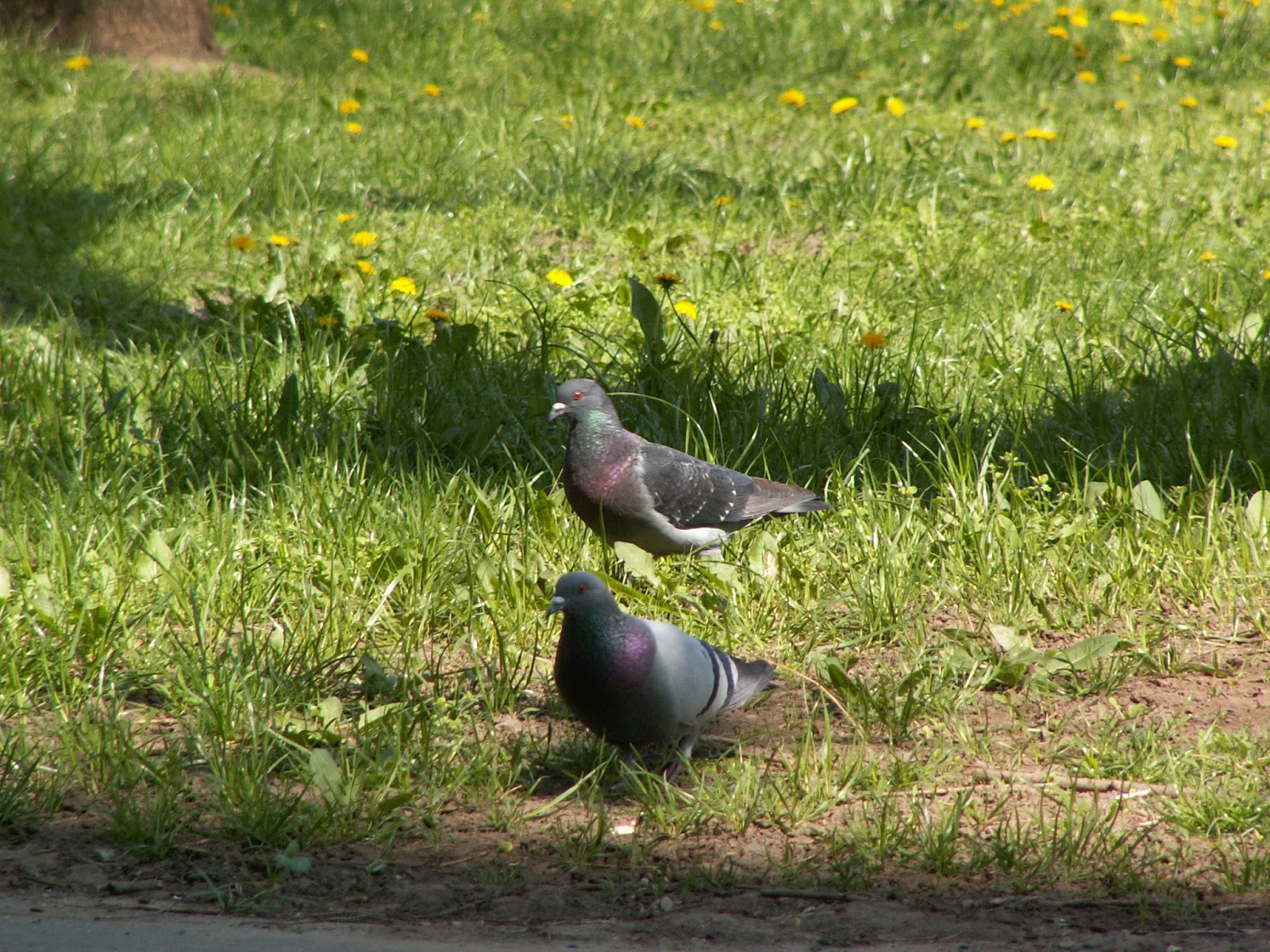
    “Look, there’s a pigeon. She’s eating.” or “The pigeons have flown away.”
    “The pigeons have flown away.”

    “Can you see that big tree? The leaves are all green.”

    Pansies in the flowerbed
    “Let’s smell the flowers. Atishoo. Atishooooo.” (Here she smiles or even laughs at this.)
    “Look, this flower is purple, and this one is white. And your favourite colour is here. It’s yellow.”
    “What is buzzing? It’s a bee, flying from one flower to the other.”
    We were blowing dandelions: “Look, mommy’s blowing the dandelion.” (minimum 10 times 🙂 )
    “I’ll taste this blowball.”

    If we see a dog: “Look, what’s coming? A doggy. (She screams or says da-da)

    If we go on a bumpy road I make it even bumpier and shake the pushchair a little: “Bumpy, bumpy, bumpy” (She enjoys it as well and grabs the sides of the pushchair hard)


    Two pigeons

    Today we have counted three pigeons and two doves: “One pigeon, two pigeons, three pigeons.””Are those pigeons? Nooooo. They’re doves. One dove, two doves”

    These are some of the example, but as usual I’m talking to her continuously about what we see around us. She likes touching (and picking) leaves from the bushes. She is pointing at things so I name them (flowers, animals, people etc.)

    Of course, I don’t know a lot of flowers and tree types, but I’m working on collecting some of the most common ones, which can be found in our area. I don’t like the long lists of vocabulary which include ALL the plant names. We need a small part of them only. The other thing is that I, myself, really need to learn them.
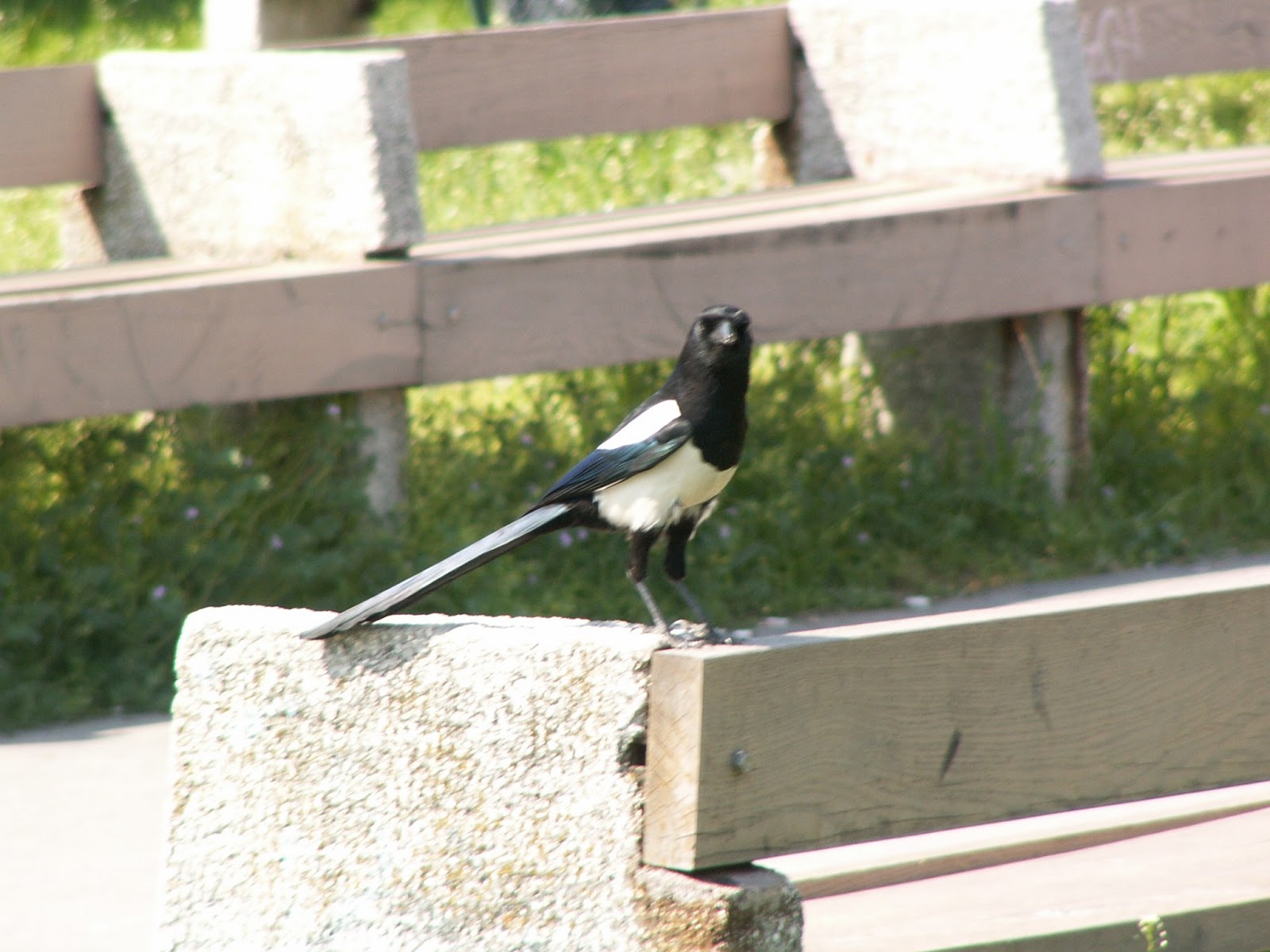
    I don’t believe saying only “flower” or “tree” when we name plants is natural. In Hungarian I name them exactly (the ones I know, as I have deficiency in this field even in my mother tongue).

    So here is a small collection of useful vocabulary concerning nature or rather wildlife in Budapest parks:

    Birds:

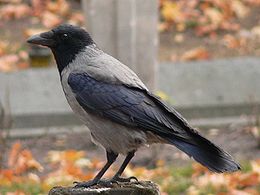
    crow
    dove


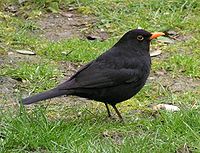
    blackbird
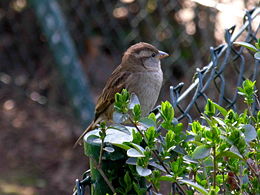
    house sparrow
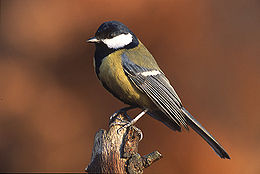
    great tit 😉
    swallow
    woodpecker
    magpie


    English
    Magyar
    magpie
    szarka
    sparrow
    veréb
    crow
    varjú
    swallow
    fecske
    pigeon
    galamb
    dove
    gerle
    blackbird
    feketerigó
    great tit
    széncinege
    woodpecker
    fakopáncs
    warbler
    énekesmadár

    Trees:

    acacia
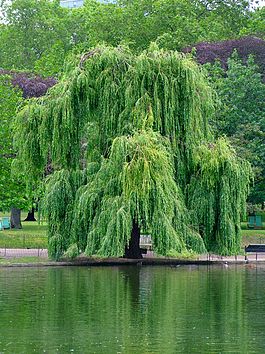
    willow
    horse-chestnut
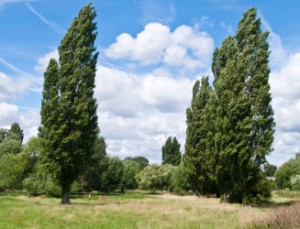
    poplar
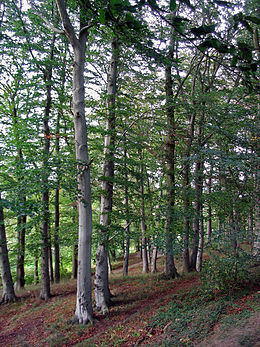
    beech tree
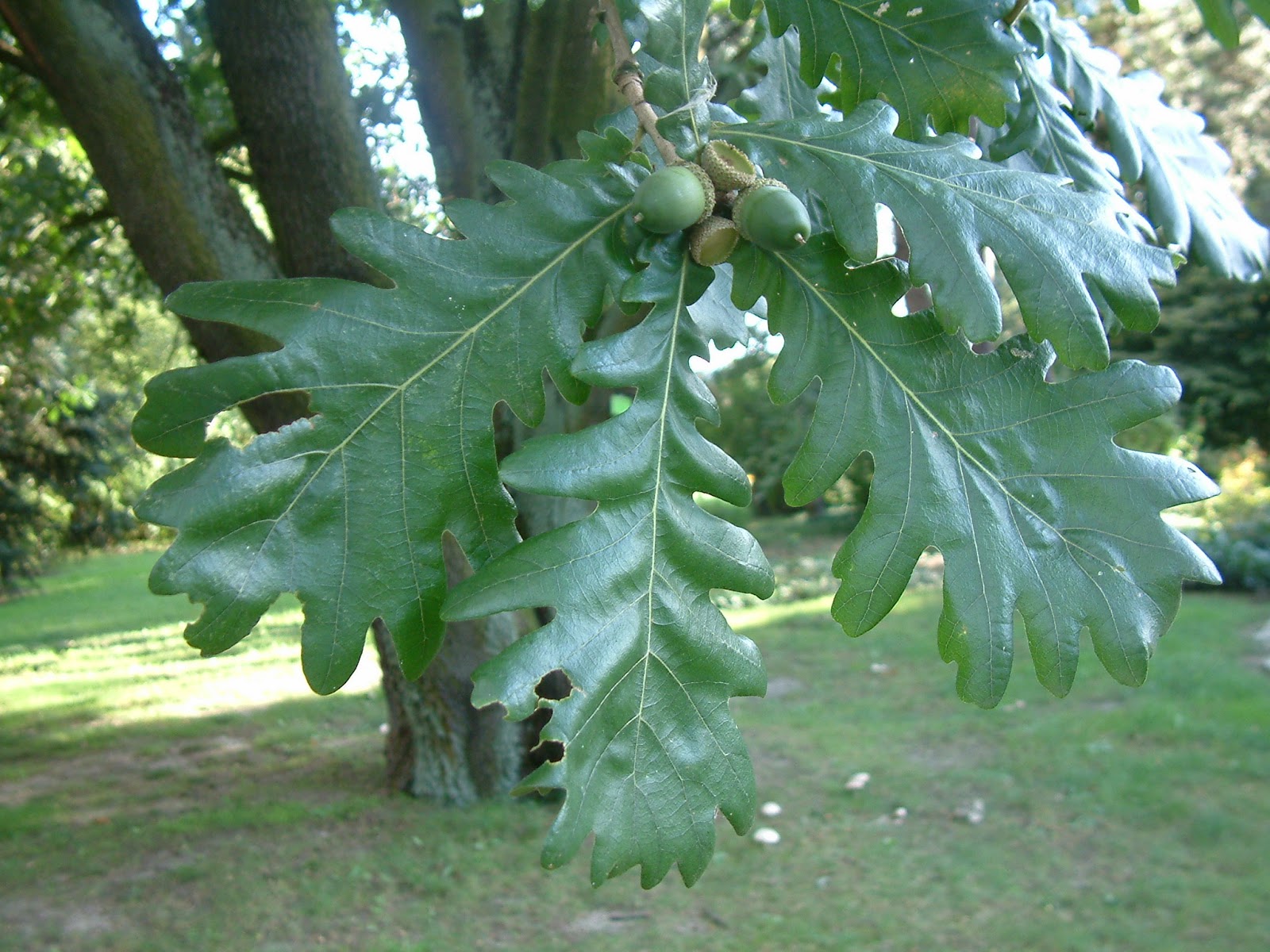
    oak
    sycamore
    English
    Magyar
    chestnut tree
    vadgesztenyefa
    acacia
    akácfa
      beech tree
    bükkfa
    oak tree
    tölgyfa
    willow
    szomorúfűz
    sycamore
    platán
    pine
    fenyő
    birch tree
    nyírfa
    poplar
    nyárfa

    Flowers:

    forget-me-not
    daisies
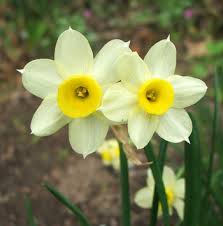
    daffodils


    dandelion or the so-called “blowball” or “clock”
    dandelion in full bloom
    geranium
    flowering almond
    golden chain
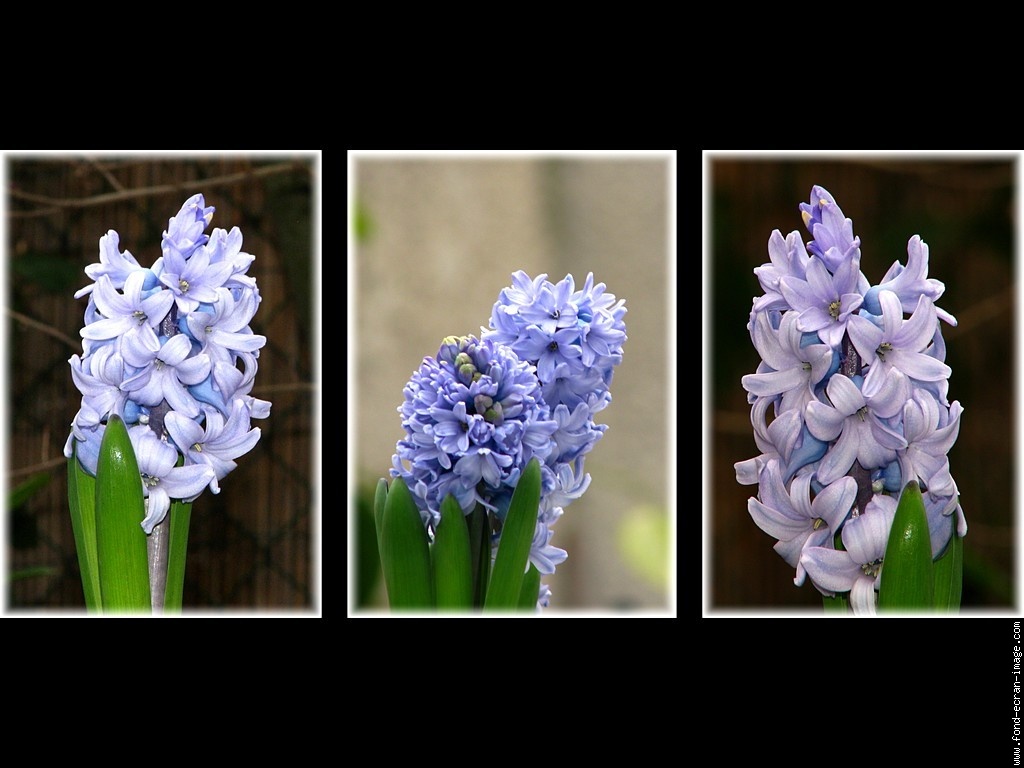
    hyacinth
    lavender
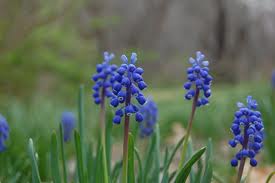
    grape hyacinth
    violet pansy
    peony
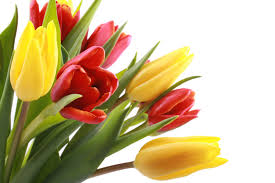
    of course, tulips
    lilac
    English
    Magyar
    lilac
    orgona
    golden chain
    aranyeső
    dandelion
    gyermekláncfű, pitypang
    daisy
    margaréta
    forget-me-not
    nefelejcs
    pansy
    árvácska
    begonia
    begónia
    tulip
    tulipán
    flowering almond
    babarózsa
    daffodil
    nárcisz
    hyacinth
    jácint
    geranium
    muskátli
    peony
    pünkösdi rózsa
    lavender
    levendula
    grape hyacinth
    fürtös gyöngyike